
Poker Galore
Rate this game
- Played
- Rarely
Poker Galore delivers six video poker variations in high-contrast EGA graphics, offering a stripped-down card hall experience for PC players in 1992.
What Diana Gruber put on the screen in 1992
Developer Diana Gruber released Poker Galore through Galore Games during the mid-1990s boom of MS-DOS card titles. Rather than building a sprawling casino floor with virtual walking paths or animated dealers, this title focuses entirely on the screen layout of dedicated arcade cabinet hardware. You are placed in front of a clean, first-person view of the card area with simple key bindings for keeping and discarding your draw.
The visual presentation relies strictly on standard EGA graphics capabilities. Crisp, blocky numbers and thick card borders fill the top-down playing surface, backed by minimal PC speaker beeps whenever a hand pays out. If you are looking to play gambling games from this era, the directness of the visual layout makes the odds and payouts immediately clear without unnecessary fluff getting in the way of a fast hand cycle.
Six modes with distinct rules and betting stakes
Instead of locking you into a single draw style, the game packages six distinct rule sets into one main menu interface. Every variant tweaks the baseline paytable or adds a mechanics shift that alters your hold strategy:
- Jacks or Better: The baseline standard where a pair of Jacks is your minimum qualifier to get a payout.
- Joker Poker: Adds a wildcard Joker to the standard deck, lowering the rarity of high-tier hands while tweaking payouts.
- Deuces Wild: Turns every two into a wild card, though you need at least three of a kind to claim any prize.
- Multi-Meter Progressive: Lets you push stakes up to six coins per deal, raising a shared jackpot tracker that grows as you play.
- Double Down: Offers a post-win gamble feature where you pick one of four hidden cards to beat the dealer's face-up draw.
- Second Chance: Analyzes your winning hands and prompts you for an extra side bet if the software detects a high-value straight or flush draw.
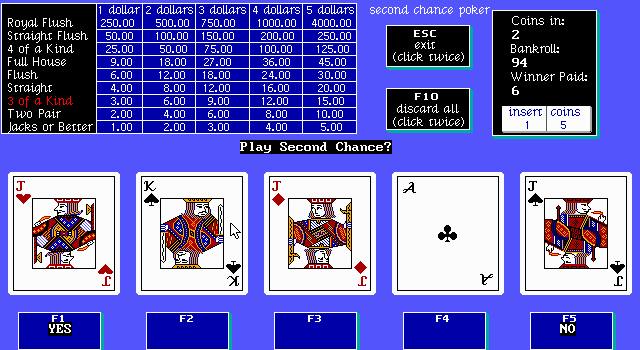
Where the single-player simulation hits a wall
While having six game types adds variety, the underlying code lacks long-term hooks once your bankroll starts climbing. The internal tracking covers total winnings and basic hand counts, but there are no virtual opponents to read or bluff in this package. Whether you select standard draw or try out the high-stakes modes, you are playing strictly against an internal random number generator and static pay schedules.
The control flow is fast, but the complete absence of environmental detail or background audio means sessions tend to feel mechanical quite quickly. Without a campaign structure or high-score tables to save across sessions, pushing your bankroll high serves only as a temporary personal record before you exit back to the command prompt.
How this DOS title compares to its contemporaries
Looking back at the 1992 releases on PC, Poker Galore sits in a middle ground between primitive text-based titles and rich multimedia casino suites. By keeping the graphics constrained to basic EGA colors, the software maintains snappy response times, avoiding the long shuffle animations that slowed down heavy graphical ports of the same period. It delivers immediate input response every time you toggle card holds.
The trade-off is a total reliance on raw card math. Games with broader scope included fully modeled tables or interactive characters, whereas this collection cuts everything down to payout odds and coin counts. If you enjoy calculating drawing probabilities without waiting for visual transitions, the raw speed here works in your favor.
How to play Poker Galore online today
You can run this Diana Gruber creation without hunting down vintage disk images or tweaking sound card drivers in DOSBox. You can play Poker Galore free in your browser right here on this page with full keyboard support and immediate card dealing ready to go.
The clean EGA interface and instantaneous card shuffling hold up well for quick sessions, even if the total lack of sound design and visual polish limits its long-term replay value. If you want to test your video poker odds across classic wild-card variants, jump straight into a game of Deuces Wild or test your luck on the Double Down screen right now in your web browser.
How Poker Galore is played — the keys the game listens to, grouped by what they do.
- Action
- Interface
- Space / Left click — Insert one coin
- Enter / Right click — Deal or draw cards
Highlighted keys are mapped — hover or tap one to see what it does.
Player name entry is prompted via text typing. Mouse control is optional for selecting options, betting, and holding cards.
Players' controls
Touch and gamepad controls
The on-screen keyboard and gamepad mapping the browser player uses on a phone, a tablet or a controller, as opposed to the real keys above. $PRO members make their own in the player and share them here; anyone can pick one to play with.
Make your own touch controlsPRO
- 1Open the editorSign in below, then pick what to make. The game starts with the editor open over it.
- 2Place your keysAdd keys and drag them where your thumbs rest, or map a controller's buttons. Test plays the game with them; Save keeps them, and you play with them from then on.
- 3Share themShare them right after saving in the game, or name and share them here. Players vote, and the best become this game's controls for everyone.
Go PROSee how it worksSign in+20 XP for sharing · +50 XP if yours become the game's own
- The game's own controlsKeyboardGamepadWhat every player starts with.In use
2 screenshots
From the archive
No gameplay video yet
No gameplay video for Poker Galore yet. Sign in to add one.
No reviews yet
Tell the community what you think of Poker Galore. Reviews are public and tied to your username.
No archived manuals for Poker Galore yet
No manuals archived for this title yet. Sign in to upload the first scan.
Cheat codes, console commands and memory pokes for Poker Galore — each one verified and attributed.
Sign in to submitNo cheats yet for this title
Know a working cheat, poke or trainer? Add it with the button above. Moderators check every entry before it goes live.
No archived soundtrack for Poker Galore yet
No soundtrack archived for this title yet. Sign in to upload the first rip.
No save states for Poker Galore yet
No save states for this title yet. Sign in to share one.
Discussions
Sign in to post- Threads0
- Total posts0
- Online now6
Community · Poker Galore
Who's contributing, and what's new
- Reviews0
- Threads0
- Uploadsapproved0
- Contributors0
Recent activity
Nothing here yet
Reviews, discussion threads and approved uploads appear here as members add them.