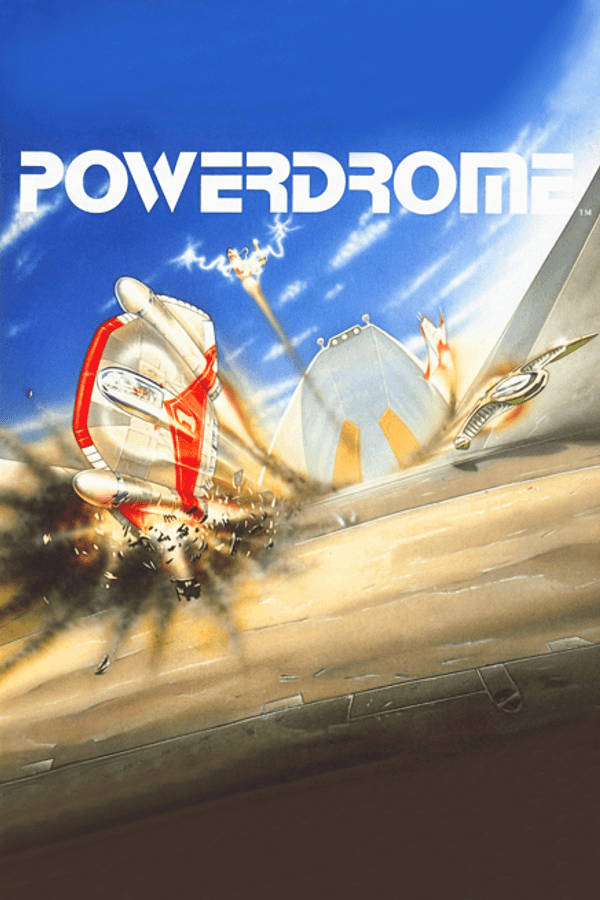

Before hover racers made futuristic speed look slick, Powerdrome dropped players into the cockpit of a twitchy jet craft and forced them to learn flight physics just to survive a corner.
Most racing games ask you to turn left or right, but Powerdrome expects you to pilot a high-speed vehicle called a blade using pitch and roll. Instead of swinging flat around a sharp bend, you have to bank hard into the turn, tilt your nose up or down, and feather the thrusters to avoid sliding sideways into the scenery.
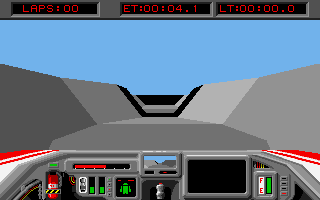
When you launch this 1990 action game on MS-DOS, your cockpit viewport places you right at ground level. Flying inside a sci-fi half-pipe means that managing your tilt matters just as much as keeping your speed up, because tilting the wrong way will instantly launch you into an unrecoverable skid.
If you play the DOS version with a mouse, activating your boost requires holding down both mouse buttons at once while trying to sweep the cursor across the pad. Trimming your vector at maximum velocity while barreling down a narrow pipe takes absurd precision, and a tiny mistake usually ends with a sudden crunch against a tunnel wall.
The steering sensitivity remains notorious among fans because the game handles more like an atmospheric flight simulator than a typical arcade racer. Missing a entry line by a millimeter sends your craft bouncing off boundaries, and on modern computers running unthrottled CPU speeds, the action speeds up to an unplayable smear unless you drop your DOSBox cycles down low.
Winning a race takes more than raw reflexes because your machine requires custom setup work before you ever touch the throttle. The championship takes you across five distinct planets, each featuring its own atmospheric pressure, weather patterns, and gravitational drag.
Before launching into a run on a new world, you must open the vehicle setup screens and configure specific hardware components to handle the local conditions:
Ignore the local weather report, and your blade will underperform or overheat within two laps. If heavy rain rolls in mid-race or an opponent rams your chassis, you have to hunt for a flashing wall section along the track boundary that acts as a pit stop. Pulling into the pit lets you swap damaged filters or patch up structural damage before returning to the grid.
If you wreck completely out on the circuit, you do not instantly respawn in place. Instead, you have to press the B key to summon a specialized breakdown craft to haul your shattered vehicle back to the repair bay while your five computer opponents pull far ahead.
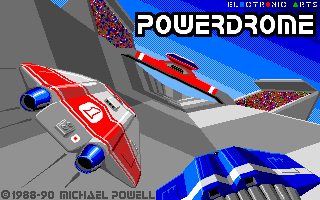
Designer Michael Powell originally crafted this vision of anti-gravity racing on the Atari ST before Electronic Arts, Inc. brought the code to DOS in 1990. Production ran into an unexpected delay when Powell suffered a serious motorcycle accident, but the final release stood out for its 3D polygon math and wide hardware support ranging from CGA and Hercules up to 256-color VGA.
The visual presentation delivers a great sense of motion when the tracks loop through wide mountain passes and metallic tunnels. Polygon clipping can get messy around the extreme edges of the screen, but the geometry of the six circuits creates genuine verticality that few racers matched at the time. You can even hook up a serial cable to challenge another player in a direct data link match.
Where the experience stumbles heavily is in the audio department. The music tracks feel lackluster, the engine sound effects lack real bass rumble, and the short voice samples played for pilot warnings become deeply annoying after a few minutes of play. Combined with a manual that famously forgets to list basic keyboard commands, figuring out how to play requires a lot of initial trial and error.
Despite those flaws, the underlying physics model offers a satisfying challenge once you wrap your head around flight control mechanics. Mastering a track full of chicanes and crusher gates gives you a genuine rush of accomplishment that ground-based racers rarely replicate.
The steep learning curve and punishing collision logic mean that Powerdrome will not appeal to everyone, but anyone curious about early 3D flight racers should sample it. The flight mechanics require genuine discipline, and successfully balancing your planetary atmospheric settings before pulling off a clean lap still feels fantastic thirty years later.
You can play Powerdrome online directly on this page for free right now in your browser with no installation needed. Grab your mouse, adjust your gas filters for the current planet, and see if you can handle these fast-paced 3D anti-gravity tracks without smashing your blade into the first tunnel wall.
Before hover racers made futuristic speed look slick, Powerdrome dropped players into the cockpit of a twitchy jet craft and forced them to learn flight physics just to survive a corner.
Most racing games ask you to turn left or right, but Powerdrome expects you to pilot a high-speed vehicle called a blade using pitch and roll. Instead of swinging flat around a sharp bend, you have to bank hard into the turn, tilt your nose up or down, and feather the thrusters to avoid sliding sideways into the scenery.
When you launch this 1990 action game on MS-DOS, your cockpit viewport places you right at ground level. Flying inside a sci-fi half-pipe means that managing your tilt matters just as much as keeping your speed up, because tilting the wrong way will instantly launch you into an unrecoverable skid.
If you play the DOS version with a mouse, activating your boost requires holding down both mouse buttons at once while trying to sweep the cursor across the pad. Trimming your vector at maximum velocity while barreling down a narrow pipe takes absurd precision, and a tiny mistake usually ends with a sudden crunch against a tunnel wall.
The steering sensitivity remains notorious among fans because the game handles more like an atmospheric flight simulator than a typical arcade racer. Missing a entry line by a millimeter sends your craft bouncing off boundaries, and on modern computers running unthrottled CPU speeds, the action speeds up to an unplayable smear unless you drop your DOSBox cycles down low.
Winning a race takes more than raw reflexes because your machine requires custom setup work before you ever touch the throttle. The championship takes you across five distinct planets, each featuring its own atmospheric pressure, weather patterns, and gravitational drag.
Before launching into a run on a new world, you must open the vehicle setup screens and configure specific hardware components to handle the local conditions:
Ignore the local weather report, and your blade will underperform or overheat within two laps. If heavy rain rolls in mid-race or an opponent rams your chassis, you have to hunt for a flashing wall section along the track boundary that acts as a pit stop. Pulling into the pit lets you swap damaged filters or patch up structural damage before returning to the grid.
If you wreck completely out on the circuit, you do not instantly respawn in place. Instead, you have to press the B key to summon a specialized breakdown craft to haul your shattered vehicle back to the repair bay while your five computer opponents pull far ahead.
Designer Michael Powell originally crafted this vision of anti-gravity racing on the Atari ST before Electronic Arts, Inc. brought the code to DOS in 1990. Production ran into an unexpected delay when Powell suffered a serious motorcycle accident, but the final release stood out for its 3D polygon math and wide hardware support ranging from CGA and Hercules up to 256-color VGA.
The visual presentation delivers a great sense of motion when the tracks loop through wide mountain passes and metallic tunnels. Polygon clipping can get messy around the extreme edges of the screen, but the geometry of the six circuits creates genuine verticality that few racers matched at the time. You can even hook up a serial cable to challenge another player in a direct data link match.
Where the experience stumbles heavily is in the audio department. The music tracks feel lackluster, the engine sound effects lack real bass rumble, and the short voice samples played for pilot warnings become deeply annoying after a few minutes of play. Combined with a manual that famously forgets to list basic keyboard commands, figuring out how to play requires a lot of initial trial and error.
Despite those flaws, the underlying physics model offers a satisfying challenge once you wrap your head around flight control mechanics. Mastering a track full of chicanes and crusher gates gives you a genuine rush of accomplishment that ground-based racers rarely replicate.
The steep learning curve and punishing collision logic mean that Powerdrome will not appeal to everyone, but anyone curious about early 3D flight racers should sample it. The flight mechanics require genuine discipline, and successfully balancing your planetary atmospheric settings before pulling off a clean lap still feels fantastic thirty years later.
You can play Powerdrome online directly on this page for free right now in your browser with no installation needed. Grab your mouse, adjust your gas filters for the current planet, and see if you can handle these fast-paced 3D anti-gravity tracks without smashing your blade into the first tunnel wall.
How Powerdrome is played — the keys the game listens to, grouped by what they do.
Highlighted keys are mapped — hover or tap one to see what it does.
Official documentation lacks a complete key mapping. In DOSBox, CPU speed should be throttled to roughly 3,000 cycles for playable game speed.
The on-screen keyboard and gamepad mapping the browser player uses on a phone, a tablet or a controller, as opposed to the real keys above. $PRO members make their own in the player and share them here; anyone can pick one to play with.
Cheat codes, console commands and memory pokes for Powerdrome — each one verified and attributed.
Sign in to submitHow Powerdrome is played — the keys the game listens to, grouped by what they do.
Highlighted keys are mapped — hover or tap one to see what it does.
Official documentation lacks a complete key mapping. In DOSBox, CPU speed should be throttled to roughly 3,000 cycles for playable game speed.
The on-screen keyboard and gamepad mapping the browser player uses on a phone, a tablet or a controller, as opposed to the real keys above. $PRO members make their own in the player and share them here; anyone can pick one to play with.
Cheat codes, console commands and memory pokes for Powerdrome — each one verified and attributed.
Sign in to submit