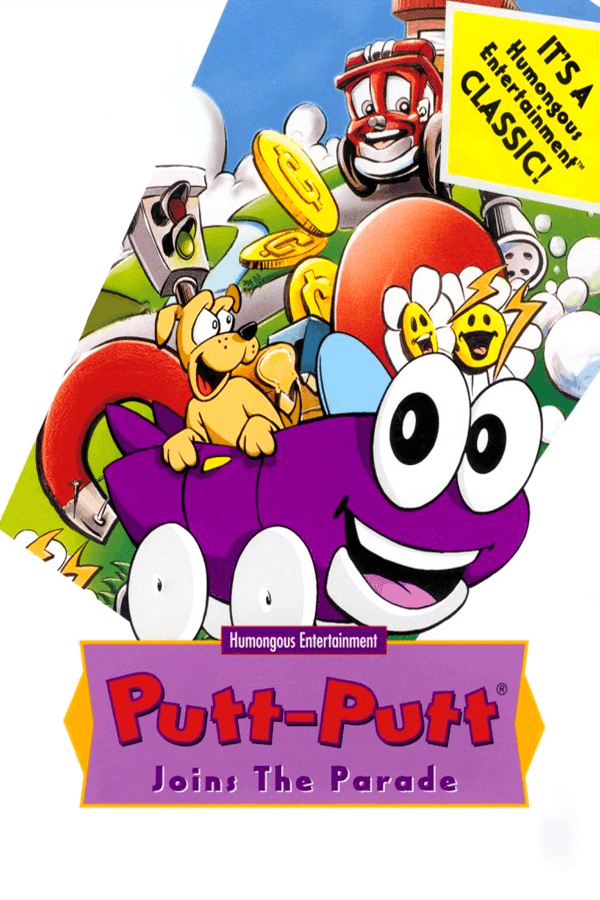
Putt-Putt Joins the Parade
aka Putt Putt Joins the Parade
In Putt-Putt Joins the Parade, you guide a small purple convertible through a cheerful town to earn a spot in the local pet procession by finding a balloon, getting a wash, and rescuing a lost puppy.
Putt-Putt Joins the Parade swaps complex LucasArts parser logic for simple clicks
When designer Ron Gilbert co-founded Humongous Entertainment and set out to build an engine for children, he did not invent a completely new codebase from scratch. He modified the SCUMM engine that powered classic LucasArts graphic adventures like The Secret of Monkey Island, stripping away text commands and complex inventory cross-referencing in favor of a clean interface where a simple click drives the whole experience. Released in 1992 as an adventure for MS-DOS computers, Putt-Putt Joins the Parade gives young players a direct line into digital storytelling without forcing them to wrestle with verbs or syntax.
You start your morning inside Putt-Putt's home, pouring a bowl of Tire-O's cereal before checking the local news on screen. Putt-Putt reads background signs out loud when you select them, an addition that opened the game to pre-readers who had never tackled a text-heavy computer game before. The graphics use standard 320x200 VGA cartoon artwork, paired with full voice acting led by child actor Jason Ellefson. Every backdrop is stuffed with interactive click points, so clicking an innocuous window frame, flowerbed, or street sign triggers a tiny customized sound effect or miniature animation sequence that rewards curious exploration.
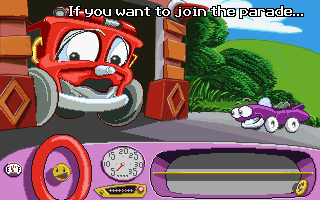
Finding a pet and getting clean in Putt-Putt Joins the Parade takes real work
The core structure is a straightforward checklist. To enter the grand Cartown Pet Parade, Putt-Putt has to secure three specific things: a shiny new balloon, a fresh car wash or paint job, and a pet to walk alongside him. Getting those items means exploring three main streets, chatting with local residents like Smokey the Fire Engine, and solving sequential errands around town.
The logic is entirely fair, teaching basic cause-and-effect reasoning without unfair traps or sudden dead ends:
- Picking up a magnet lets you clear a patch of sharp nails blocking Red Street so you can travel safely into new areas.
- Buying a bag of bird seed from Mr. Baldini's grocery store allows you to clear out birds blocking Green Street.
- Mowing lawns for neighbors earns the coins required to purchase essential parade supplies and pay for your car wash.
- Finding a stray bone gives you the key to befriending Pep, a tiny puppy hidden deep inside a nearby dark cave.
Inventory management is easy because Putt-Putt simply extends an extendable arm out of his rear trunk to grab items and stash them. You carry only a few tools at any single time, which keeps the focus on spatial memory and simple problem solving rather than guessing endless combination puzzles.
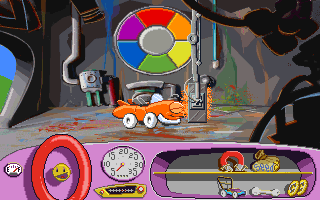
The lawnmower and sliding puzzles pull the momentum to a halt
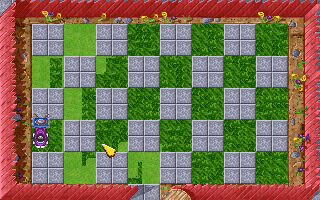
While the point-and-click pacing flows smoothly for the most part, a few specific side activities can feel tedious on a modern playthrough. Earning cash requires tackling a lawnmowing mini-game where you push a mower across grid-like yards to trim every last blade of grass. The collision detection on the grass patches is surprisingly picky, meaning you often have to backtrack over the same strip multiple times just to clear the screen and claim your reward money.
There is also a sliding block puzzle cube and a balloon-catching activity that serve as mandatory diversions. Because there are no fail states or actual threats, you can never lose your progress, but these mini-games slow down an adventure that otherwise moves briskly. An experienced adult player can run through the complete story in roughly forty minutes, which leaves very little margin for error if a side task feels like artificial inflation.
Play Putt-Putt Joins the Parade online right in your browser
Even with its occasionally slow mini-games, this title holds up as a masterwork of accessible design. The audio work by composer Tom McMail gives Cartown a warm atmosphere, and the lack of punishing mechanics makes it a stress-free experience from start to finish. If you want to sample early nineties point-and-click history without dealing with classic adventure game death screens or obscure logic jumps, this friendly trip down Red Street is as gentle as the genre gets.
You can play Putt-Putt Joins the Parade free in your browser right now with no setup needed. Jump straight into Cartown, grab a box of bird seed, and see how fast you can find Pep the puppy today.