You type an angle, guess the velocity, and watch an exploding banana arch over a blocky cityscape toward your friend's ape in QBasic Gorillas: The Deluxe Edition.
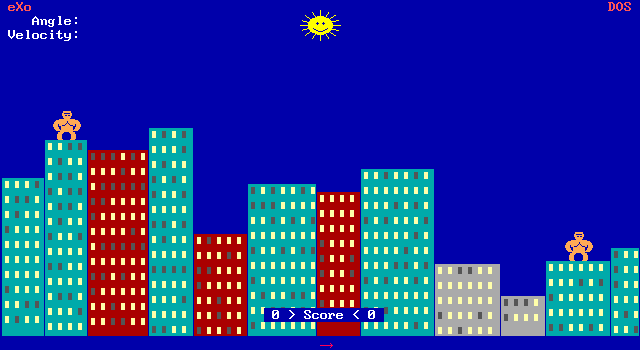
The core loop of this action game is completely unchanged from the 1990 Microsoft original that shipped with MS-DOS 5. Two gorillas stand atop a procedurally generated skyline, taking turns throwing high-explosive fruit at each other. You do not touch a mouse or press arrow keys to aim. You type raw numbers for the angle and velocity, press Enter, and hope your math accounts for the wind vector blowing across the bottom of the screen.
That mechanical simplicity is where the tension comes from. A bad guess sends your projectile straight into the side of a building, carving out a giant circular crater and shortening the terrain for future turns. Over-adjust on your second shot, and the banana sails off the screen entirely while your opponent dials in their trajectory. It is pure artillery math distilled into two numeric inputs.
Developer Daniel Beardsmore started tinkering with the source code around 1997, built a solid version on a school computer in 1998, and released this expanded edition to friends in August 1999. While the original was just a sample program meant to demonstrate QBasic, this version turns it into a proper software release. You get cleaner menus, custom configuration files, support for localized text, and a persistent league table that tracks up to 20 player records over multiple matches.
The underlying tech got a major tune-up as well. The original 1990 code tied its physics loop directly to processor speed, meaning modern PCs ran the math so fast the bananas vanished instantly. Beardsmore implemented proper delay loops to ensure the gravity and wind calculations run at a playable speed on fast machines. It still produces classic PC speaker blips when a banana detonates, maintaining that authentic early-nineties sound profile.
Despite the code cleanup, the physics engine still suffers from an infamous quirk carried over from the QBasic math. If you throw a banana with exceptionally high velocity, the collision detection sometimes fails to register. The projectile can clip right through the enemy gorilla's head or pass completely through their body without exploding, robbing you of a guaranteed kill after a perfect calculation.
There are no power-ups, extra weapons, or single-player campaigns here. Your only enemy is the sitting player next to you on the keyboard. Matches run for a set number of rounds, defaulting to four, and the player with the most kills takes the leaderboard spot. If you want to check out other work by Daniel Beardsmore, he also released a minor patch of the original code titled Gorillas: The Fixed Edition to repair CPU speed bugs without changing the interface.
This edition takes a well-known piece of software history and fixes its worst technical oversights while keeping the competitive heart intact. The turn-based pacing makes it easy to pick up, even if you never touched the original MS-DOS version. It strips away modern bloat to focus entirely on out-guessing your rival's ballistic calculations.
You can play QBasic Gorillas: The Deluxe Edition free in your browser right now on this page. You can jump straight into this MS-DOS game with zero setup, type your angles, and start trading explosive fruit across the skyline within seconds.
You type an angle, guess the velocity, and watch an exploding banana arch over a blocky cityscape toward your friend's ape in QBasic Gorillas: The Deluxe Edition.
The core loop of this action game is completely unchanged from the 1990 Microsoft original that shipped with MS-DOS 5. Two gorillas stand atop a procedurally generated skyline, taking turns throwing high-explosive fruit at each other. You do not touch a mouse or press arrow keys to aim. You type raw numbers for the angle and velocity, press Enter, and hope your math accounts for the wind vector blowing across the bottom of the screen.
That mechanical simplicity is where the tension comes from. A bad guess sends your projectile straight into the side of a building, carving out a giant circular crater and shortening the terrain for future turns. Over-adjust on your second shot, and the banana sails off the screen entirely while your opponent dials in their trajectory. It is pure artillery math distilled into two numeric inputs.
Developer Daniel Beardsmore started tinkering with the source code around 1997, built a solid version on a school computer in 1998, and released this expanded edition to friends in August 1999. While the original was just a sample program meant to demonstrate QBasic, this version turns it into a proper software release. You get cleaner menus, custom configuration files, support for localized text, and a persistent league table that tracks up to 20 player records over multiple matches.
The underlying tech got a major tune-up as well. The original 1990 code tied its physics loop directly to processor speed, meaning modern PCs ran the math so fast the bananas vanished instantly. Beardsmore implemented proper delay loops to ensure the gravity and wind calculations run at a playable speed on fast machines. It still produces classic PC speaker blips when a banana detonates, maintaining that authentic early-nineties sound profile.
Despite the code cleanup, the physics engine still suffers from an infamous quirk carried over from the QBasic math. If you throw a banana with exceptionally high velocity, the collision detection sometimes fails to register. The projectile can clip right through the enemy gorilla's head or pass completely through their body without exploding, robbing you of a guaranteed kill after a perfect calculation.
There are no power-ups, extra weapons, or single-player campaigns here. Your only enemy is the sitting player next to you on the keyboard. Matches run for a set number of rounds, defaulting to four, and the player with the most kills takes the leaderboard spot. If you want to check out other work by Daniel Beardsmore, he also released a minor patch of the original code titled Gorillas: The Fixed Edition to repair CPU speed bugs without changing the interface.
This edition takes a well-known piece of software history and fixes its worst technical oversights while keeping the competitive heart intact. The turn-based pacing makes it easy to pick up, even if you never touched the original MS-DOS version. It strips away modern bloat to focus entirely on out-guessing your rival's ballistic calculations.
You can play QBasic Gorillas: The Deluxe Edition free in your browser right now on this page. You can jump straight into this MS-DOS game with zero setup, type your angles, and start trading explosive fruit across the skyline within seconds.
How QBasic Gorillas: The Deluxe Edition is played — the keys the game listens to, grouped by what they do.
Highlighted keys are mapped — hover or tap one to see what it does.
Configuration is managed via the Gorillas.ini text file.
The on-screen keyboard and gamepad mapping the browser player uses on a phone, a tablet or a controller, as opposed to the real keys above. $PRO members make their own in the player and share them here; anyone can pick one to play with.
Cheat codes, console commands and memory pokes for QBasic Gorillas: The Deluxe Edition — each one verified and attributed.
Sign in to submitaka Gorillas Deluxe
How QBasic Gorillas: The Deluxe Edition is played — the keys the game listens to, grouped by what they do.
Highlighted keys are mapped — hover or tap one to see what it does.
Configuration is managed via the Gorillas.ini text file.
The on-screen keyboard and gamepad mapping the browser player uses on a phone, a tablet or a controller, as opposed to the real keys above. $PRO members make their own in the player and share them here; anyone can pick one to play with.
Cheat codes, console commands and memory pokes for QBasic Gorillas: The Deluxe Edition — each one verified and attributed.
Sign in to submit