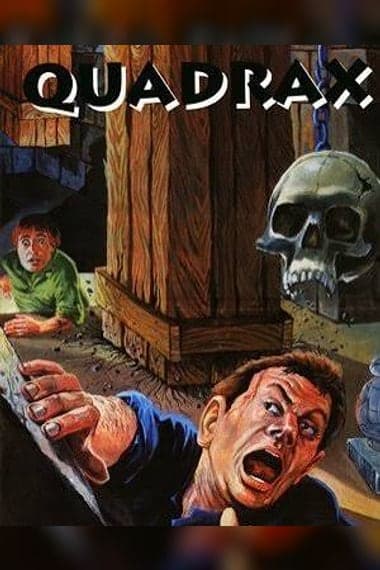
In Quadrax, progress depends entirely on making two archaeologists work in perfect tandem across screen after screen of unforgiving physical hazards.
The moment you realize how this game operates, any lingering thoughts of a typical run-and-jump platformer vanish. You control two archaeologists trapped inside side-view screens crowded with stone structures, heavy blockades, and mechanical contraptions. Instead of reflex testing, every single screen is a pure logic problem where moving one tile out of order can ruin the entire attempt.
Success requires constant coordination between both characters. One explorer might need to stand on a pressure plate to hold a security door open, giving the second player time to ride an elevator down to a lever. That lever then clears a pathway for the first explorer to reach a magnetic block or step into a teleport. You can play through this solo by swapping active control back and forth, or hand a keyboard side to a partner for direct co-op play.
There is no tick-down clock pressing you to rush, but safety is entirely conditional. Characters cannot survive a plunge from a high ledge, and falling boulders or triggered traps will squash them instantly. Leaving one explorer vulnerable while moving the other usually ends in an abrupt restart, forcing you to retrace every switch flip from the beginning.
Programming duo David Durčák and Marián Ferko originally built the core game on Didaktik Gama hardware before finalizing it through a ZX Spectrum emulator running under MS-DOS. When developer Cauldron Ltd. expanded the concept into a full 1994 release on PC, publisher Riki Computer Games put out a substantial package. The DOS port expanded the scope from the Spectrum's original 50 stages up to 100 logical rooms, adding animated cutscenes, story text by Maroš Stano, and a full soundtrack stored on CD.
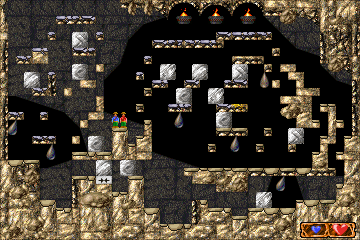
To avoid standard graphics limitations, the coders rendered the visuals in a custom VGA Mode X tweak, granting sharper detail than standard 320x240 display modes. That visual clarity helps when scanning complex rooms, but it does nothing to soften the game's infamous difficulty curve. Most players manage the introductory levels with minimal fuss, only to collide with a massive wall around Level 14, where multi-step lever puzzles and tight spatial rules stall progress for days.
Inspiration for the underlying mechanics comes straight from block-pushing classics like Sokoban combined with two-hero cooperation reminiscent of early computer action-adventures. Because every object obeys strict physical interactions, the board state gets altered permanently with every push. Miscalculating a block slide by a single tile can wedge a stone against a wall, completely blocking off an elevator access point or trapping your partner underneath a chute.
Crucial features across the campaign include the following mechanisms:
This strict interlinking means you cannot guess your way through late stages. If you are hunting for a challenging puzzle title, this absolute demands on spatial reasoning hit harder than almost any other Quadrax MS-DOS game rival from the middle of the decade.
When the commercial PC version hit store shelves in 1996, it became the top-selling game title across Slovakia and the Czech Republic. The regional popularity was so strong that even though Cauldron moved on to completely different genres afterward, independent developer Josef Kreutzer picked up the torch to create fan-made sequels like Return to Quadrax.
Cauldron eventually released the original release as freeware, allowing wider access to a game that was difficult to find outside Central Europe during its initial print run. The lack of an early English localizing pass meant foreign players had to ignore non-translated text screens, but the graphical icons and clean grid logic required no language skills to solve.
The logic here holds up well if you enjoy methodical, turn-by-turn spatial reasoning, though the sharp wall in difficulty will test anyone used to modern hint systems. Getting stranded on early levels is a common rite of passage, but working out a stubborn screen solution through patient trial and error feels great.
You can play Quadrax online right now, completely free in your browser with no extra software to install. When you launch into the first level, remember the primary mistake newcomers make: never advance one archaeologist all the way across the chamber until you have confirmed a clear return route or a safe waiting ledge for the second character.
In Quadrax, progress depends entirely on making two archaeologists work in perfect tandem across screen after screen of unforgiving physical hazards.
The moment you realize how this game operates, any lingering thoughts of a typical run-and-jump platformer vanish. You control two archaeologists trapped inside side-view screens crowded with stone structures, heavy blockades, and mechanical contraptions. Instead of reflex testing, every single screen is a pure logic problem where moving one tile out of order can ruin the entire attempt.
Success requires constant coordination between both characters. One explorer might need to stand on a pressure plate to hold a security door open, giving the second player time to ride an elevator down to a lever. That lever then clears a pathway for the first explorer to reach a magnetic block or step into a teleport. You can play through this solo by swapping active control back and forth, or hand a keyboard side to a partner for direct co-op play.
There is no tick-down clock pressing you to rush, but safety is entirely conditional. Characters cannot survive a plunge from a high ledge, and falling boulders or triggered traps will squash them instantly. Leaving one explorer vulnerable while moving the other usually ends in an abrupt restart, forcing you to retrace every switch flip from the beginning.
Programming duo David Durčák and Marián Ferko originally built the core game on Didaktik Gama hardware before finalizing it through a ZX Spectrum emulator running under MS-DOS. When developer Cauldron Ltd. expanded the concept into a full 1994 release on PC, publisher Riki Computer Games put out a substantial package. The DOS port expanded the scope from the Spectrum's original 50 stages up to 100 logical rooms, adding animated cutscenes, story text by Maroš Stano, and a full soundtrack stored on CD.
To avoid standard graphics limitations, the coders rendered the visuals in a custom VGA Mode X tweak, granting sharper detail than standard 320x240 display modes. That visual clarity helps when scanning complex rooms, but it does nothing to soften the game's infamous difficulty curve. Most players manage the introductory levels with minimal fuss, only to collide with a massive wall around Level 14, where multi-step lever puzzles and tight spatial rules stall progress for days.
Inspiration for the underlying mechanics comes straight from block-pushing classics like Sokoban combined with two-hero cooperation reminiscent of early computer action-adventures. Because every object obeys strict physical interactions, the board state gets altered permanently with every push. Miscalculating a block slide by a single tile can wedge a stone against a wall, completely blocking off an elevator access point or trapping your partner underneath a chute.
Crucial features across the campaign include the following mechanisms:
This strict interlinking means you cannot guess your way through late stages. If you are hunting for a challenging puzzle title, this absolute demands on spatial reasoning hit harder than almost any other Quadrax MS-DOS game rival from the middle of the decade.
When the commercial PC version hit store shelves in 1996, it became the top-selling game title across Slovakia and the Czech Republic. The regional popularity was so strong that even though Cauldron moved on to completely different genres afterward, independent developer Josef Kreutzer picked up the torch to create fan-made sequels like Return to Quadrax.
Cauldron eventually released the original release as freeware, allowing wider access to a game that was difficult to find outside Central Europe during its initial print run. The lack of an early English localizing pass meant foreign players had to ignore non-translated text screens, but the graphical icons and clean grid logic required no language skills to solve.
The logic here holds up well if you enjoy methodical, turn-by-turn spatial reasoning, though the sharp wall in difficulty will test anyone used to modern hint systems. Getting stranded on early levels is a common rite of passage, but working out a stubborn screen solution through patient trial and error feels great.
You can play Quadrax online right now, completely free in your browser with no extra software to install. When you launch into the first level, remember the primary mistake newcomers make: never advance one archaeologist all the way across the chamber until you have confirmed a clear return route or a safe waiting ledge for the second character.
How Quadrax is played — the keys the game listens to, grouped by what they do.
Highlighted keys are mapped — hover or tap one to see what it does.
Controls documented from search notes; complete key mapping for the MS-DOS release was not fully available.
The on-screen keyboard and gamepad mapping the browser player uses on a phone, a tablet or a controller, as opposed to the real keys above. $PRO members make their own in the player and share them here; anyone can pick one to play with.
Cheat codes, console commands and memory pokes for Quadrax — each one verified and attributed.
Sign in to submitHow Quadrax is played — the keys the game listens to, grouped by what they do.
Highlighted keys are mapped — hover or tap one to see what it does.
Controls documented from search notes; complete key mapping for the MS-DOS release was not fully available.
The on-screen keyboard and gamepad mapping the browser player uses on a phone, a tablet or a controller, as opposed to the real keys above. $PRO members make their own in the player and share them here; anyone can pick one to play with.
Cheat codes, console commands and memory pokes for Quadrax — each one verified and attributed.
Sign in to submit