
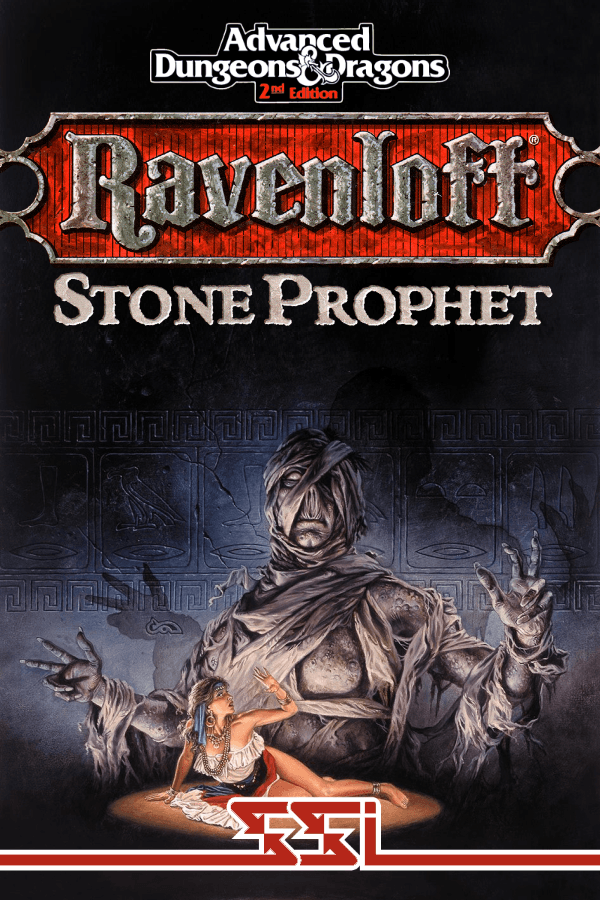

Ravenloft: Stone Prophet dumps your party directly into the blistering desert of Har'Akir, where wandering sandstorms and mummies force you to manage drinking water as carefully as your spell slots. Developed by DreamForge Intertainment, Inc. in 1995, it polished the real-time engine from its precursor into a far more focused crawl through ancient obelisks and tombs.
The first minute in the wasteland makes the environment clear. Your party steps through a magical portal and instantly lands in a barren expanse where standing still costs vital health if you run out of water. DreamForge built this adventure on the same 3D first-person engine used in Ravenloft: Strahd's Possession and Menzoberranzan, giving players step-based movement alongside smooth mouse freelook that felt strikingly fluid for a DOS title. You scan the horizon for landmarks, but visibility drops rapidly when sandstorms roll across the dunes.
Real-time battles run on the Advanced Dungeons & Dragons 2nd Edition framework. Right-clicking weapon icons in your hands or clicking spell cards swings blades and launches magic without waiting for turn sequences. That setup worked well when battling small groups of desert monsters, but it turns chaotic fast when several mummies corner your party inside a narrow tomb passage. Managing inventory icons, drinking potions mid-fight, and casting cure disease before infection sets in requires quick clicking across the lower screen panel.
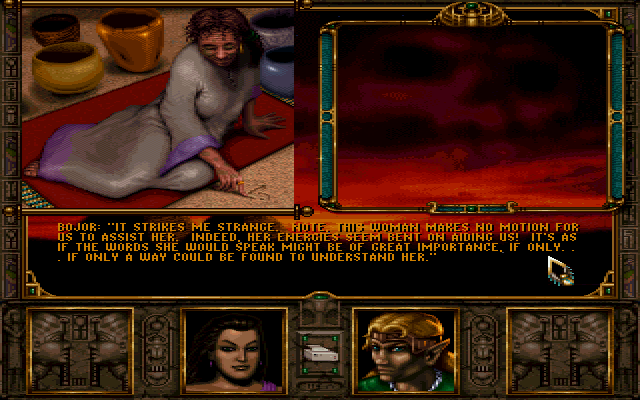
Publisher Strategic Simulations, Inc. positioned this release as a major entry in its late-era TSR lineup. Comparing this role-playing adventure against grid-based classics shows how fast computer RPGs were evolving in the mid-nineties. Instead of step-only turn-based movement, turning your sightline to check corners while walking made dungeon navigation far more natural.
Surviving Har'Akir takes more than heavy armor and high strength rolls. Dehydration is a constant threat that ticks away in the background. If you forget to carry heavy skin containers full of liquid or fail to keep a cleric memorized with Create Water spells, your party weakens until members collapse. This mechanic turns every trek across open ground into a timed execution run between fresh water sources and safe resting spots.
The core quest turns on deciphering the mysterious Stone Prophet wall tucked deep within an ancient obelisk. You gather stone fragments, collect translation scrolls, and use scroll-deciphering tools to piece together the history of the mummified pharaoh Anhktepot. The game leans heavily into logic puzzles, requiring you to manipulate environmental fixtures, solve sequence riddles, and aid diseased villagers in forgotten settlements across the domain.
Computer Gaming World writer Scorpia highlighted the quest structure as a major step forward over previous entries, and PC Zone later placed it among top RPGs for its intuitive magic system. The desert setting feels distinct from standard high-fantasy forests, even if the brown and yellow wall textures inside ancient ruins get repetitive over a long play session.
You begin by generating two primary characters or importing an established duo from Strahd's Possession. Along the journey, you can recruit up to four additional party members to reach the full party cap of six. Importing an old party seems appealing on paper, but it introduces immediate balance headaches. Thieves gained the ability to perform backstab attacks in this entry, so entering the desert without a thief leaves a powerful combat option completely on the table.
The biggest flaw modern players face is the mathematical experience wall. The campaign contains a finite number of monsters and quest rewards, meaning total experience points are strictly capped across the whole module. If you run a full party of six characters, the total pool splits so thinly that nobody hits high-level spell tiers or top-tier combat stats without tedious grinding trickery. A lean party of three or four scales far better against late-game encounters.
The narrative pacing hits a sudden wall at the finish line. Period reviews in PC Gamer praised the atmospheric build-up and solid mechanics, but retrospective player discussions regularly call out the ending sequence. After spending dozens of hours solving ancient riddles and tracking down cursed artifacts to confront Anhktepot, the final payoff wraps up abruptly with little fanfare, leaving the narrative feeling cut short.
Despite its abrupt narrative conclusion and strict experience rationing, this Egyptian-themed crawl hits a sweet spot for nineties RPG fans. The real-time spellcasting, clever tomb puzzles, and oppressive dehydration mechanic combine to make a desert survival experience that feels distinctly rewarding when you finally unlock the obelisk mysteries. If you want a deep DOS dungeon crawler that favors careful resource planning over mindless button mashing, it holds up surprisingly well.
You can play Ravenloft: Stone Prophet online free in your browser right here without installing anything or fiddling with DOSBox setups. Anyone starting this Ravenloft: Stone Prophet MS-DOS game should remember two practical rules before setting out: keep a dedicated cleric packed with water spells at all times, and keep your total party size small so your primary spellcasters can actually earn enough experience to survive the final tombs.
Ravenloft: Stone Prophet dumps your party directly into the blistering desert of Har'Akir, where wandering sandstorms and mummies force you to manage drinking water as carefully as your spell slots. Developed by DreamForge Intertainment, Inc. in 1995, it polished the real-time engine from its precursor into a far more focused crawl through ancient obelisks and tombs.
The first minute in the wasteland makes the environment clear. Your party steps through a magical portal and instantly lands in a barren expanse where standing still costs vital health if you run out of water. DreamForge built this adventure on the same 3D first-person engine used in Ravenloft: Strahd's Possession and Menzoberranzan, giving players step-based movement alongside smooth mouse freelook that felt strikingly fluid for a DOS title. You scan the horizon for landmarks, but visibility drops rapidly when sandstorms roll across the dunes.
Real-time battles run on the Advanced Dungeons & Dragons 2nd Edition framework. Right-clicking weapon icons in your hands or clicking spell cards swings blades and launches magic without waiting for turn sequences. That setup worked well when battling small groups of desert monsters, but it turns chaotic fast when several mummies corner your party inside a narrow tomb passage. Managing inventory icons, drinking potions mid-fight, and casting cure disease before infection sets in requires quick clicking across the lower screen panel.
Publisher Strategic Simulations, Inc. positioned this release as a major entry in its late-era TSR lineup. Comparing this role-playing adventure against grid-based classics shows how fast computer RPGs were evolving in the mid-nineties. Instead of step-only turn-based movement, turning your sightline to check corners while walking made dungeon navigation far more natural.
Surviving Har'Akir takes more than heavy armor and high strength rolls. Dehydration is a constant threat that ticks away in the background. If you forget to carry heavy skin containers full of liquid or fail to keep a cleric memorized with Create Water spells, your party weakens until members collapse. This mechanic turns every trek across open ground into a timed execution run between fresh water sources and safe resting spots.
The core quest turns on deciphering the mysterious Stone Prophet wall tucked deep within an ancient obelisk. You gather stone fragments, collect translation scrolls, and use scroll-deciphering tools to piece together the history of the mummified pharaoh Anhktepot. The game leans heavily into logic puzzles, requiring you to manipulate environmental fixtures, solve sequence riddles, and aid diseased villagers in forgotten settlements across the domain.
Computer Gaming World writer Scorpia highlighted the quest structure as a major step forward over previous entries, and PC Zone later placed it among top RPGs for its intuitive magic system. The desert setting feels distinct from standard high-fantasy forests, even if the brown and yellow wall textures inside ancient ruins get repetitive over a long play session.
You begin by generating two primary characters or importing an established duo from Strahd's Possession. Along the journey, you can recruit up to four additional party members to reach the full party cap of six. Importing an old party seems appealing on paper, but it introduces immediate balance headaches. Thieves gained the ability to perform backstab attacks in this entry, so entering the desert without a thief leaves a powerful combat option completely on the table.
The biggest flaw modern players face is the mathematical experience wall. The campaign contains a finite number of monsters and quest rewards, meaning total experience points are strictly capped across the whole module. If you run a full party of six characters, the total pool splits so thinly that nobody hits high-level spell tiers or top-tier combat stats without tedious grinding trickery. A lean party of three or four scales far better against late-game encounters.
The narrative pacing hits a sudden wall at the finish line. Period reviews in PC Gamer praised the atmospheric build-up and solid mechanics, but retrospective player discussions regularly call out the ending sequence. After spending dozens of hours solving ancient riddles and tracking down cursed artifacts to confront Anhktepot, the final payoff wraps up abruptly with little fanfare, leaving the narrative feeling cut short.
Despite its abrupt narrative conclusion and strict experience rationing, this Egyptian-themed crawl hits a sweet spot for nineties RPG fans. The real-time spellcasting, clever tomb puzzles, and oppressive dehydration mechanic combine to make a desert survival experience that feels distinctly rewarding when you finally unlock the obelisk mysteries. If you want a deep DOS dungeon crawler that favors careful resource planning over mindless button mashing, it holds up surprisingly well.
You can play Ravenloft: Stone Prophet online free in your browser right here without installing anything or fiddling with DOSBox setups. Anyone starting this Ravenloft: Stone Prophet MS-DOS game should remember two practical rules before setting out: keep a dedicated cleric packed with water spells at all times, and keep your total party size small so your primary spellcasters can actually earn enough experience to survive the final tombs.
How Ravenloft: Stone Prophet is played — the keys the game listens to, grouped by what they do.
Highlighted keys are mapped — hover or tap one to see what it does.
Tile-based step movement can be toggled via the options menu or on-screen compass.
The on-screen keyboard and gamepad mapping the browser player uses on a phone, a tablet or a controller, as opposed to the real keys above. $PRO members make their own in the player and share them here; anyone can pick one to play with.
Cheat codes, console commands and memory pokes for Ravenloft: Stone Prophet — each one verified and attributed.
Sign in to submitHow Ravenloft: Stone Prophet is played — the keys the game listens to, grouped by what they do.
Highlighted keys are mapped — hover or tap one to see what it does.
Tile-based step movement can be toggled via the options menu or on-screen compass.
The on-screen keyboard and gamepad mapping the browser player uses on a phone, a tablet or a controller, as opposed to the real keys above. $PRO members make their own in the player and share them here; anyone can pick one to play with.
Cheat codes, console commands and memory pokes for Ravenloft: Stone Prophet — each one verified and attributed.
Sign in to submit