SCI-Man
Rate this game
- Played
- Now and then
Built inside Sierra's adventure game engine for a 2007 New Year contest, SCI-Man turns classic arcade maze chasing into a tight fight against the clock where your ultimate goal is eating twelve grapes before midnight strikes.
Arcade mechanics meet Sierra adventure tools in SCI-Man
Forcing a point-and-click adventure interpreter to run a fast-paced maze game sounds like a absurd project on paper. Sierra's engine was engineered to process text parsers, inventory items, and slow character pathfinding across static backgrounds, not to calculate real-time collision detection for hungry ghosts. Yet designer Jesse Tyler built this fanmade action game using those exact scripting tools, re-engineering the system to act like an arcade cabinet.
When you start the game, you are placed in a grid-based maze that immediately evokes classic dot-munching titles. Instead of endless level progression or high-score chasing for its own sake, the core loop places a strict countdown timer over your head. You move through the corridors, clearing path dots while keeping one eye fixed on the clock as it ticks inexorably toward midnight.
The top-down perspective shifts how you read the board compared to traditional arcade setups. Because the interpreter renders characters and walls through vector-like path scripts, sprite movement feels distinct from standard DOS games written in C or Assembly. Every turn demands deliberate keyboard taps rather than casual joystick sweeps.
Chasing twelve grapes against the midnight clock
The defining twist in SCI-Man comes from its holiday competition origins. Inspired by the Spanish New Year tradition of eating twelve grapes during the final twelve seconds or minutes leading to midnight, the level layout builds its entire structure around that single custom ritual. You cannot simply clear the screen at your leisure, because the final stage of the match hinges on timing your collection run perfectly.
During the opening phase, your primary job is clearing obstacles and staying clear of roaming pursuers that patrol the intersecting hallways. As the clock enters its final minute, twelve specific grapes appear across the maze layout. You have to navigate the tight passages and swallow all twelve before the chime hits twelve o'clock, turning what would be a standard maze stroll into a frantic sprint.
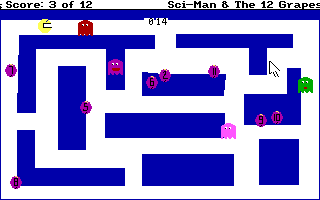
Managing your route becomes essential once those final fruit items populate the screen. If you misjudge a turn or get cornered by a ghost sprite early on, you will not have enough seconds left to sweep the board. The tension relies entirely on route optimization under pressure.
- Clear initial maze paths to keep escape corridors open before the timer drops.
- Monitor the corner clock as it approaches the final sixty-second mark.
- Execute a pre-planned sweep to collect all twelve grapes in order before midnight hits.
Why writing a maze game in SCI was a strange challenge
To understand what makes the project unusual, you have to look at the underlying technology. The Sierra Creative Interpreter (SCI) was designed in the late 1980s to power narrative titles like King's Quest and Space Quest. It managed event loops through scripts that checked player input against room objects, state flags, and dialog parser entries.
Building an arcade clone inside that framework required tricking the engine's object handling into updating positions constantly without waiting for room scripts to complete. Movement scripts had to be hooked directly into the main execution cycle to draw smooth updates on screen. ScummVM officially cataloged the project as a fanmade SCI game, highlighting how far Tyler pushed the interpreter's original boundaries.
Released as version 1.0 following its competition entry in 2007, the game is a clever piece of engine hacking. Commercial DOS developers abandoned Sierra's engine long before the mid-2000s, but homebrew creators found new life in its scripting language. Fitting an arcade framework into an adventure system is an unexpected design choice for an indie project.
The sharp edges of homebrew interpreter hacks
Because the engine was never meant for twitch reactions, the controls carry a notable input delay that will take a few attempts to master. If you press a directional key right as your character hits an intersection, the interpreter sometimes registers the command a frame too late, causing you to bump flat into a wall. That lag creates instant panic when a ghost sprite is trailing right behind your heels.
The difficulty curve is similarly unyielding due to the rigid win condition. Failing to collect the twelfth grape before the timer expires results in an immediate loss, regardless of how cleanly you played the first two minutes. There are no mid-stage checkpoints or extra lives to save a botched run, so one wrong turn means restarting the whole countdown from scratch.
Sound design is basic, relying on standard PC speaker or simple synthetic audio cues that mirror early Sierra titles rather than rich arcade sound chips. The minimalist audio leaves you relying entirely on visual cues to track incoming enemies. It is rough around the edges, but that raw, unpolished feel is part of the charm when playing fanmade interpreter software.
Taking on SCI-Man free in your browser today
For engine enthusiasts and fans of retro homebrew projects, this little experiment is well worth twenty minutes of your time. The central mechanics work as a fun novelty, proving that creative scripting can bend rigid game engines into totally unexpected shapes. Anyone who appreciates classic DOS tinkering will appreciate its odd layout and strict countdown mechanic.
You can play SCI-Man free in your browser right now with no setup required. Load up this unique SCI-Man MS-DOS game, keep your eyes on the clock in the corner, and try to snag all twelve grapes before midnight brings your run to an end.
How SCI-Man is played — the keys the game listens to, grouped by what they do.
- Interface
Highlighted keys are mapped — hover or tap one to see what it does.
Players' controls
Touch and gamepad controls
The on-screen keyboard and gamepad mapping the browser player uses on a phone, a tablet or a controller, as opposed to the real keys above. $PRO members make their own in the player and share them here; anyone can pick one to play with.
Make your own touch controlsPRO
- 1Open the editorSign in below, then pick what to make. The game starts with the editor open over it.
- 2Place your keysAdd keys and drag them where your thumbs rest, or map a controller's buttons. Test plays the game with them; Save keeps them, and you play with them from then on.
- 3Share themShare them right after saving in the game, or name and share them here. Players vote, and the best become this game's controls for everyone.
Go PROSee how it worksSign in+20 XP for sharing · +50 XP if yours become the game's own
- The game's own controlsKeyboardGamepadWhat every player starts with.In use
2 screenshots
From the archive
No reviews yet
Tell the community what you think of SCI-Man. Reviews are public and tied to your username.
No archived manuals for SCI-Man yet
No manuals archived for this title yet. Sign in to upload the first scan.
Cheat codes, console commands and memory pokes for SCI-Man — each one verified and attributed.
Sign in to submitNo cheats yet for this title
Know a working cheat, poke or trainer? Add it with the button above. Moderators check every entry before it goes live.
No archived soundtrack for SCI-Man yet
No soundtrack archived for this title yet. Sign in to upload the first rip.
No save states for SCI-Man yet
No save states for this title yet. Sign in to share one.
Discussions
Sign in to post- Threads0
- Total posts0
- Online now6
Community · SCI-Man
Who's contributing, and what's new
- Reviews0
- Threads0
- Uploadsapproved0
- Contributors0
Recent activity
Nothing here yet
Reviews, discussion threads and approved uploads appear here as members add them.