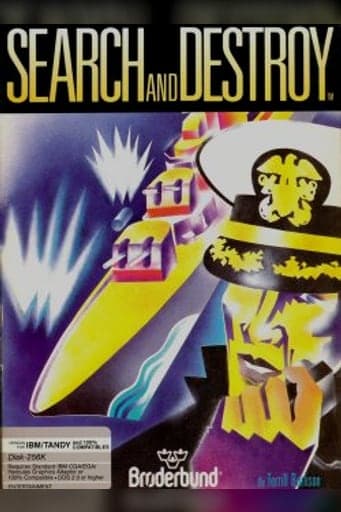
Search and Destroy
aka Search & Destroy
When you launch Search and Destroy, your World War II Fletcher-class destroyer has exactly thirty-six depth charges and a sonar scope that refuses to point north.
The depth charge math behind Search and Destroy
Terrill Burlison programmed this naval battle from scratch, mixing compiled BASIC with assembly language so the code could fit inside 64K of system memory. That tight ceiling shaped the whole design. You do not get smooth scrolling ocean textures or cinematic explosion cutscenes. Instead, the display splits down the middle to give you a strategic quadrant map on one side and a tactical close-up of your destroyer on the other.
Published by Brøderbund Software, Inc., the action plays out in real time. Enemy submarines stalk merchant vessels or lay siege to allied islands, while your dashboard displays heading dials, depth indicators, bilge pump switches, and a round sonar scope. Every maneuver requires balancing your speed against the sound you make in the water. Run your engines at full throttle, and you blind your own hydrophones while giving the enemy a free target.
Reading relative sonar while your bilge pumps fail
The sonar scope is where most captains lose their first three ships. Unlike a standard radar map, the top of the sonar scope is always the bow of your destroyer rather than true north. If an enemy submarine shows up on the right side of the circle, it sits to your starboard beam, regardless of which way your ship points on the main map. That relative tracking throws people off until the spatial layout finally clicks.
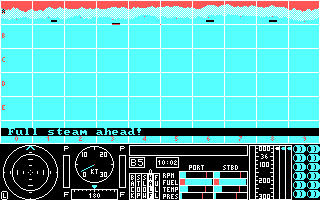
When an unseen aircraft spotter radios in a sighting, you plot an intercept path across the quadrant. Once you close the distance, combat becomes a methodical game of depth setting. You roll depth charges off the stern, setting the fuse depth to match where you think the submarine is hiding. Thirty-six barrels sound like a generous stash until you toss half of them into empty water while a homing torpedo punches through your hull.
Damage control is active work rather than an abstract status bar. Torpedo strikes rupture compartments and flood the lower decks. You have to manually engage bilge pumps, isolate flooded sections, and assign automated repair crews to keep the vessel afloat while still turning your ship to meet the next attack run.
Career mode punished cowardice long before modern roguelikes
This 1987 release treats your naval service as an ongoing record. In the Hall of Valor, the game tracks every captain you create alongside authentic historical ship names from the Fletcher class. You earn promotions and medals for escorting convoy fleets across dangerous sectors, but the game keeps score when things go wrong.
- Successful missions yield commendations, higher naval ranks, and decorated military records.
- Aborting an escort mission midway brings an immediate demotion for desertion.
- Taking a torpedo to the engine room ends the campaign permanently with a killed-in-action entry.
If you want to practice torpedo evasions without ruining a captain's service record, the main menu includes a Sea Trials mode. The game also features a full mission replay tool. After a close encounter, you can rewatch the entire engagement with the target submarine visible on screen, showing you exactly where your depth charge pattern missed.
Why the missing save button broke computer admirals
When Computer Gaming World reviewed the title in Issue 32, the critic praised the core combat but slammed the documentation. The manual, written by Burlison and Lawrence R. Ertel, covers basic ship movement but leaves out critical details about submarine AI patterns and damage mitigation formulas. The magazine also criticized the total absence of a save option during ongoing campaigns.
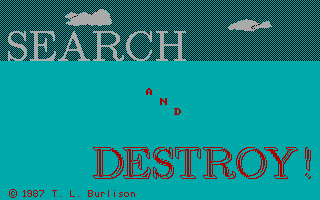
The original MS-DOS simulation relies entirely on CGA graphics and the built-in IBM PC speaker. The speaker bleeps out pinging sonar pulses and gunfire rattles, delivering a surprisingly tense atmosphere despite the rudimentary sound hardware. The visual presentation supports CGA display modes, though players in the late eighties often ran it on EGA or Hercules cards configured for CGA compatibility.
The tactical pressure stays unforgiving throughout. As early work from T. L. Burlison, it prioritizes authentic mechanical management over easy arcade thrills. The lack of mid-mission saves means a single misread sonar ping can wipe out forty minutes of careful convoy protection.
Hunt U-boats right now in your browser
You can play Search and Destroy online right now in your browser with zero installation needed. The game loads straight into your web browser ready for action. New captains usually make the mistake of reading the sonar scope like a static overhead map, so keep your eyes locked on your ship's heading before dropping your first salvo of depth charges.