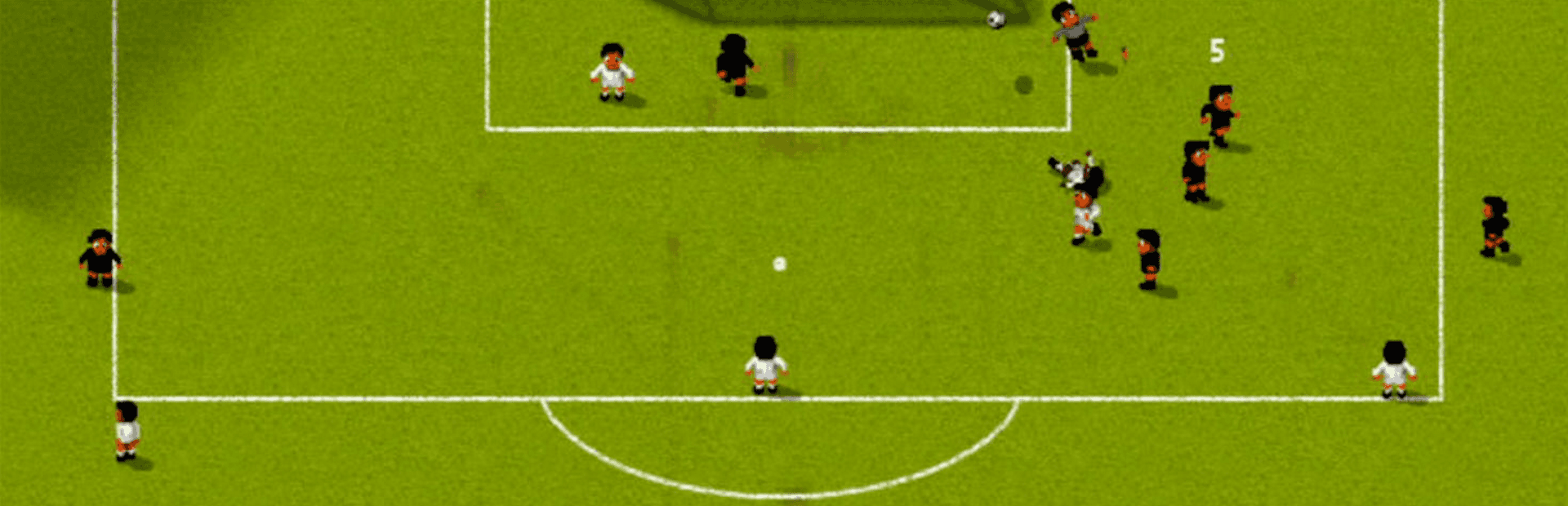


From the opening kick, Sensible World of Soccer demands absurdly fast reaction times as your tiny pixelated players sprint across a massive pitch at breakneck speed.
You launch into a match and immediately notice how light the ball feels. Controlling the active player marked by the overhead icon takes immediate practice. A single button on your joystick or keyboard handles passes, tackles, and shots. Holding the button charges your strike, while tapping it delivers a crisp floor pass.
The real magic happens the moment the ball leaves your boot. By pulling back on the controls right after a kick, you apply sharp aftertouch, curling shots around defenders or bending wide crosses into the top corner. It feels frantic, but the top-down perspective gives you complete sight of the field. You can read passing lanes three steps early if your fingers keep up.
That extreme pace cuts both ways. The speed is totally unforgiving, and mistiming a slide tackle usually sends your defender sliding off the screen while the computer punishes your mistake. Early PC releases on MS-DOS had launch bugs that needed a floppy disk patch in April 1995 to clean up performance. Once patched, the match engine ran smooth on standard PC hardware.
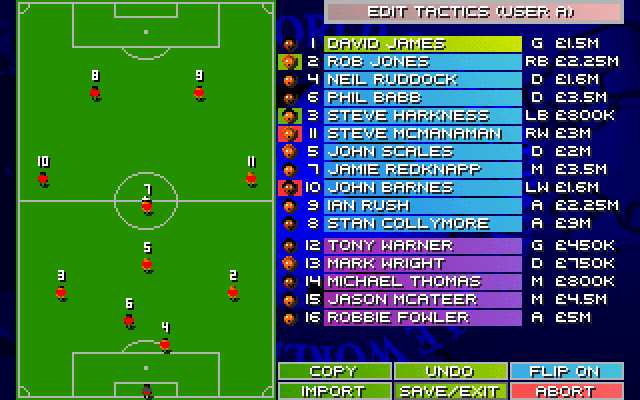
Outside match day, Sensible Software packed a staggering amount of depth into the management menus. You can take charge of club or national teams across 140 different competitions. The internal database tracks over 24,000 real-world players and roughly 1,500 teams, letting you hunt for bargains in obscure global divisions.
Your career lasts up to 20 seasons as either a pure manager or a player-manager. Success brings lucrative contract offers from wealthier clubs, while bankruptcy or poor performance gets you fired. To test squad depth, you can arrange internal trial matches between your squad's A and B rosters, testing tactical tweaks and reserve players without risking league points.
Buying players requires careful budget management. Balancing balance sheets against squad fatigue adds real weight to every transfer deadline day. It bridges arcade action with real spreadsheet management in a way few title-seekers managed in 1995.
Designed by Jon Hare alongside programmer Chris Chapman and artist Stoo Cambridge, the game traces its visual roots to 16x16 pixel sprites repurposed from Mega Lo Mania. The Audio design built by Hare, Richard Joseph, and Jason Page added vital energy, anchored by the catchy "Goalscoringsuperstarhero" theme song. Wave Software handled the DOS port from the original Amiga code, creating a staple Renegade Software release.

The Library of Congress named it one of the ten most important video games of all time in 2007 for preservation. Publications like Amiga Power famously ranked it as the top title on its home platform, while Amiga Computing awarded its 1996 update a 92% review score. The game built that reputation by keeping pitch controls simple while expanding career scope to unprecedented limits.
Some players still dislike the sheer velocity of the pitch action, preferring modern television-style simulations. Yet the purity of its input design holds up today, setting the bar for 1990s sports games.
You can play Sensible World of Soccer free in your browser right now, with no extra setup required. Experience the MS-DOS game instantly without installing emulator packages. Jump into a friendly match, take control of your squad, and start bending aftertouch shots into the top corner today.
From the opening kick, Sensible World of Soccer demands absurdly fast reaction times as your tiny pixelated players sprint across a massive pitch at breakneck speed.
You launch into a match and immediately notice how light the ball feels. Controlling the active player marked by the overhead icon takes immediate practice. A single button on your joystick or keyboard handles passes, tackles, and shots. Holding the button charges your strike, while tapping it delivers a crisp floor pass.
The real magic happens the moment the ball leaves your boot. By pulling back on the controls right after a kick, you apply sharp aftertouch, curling shots around defenders or bending wide crosses into the top corner. It feels frantic, but the top-down perspective gives you complete sight of the field. You can read passing lanes three steps early if your fingers keep up.

That extreme pace cuts both ways. The speed is totally unforgiving, and mistiming a slide tackle usually sends your defender sliding off the screen while the computer punishes your mistake. Early PC releases on MS-DOS had launch bugs that needed a floppy disk patch in April 1995 to clean up performance. Once patched, the match engine ran smooth on standard PC hardware.
Outside match day, Sensible Software packed a staggering amount of depth into the management menus. You can take charge of club or national teams across 140 different competitions. The internal database tracks over 24,000 real-world players and roughly 1,500 teams, letting you hunt for bargains in obscure global divisions.
Your career lasts up to 20 seasons as either a pure manager or a player-manager. Success brings lucrative contract offers from wealthier clubs, while bankruptcy or poor performance gets you fired. To test squad depth, you can arrange internal trial matches between your squad's A and B rosters, testing tactical tweaks and reserve players without risking league points.
Buying players requires careful budget management. Balancing balance sheets against squad fatigue adds real weight to every transfer deadline day. It bridges arcade action with real spreadsheet management in a way few title-seekers managed in 1995.
Designed by Jon Hare alongside programmer Chris Chapman and artist Stoo Cambridge, the game traces its visual roots to 16x16 pixel sprites repurposed from Mega Lo Mania. The Audio design built by Hare, Richard Joseph, and Jason Page added vital energy, anchored by the catchy "Goalscoringsuperstarhero" theme song. Wave Software handled the DOS port from the original Amiga code, creating a staple Renegade Software release.

The Library of Congress named it one of the ten most important video games of all time in 2007 for preservation. Publications like Amiga Power famously ranked it as the top title on its home platform, while Amiga Computing awarded its 1996 update a 92% review score. The game built that reputation by keeping pitch controls simple while expanding career scope to unprecedented limits.
Some players still dislike the sheer velocity of the pitch action, preferring modern television-style simulations. Yet the purity of its input design holds up today, setting the bar for 1990s sports games.
You can play Sensible World of Soccer free in your browser right now, with no extra setup required. Experience the MS-DOS game instantly without installing emulator packages. Jump into a friendly match, take control of your squad, and start bending aftertouch shots into the top corner today.
How Sensible World of Soccer is played — the keys the game listens to, grouped by what they do.
Highlighted keys are mapped — hover or tap one to see what it does.
Controls can also be mapped to a joystick via the PC installation setup.
The on-screen keyboard and gamepad mapping the browser player uses on a phone, a tablet or a controller, as opposed to the real keys above. $PRO members make their own in the player and share them here; anyone can pick one to play with.
Cheat codes, console commands and memory pokes for Sensible World of Soccer — each one verified and attributed.
Sign in to submitHow Sensible World of Soccer is played — the keys the game listens to, grouped by what they do.
Highlighted keys are mapped — hover or tap one to see what it does.
Controls can also be mapped to a joystick via the PC installation setup.
The on-screen keyboard and gamepad mapping the browser player uses on a phone, a tablet or a controller, as opposed to the real keys above. $PRO members make their own in the player and share them here; anyone can pick one to play with.
Cheat codes, console commands and memory pokes for Sensible World of Soccer — each one verified and attributed.
Sign in to submit