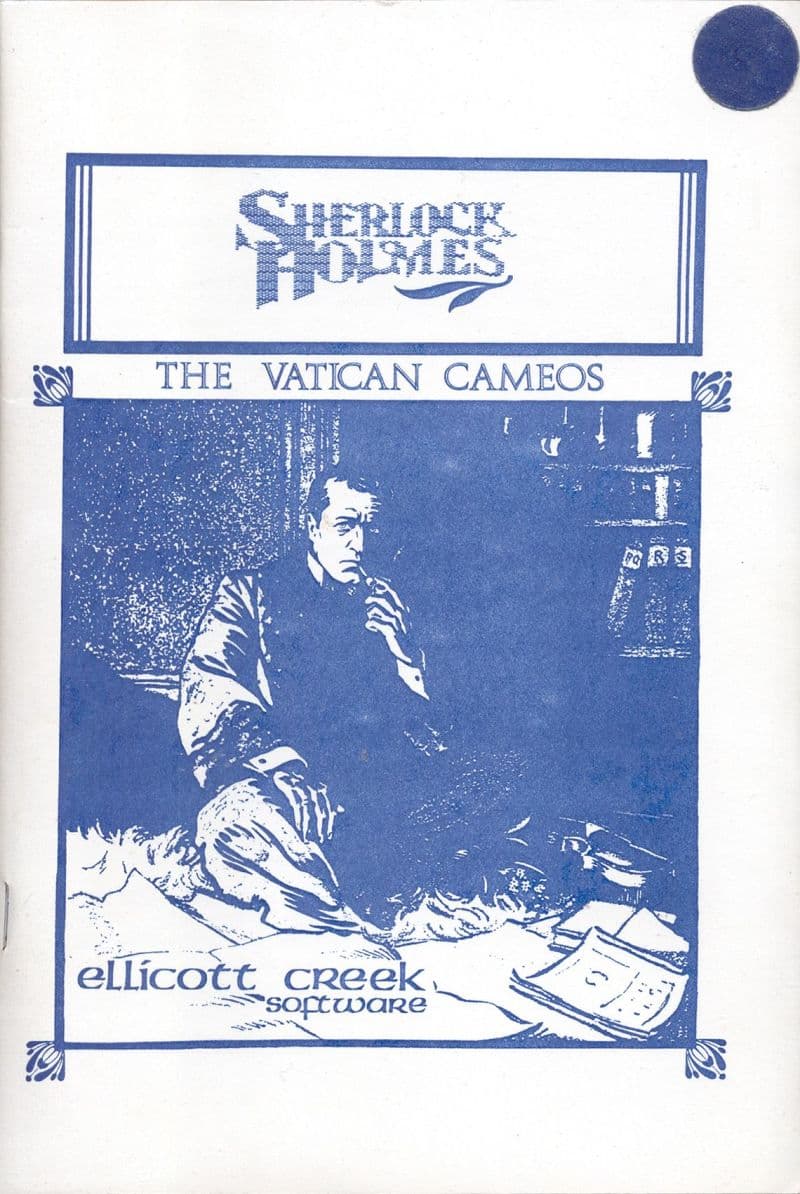
Sherlock Holmes: The Vatican Cameos
Checking…
Sherlock Holmes: The Vatican Cameos abandons the traditional text adventure parser entirely, forcing you to navigate a murder investigation using numbered menus while a real-time clock ticks down. Developed by Ellicott Creek Software in 1986, it trades scenic descriptions for strict schedules and constant time pressure.
Ticking clocks and fixed menus in Sherlock Holmes: The Vatican Cameos
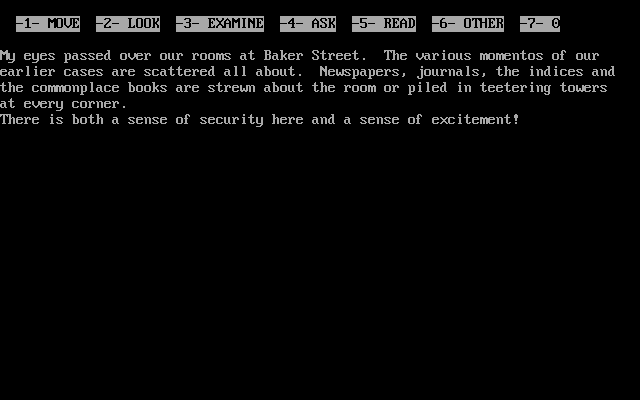
Most interactive fiction in 1980s required players to wrestle with text parsers, guessing verbs and syntax to reveal the next room. This Ellicott Creek Software title threw out the command prompt in favor of a static menu locked at the top of the screen. You navigate London using seven discrete commands:
- 1: Move
- 2: Look
- 3: Examine
- 4: Ask
- 5: Read
- 6: Other
- 7: Time
While the menu simplified input, it introduced a brutal complication: time moves in real time. Standard text parser games let you pause indefinitely to contemplate a puzzle, but here the internal clock continuously ticks. If you linger in a location trying to figure out your next destination, precious minutes vanish, directly altering where non-player characters are located throughout London.
This design gives characters dynamic schedules. Suspects and witnesses do not wait around in static rooms for you to discover them. They go about their daily routines, leaving specific places at designated hours. If you fail to reach a target location on time, you miss vital evidence or the chance to interrogate a key figure, turning the entire investigative process into a strict trial of time management.
Reading the manual for the murder mystery
The core setup relies entirely on physical documentation included in the original retail box, serving both as copy protection and narrative foundation. The manual details a backstory referencing an untold case briefly mentioned in Sir Arthur Conan Doyle's The Hound of the Baskervilles: the theft of Michelangelo's Vatican cameos and the sudden disappearance of an agent working for Mycroft Holmes. This mess leads a falsely accused suspect straight to 221B Baker Street just as Inspector Lestrade prepares to make an arrest.
Once you begin, the goal is not simply finding a culprit, but gathering enough concrete evidence to serve as a proper witness in court. To secure a conviction, you must reach the trial venue at the scheduled time and correctly answer ten detailed questions regarding the crime. Guessing or missing even a single crucial piece of information causes the prosecution to crumble, handing you an immediate loss.
Because the game provides zero visual elements and only sparse PC speaker beeps to acknowledge inputs, the physical booklet carries the heavy lifting for world building. Without the manual in hand, modern players will find themselves hopelessly lost, completely unaware of why the suspect arrived at your door or what background context connects the murder to the stolen cameos.
Minimal presentation and trial-and-error design
As a 100% text-based adventure game, there are no graphics to depict Victorian London. The PC speaker emits only functional, solitary beeps, leaving the atmosphere entirely to your imagination. When held beside mainstream late-eighties releases from studios like Infocom, the stark visual presentation of this 1986 release feels sparse, relying strictly on text output to convey room contents and character reactions.
The primary point of frustration lies in its unforgiving window for error. Because NPC schedules are rigid and the clock never stops, a single wrong move or unnecessary delay often ruins a run hours down the line. You might spend thirty minutes pursuing a cold lead, only to arrive at a crime scene after a suspect has already left, forcing a complete restart from the beginning once you realize you cannot answer the court's ten final questions.
Ellicott Creek Software planned this release as the flagship entry in an ongoing series of digital Holmes cases. However, the studio closed its doors shortly after release without producing a second chapter. That leaves this single case as a unique historical curiosity: an early attempt at simulating an active, schedule-driven world inside a strict menu system.
How to play Sherlock Holmes: The Vatican Cameos free in your browser
If you want to test your investigative speed against a ticking 1980s clock, you can play Sherlock Holmes: The Vatican Cameos online right now. The game runs directly in your browser with zero installation needed, letting you jump straight into the DOS release without messing with retro hardware settings.
Before launching your investigation, keep a note pad nearby and map out your movement choices early. Modern players usually fail their first attempt because they spend too much time exploring aimlessly while the clock runs down. Treat your first playthrough as a mapping run to learn character schedules, and be ready to move quickly once you restart to catch your suspect at the right location.
How Sherlock Holmes: The Vatican Cameos is played — the keys the game listens to, grouped by what they do.
- Look
- Action
Highlighted keys are mapped — hover or tap one to see what it does.
Requires the printed Casebook manual to obtain case details and bypass copy protection.
Players' controls
Touch and gamepad controls
The on-screen keyboard and gamepad mapping the browser player uses on a phone, a tablet or a controller, as opposed to the real keys above. $PRO members make their own in the player and share them here; anyone can pick one to play with.
Make your own touch controlsPRO
- 1Open the editorSign in below, then pick what to make. The game starts with the editor open over it.
- 2Place your keysAdd keys and drag them where your thumbs rest, or map a controller's buttons. Test plays the game with them; Save keeps them, and you play with them from then on.
- 3Share themShare them right after saving in the game, or name and share them here. Players vote, and the best become this game's controls for everyone.
Go PROSee how it worksSign in+20 XP for sharing · +50 XP if yours become the game's own
- The game's own controlsKeyboardGamepadWhat every player starts with.In use
2 screenshots
From the archive
No gameplay video yet
No gameplay video for Sherlock Holmes: The Vatican Cameos yet. Sign in to add one.
No reviews yet
Tell the community what you think of Sherlock Holmes: The Vatican Cameos. Reviews are public and tied to your username.
No archived manuals for Sherlock Holmes: The Vatican Cameos yet
No manuals archived for this title yet. Sign in to upload the first scan.
Cheat codes, console commands and memory pokes for Sherlock Holmes: The Vatican Cameos — each one verified and attributed.
Sign in to submitNo cheats yet for this title
Know a working cheat, poke or trainer? Add it with the button above. Moderators check every entry before it goes live.
No archived soundtrack for Sherlock Holmes: The Vatican Cameos yet
No soundtrack archived for this title yet. Sign in to upload the first rip.
No save states for Sherlock Holmes: The Vatican Cameos yet
No save states for this title yet. Sign in to share one.
Discussions
Sign in to post- Threads0
- Total posts0
- Online now6
Community · Sherlock Holmes: The Vatican Cameos
Who's contributing, and what's new
- Reviews0
- Threads0
- Uploadsapproved0
- Contributors0
Recent activity
Nothing here yet
Reviews, discussion threads and approved uploads appear here as members add them.