In Silent Hunter, you take command of a US Navy submarine during World War II. Your job is patrolling the Pacific Ocean, tracking trade routes, and sinking Japanese shipping.
Launching a patrol places you at the main command station, surrounded by gauges, dials, and periscope controls. You are not flying around dodging energy blasts. Success relies on patience, plotting an intercept path on a strategic map, and calculating speed, distance, and angle through the Torpedo Data Computer.
When an enemy convoy pops up on sonar, the tension mounts rapidly. You dive to periscope depth, raise the optic, and align your crosshairs with the target hull. The manual targeting system expects you to identify ship classes, estimate speeds, and input target headings before firing steam or electric torpedoes.
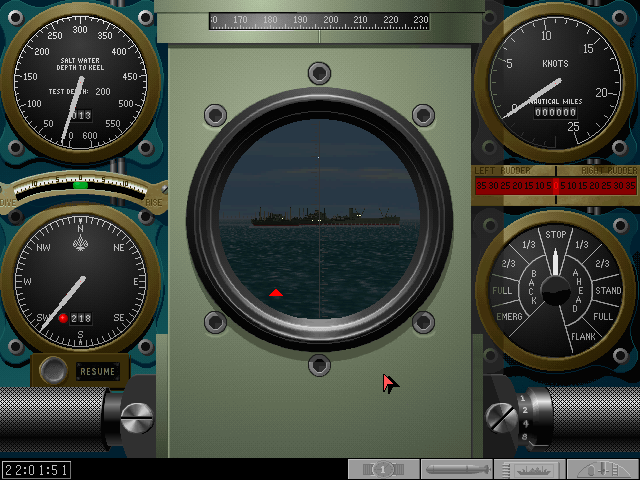
Determining a target's orientation visually can prove stubborn. Ships use 2D bitmapped sprites scaled and rotated in pseudo-3D space. Because graphics rotate in stepped increments of five to ten degrees, close-range targets can look jagged. You often end up relying heavily on your sonar operator and map calculations.
The audio presentation was built around the Miles Sound System, carrying the bulk of the atmosphere. Down in the iron belly of your fleet boat, diesel engine hums give way to creaking rivets as pressure mounts. Digitized crew voices snap to attention, while active sonar pings add a nervous pulse to every tactical approach.
Lead designer William T. Becker and artist Kim Biscoe brought an uncompromising eye for detail to the project. They worked alongside technical advisor William P. "Bud" Gruner, a real World War II submarine commander. Development at Aeon Electronic Entertainment and publisher Strategic Simulations, Inc. delivered a simulator that respected actual submarine physics.
Period reviewers praised this scope, earning the game a nomination for 1996 Simulation Game of the Year from Computer Gaming World. However, the artificial intelligence shows strange quirks. Destroyer captains sometimes drop depth charges with ruthless efficiency, while on other encounters they run erratic patterns or ignore obvious torpedo wakes.
Beyond individual scenarios, the career mode offers the central challenge. Starting near Pearl Harbor and running to August 1945, you navigate through nine distinct patrol zones across the Pacific. Total tonnage sunk is tallied against actual historic captains, rewarding performance with medals.
Non-combat assignments break up the routine of commerce raiding, forcing you into high-risk operations near hostile shorelines:
The success of the initial release led to expansion modules known as Patrol Disks 1 and 2. These add-ons introduced new patrol areas like the Java Sea, alongside fresh historical scenarios. Strategic Simulations later bundled these expansions into Silent Hunter: Commander's Edition in 1997.
While pixelated sprite scaling close to targets shows its age, the core tactical loop remains deeply satisfying. Calculating a torpedo solution from two thousand yards out and hearing the crew react as the target detonates provides a real rush. For fans of deep tactical simulation games from 1996, the original Silent Hunter MS-DOS game still delivers genuine tension.
You can play Silent Hunter free in your browser right now with no setup required. Jump straight into the commander's seat, plot your first intercept course across the Pacific, and see if you have the nerves to survive deep underwater counterattacks.
In Silent Hunter, you take command of a US Navy submarine during World War II. Your job is patrolling the Pacific Ocean, tracking trade routes, and sinking Japanese shipping.
Launching a patrol places you at the main command station, surrounded by gauges, dials, and periscope controls. You are not flying around dodging energy blasts. Success relies on patience, plotting an intercept path on a strategic map, and calculating speed, distance, and angle through the Torpedo Data Computer.
When an enemy convoy pops up on sonar, the tension mounts rapidly. You dive to periscope depth, raise the optic, and align your crosshairs with the target hull. The manual targeting system expects you to identify ship classes, estimate speeds, and input target headings before firing steam or electric torpedoes.
Determining a target's orientation visually can prove stubborn. Ships use 2D bitmapped sprites scaled and rotated in pseudo-3D space. Because graphics rotate in stepped increments of five to ten degrees, close-range targets can look jagged. You often end up relying heavily on your sonar operator and map calculations.
The audio presentation was built around the Miles Sound System, carrying the bulk of the atmosphere. Down in the iron belly of your fleet boat, diesel engine hums give way to creaking rivets as pressure mounts. Digitized crew voices snap to attention, while active sonar pings add a nervous pulse to every tactical approach.
Lead designer William T. Becker and artist Kim Biscoe brought an uncompromising eye for detail to the project. They worked alongside technical advisor William P. "Bud" Gruner, a real World War II submarine commander. Development at Aeon Electronic Entertainment and publisher Strategic Simulations, Inc. delivered a simulator that respected actual submarine physics.
Period reviewers praised this scope, earning the game a nomination for 1996 Simulation Game of the Year from Computer Gaming World. However, the artificial intelligence shows strange quirks. Destroyer captains sometimes drop depth charges with ruthless efficiency, while on other encounters they run erratic patterns or ignore obvious torpedo wakes.
Beyond individual scenarios, the career mode offers the central challenge. Starting near Pearl Harbor and running to August 1945, you navigate through nine distinct patrol zones across the Pacific. Total tonnage sunk is tallied against actual historic captains, rewarding performance with medals.
Non-combat assignments break up the routine of commerce raiding, forcing you into high-risk operations near hostile shorelines:
The success of the initial release led to expansion modules known as Patrol Disks 1 and 2. These add-ons introduced new patrol areas like the Java Sea, alongside fresh historical scenarios. Strategic Simulations later bundled these expansions into Silent Hunter: Commander's Edition in 1997.
While pixelated sprite scaling close to targets shows its age, the core tactical loop remains deeply satisfying. Calculating a torpedo solution from two thousand yards out and hearing the crew react as the target detonates provides a real rush. For fans of deep tactical simulation games from 1996, the original Silent Hunter MS-DOS game still delivers genuine tension.
You can play Silent Hunter free in your browser right now with no setup required. Jump straight into the commander's seat, plot your first intercept course across the Pacific, and see if you have the nerves to survive deep underwater counterattacks.
How Silent Hunter is played — the keys the game listens to, grouped by what they do.
Highlighted keys are mapped — hover or tap one to see what it does.
Control map is based on available reference manual documentation. Full keyboard shortcut listings were not retrieved.
The on-screen keyboard and gamepad mapping the browser player uses on a phone, a tablet or a controller, as opposed to the real keys above. $PRO members make their own in the player and share them here; anyone can pick one to play with.
Cheat codes, console commands and memory pokes for Silent Hunter — each one verified and attributed.
Sign in to submitHow Silent Hunter is played — the keys the game listens to, grouped by what they do.
Highlighted keys are mapped — hover or tap one to see what it does.
Control map is based on available reference manual documentation. Full keyboard shortcut listings were not retrieved.
The on-screen keyboard and gamepad mapping the browser player uses on a phone, a tablet or a controller, as opposed to the real keys above. $PRO members make their own in the player and share them here; anyone can pick one to play with.
Cheat codes, console commands and memory pokes for Silent Hunter — each one verified and attributed.
Sign in to submit