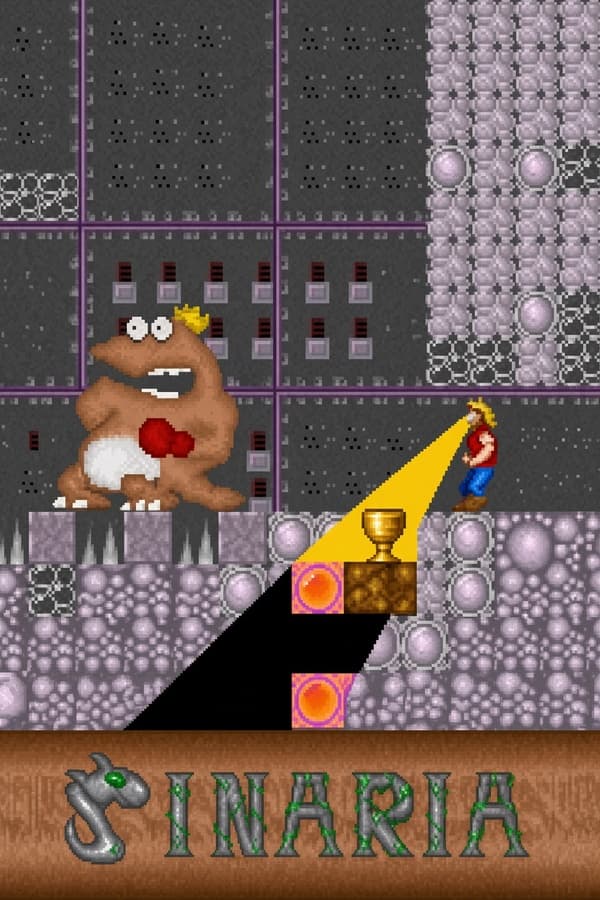
Sinaria: Lost in Space
aka Sinaria · Sinaria- Lost in Space!
Rate this game
- Played
- Rarely
If you loaded up Sinaria: Lost in Space on a PC in 1994 expecting a standard left-to-right jumper, its sprawling maze of secret passages and modular power-ups offered something far more open-ended. Developers John E. Pollard and Joe Hillman built an action platformer that directly adapted the progression structure of console hits for PC shareware disks.
Super Metroid mechanics brought to the PC platform
In 1994, PC platformers rarely tried to emulate the structure of console exploration games. Most shareware titles stuck to strict stage-by-stage progression, counting down a timer while you gathered keys to reach an exit door. John E. Pollard & Joe Hillman took a different approach, building an interconnected alien landscape where progress requires finding specialized tools scattered across the environment.
You control an unnamed astronaut tasked with liberating the alien world of Sinaria from a villain named Stomper. Before reaching Stomper himself, you have to fight your way through corridors packed with mechanical drones designed in his image. Combat is simple, but survival depends entirely on how thoroughly you search the environment for upgrades.
The movement kit is where the design intentions become obvious. The game equips you with several key tools to systematically open up the map:
- Saturn Ball: Compresses your character into a rolling sphere, allowing you to squeeze through narrow crawlspaces and drop small bombs to blast through brittle floor blocks.
- X-Ray Vision: Reveals false walls and hidden corridors that look identical to solid terrain on the standard view.
- Jump Boots: Increases vertical leap distance to reach high ledges that were previously out of range.
- Swivel: Works as a grappling tool, letting you hook onto overhead anchor points and swing across wide chasms.
Acquiring these upgrades changes how you navigate earlier zones. Backtracking is mandatory, and checking previous dead ends with newly acquired tools is the main loop driving the experience.
Navigating Sinaria: Lost in Space through visual clutter and complex layouts
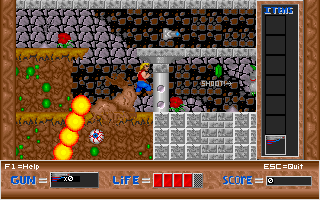
While the item-gated structure works well, the physical presentation introduces friction. The 256-color VGA art features detailed foreground structures and multiple parallax scrolling layers, but the tilesets are visually dense. Wall textures, background elements, and interactive surfaces often share identical color palettes and geometric patterns.
Because structural walls and decorative background columns look so similar, finding the path forward frequently becomes a trial of wall-hugging. Activating the X-Ray Vision tool helps identify real boundaries, but toggling inventory items during high-stress encounters slows the pace down. You often end up bumping against walls just to check if a tile is solid background art or a passage to the next room.
The level design itself is wide and branching. Rooms extend vertically as well as horizontally, making blind drops common. If you miss a jump over a pit, you rarely fall to your death; instead, you drop into a lower sub-section of the map and have to work your way back up through enemy-filled corridors. It creates a labyrinthine structure that rewards patient mapping over raw reflexes.
Where the audio and visual presentation hits a wall
When you fire up the 1994 action title today, the sound driver implementation is one of the first things you notice. The game utilizes tracked MOD audio alongside digitized sound effects. While MOD music was a popular format for DOS shareware games because it allowed rich multi-channel compositions without heavy disk space usage, the soundtrack here suffers from short loops.
The primary background tracks repeat their melodies every few dozen seconds. During long sessions spent searching for hidden passages, the audio becomes noticeably monotonous. Turn the music volume down slightly in the options menu, and the impact of the sound effects holds up much better, providing distinct auditory cues for laser blasts and bomb detonations.
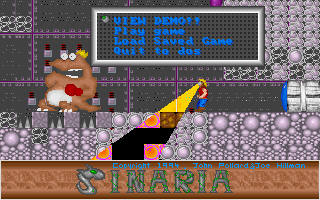
Graphically, reviewers at the time were split. Contemporary coverage on distribution networks praised the parallax scrolling layers and detail, while retrospectives noted that the art can look blocky and disjointed. Enemy sprites use limited animation frames, meaning drone enemies float toward you with minimal motion telegraphing. This makes fast reactions tricky when navigating tight vertical shafts packed with hazards.
An unfinished shareware release and its place today
Distributed under the Shareware model by PolyEx Software, the game was originally intended as the first chapter of a two-part story. The ending of the initial episode teased a direct continuation titled Return of Stomper. However, that second chapter was ultimately abandoned, leaving this single release as the sole entry in Stomper's story line.
Instead of finishing the sequel, Pollard and Hillman moved on to develop Vigilance on Talos V, carrying over many of the same scrolling mechanics and sci-fi aesthetic choices. That shift turned this initial game into a direct stepping stone toward their later work, built right when independent PC authors were testing how far they could push console-style side-scrollers on desktop hardware.
If you enjoy searching for hidden wall breakables and managing inventory tools in a classic sci-fi setting, you can play Sinaria: Lost in Space online right here. You can jump directly into this classic Sinaria: Lost in Space MS-DOS game in your browser with zero setup. Load it up, map out the sectors room by room, and see how this early shareware experiment handles its dynamic gear upgrades.
How Sinaria: Lost in Space is played — the keys the game listens to, grouped by what they do.
- Movement
- Action
- Weapons & items
- Interface
Highlighted keys are mapped — hover or tap one to see what it does.
Players' controls
Touch and gamepad controls
The on-screen keyboard and gamepad mapping the browser player uses on a phone, a tablet or a controller, as opposed to the real keys above. $PRO members make their own in the player and share them here; anyone can pick one to play with.
Make your own touch controlsPRO
- 1Open the editorSign in below, then pick what to make. The game starts with the editor open over it.
- 2Place your keysAdd keys and drag them where your thumbs rest, or map a controller's buttons. Test plays the game with them; Save keeps them, and you play with them from then on.
- 3Share themShare them right after saving in the game, or name and share them here. Players vote, and the best become this game's controls for everyone.
Go PROSee how it worksSign in+20 XP for sharing · +50 XP if yours become the game's own
- The game's own controlsKeyboardGamepadWhat every player starts with.In use
2 screenshots
From the archive
No gameplay video yet
No gameplay video for Sinaria: Lost in Space yet. Sign in to add one.
No reviews yet
Tell the community what you think of Sinaria: Lost in Space. Reviews are public and tied to your username.
No archived manuals for Sinaria: Lost in Space yet
No manuals archived for this title yet. Sign in to upload the first scan.
Cheat codes, console commands and memory pokes for Sinaria: Lost in Space — each one verified and attributed.
Sign in to submitNo cheats yet for this title
Know a working cheat, poke or trainer? Add it with the button above. Moderators check every entry before it goes live.
No archived soundtrack for Sinaria: Lost in Space yet
No soundtrack archived for this title yet. Sign in to upload the first rip.
No save states for Sinaria: Lost in Space yet
No save states for this title yet. Sign in to share one.
Discussions
Sign in to post- Threads0
- Total posts0
- Online now6
Community · Sinaria: Lost in Space
Who's contributing, and what's new
- Reviews0
- Threads0
- Uploadsapproved0
- Contributors0
Recent activity
Nothing here yet
Reviews, discussion threads and approved uploads appear here as members add them.