
Skunny: Lost in Space
Skunny: Lost in Space takes the classic arcade formula of Moon Patrol and installs a armed squirrel behind the wheel of a lunar rover.
Driving a Moonbuggy through Copysoft's take on Moon Patrol
In 1993, Belgian developer Copysoft published a horizontal shooter starring Skunny Hardnut, a cartoon squirrel sent to the Moon. Crazed alien creatures called Schnozes have stolen all human television satellite dishes and captured astronauts to use in strange lunar rituals. Your job is simple: drive across the bumpy surface, blast hostiles out of the sky, and get those satellite dishes back.
The core design directly copies Atari's arcade staple. You drive from left to right across uneven terrain, managing two main threats at once. Flying alien spacecraft drop bombs from above, while deep lunar craters sit waiting for your buggy to fall into them. It was released as a shareware action game during an era flooded with platformers and clones.
What sets this release apart from a basic arcade port is how it divides the action. Rather than forcing a single long gauntlet, you choose from a list of ten levels right from the start menu. If you played the shareware disk, you only had access to the first two stages.
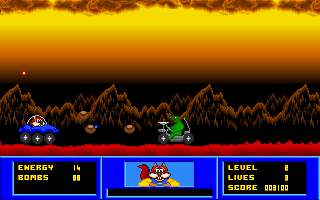
What happens when limited ammo meets crater-heavy lunar terrain
The controls feel loose, which makes jumping craters a constant hazard. Your Moonbuggy moves continuously across 2D side-scrolling landscapes, firing twin lasers that fire forward and upward simultaneously. This dual direction attack lets you clear airborne threats while dealing with obstacles in your path.
Unlike standard arcade shooters that offer infinite firing, your vehicle relies on strict resources. You operate with limited laser ammunition and finite vehicle energy. Running low on shots in the middle of a heavy wave of enemy ships turns an easy level into a scramble for drops.
To survive, you must collect items scattered along the terrain:
- Ammunition pickups that restore your twin laser reserve before you run completely dry.
- Health batteries that repair your buggy's energy after taking hits from alien bombs.
- Extra lives tucked away in tight spots over high-risk pit jumps.
Modern retrospective reviews often point out that the mascot lacks charm and the gameplay feels derivative. That assessment is entirely fair. Yet, managing shot counts while lining up low jumps over wide chasms provides a genuinely tight challenge for DOS players.
Smart saves and shareware limits in Skunny: Lost in Space
One surprisingly thoughtful feature is the auto-save system. Back in 1993, many PC arcade titles forced you to complete runs in one sitting or rely on clunky password screens. Copysoft built a save option that automatically records your progress if you exit a level mid-game.
That save feature makes working through the full roster of ten levels far less tedious. You can tackle a couple of stages, jump out to MS-DOS, and return later without losing your place. It gave the package a modern convenience that bigger commercial releases sometimes ignored.

The presentation relies on colorful, chunky VGA graphics that move at a decent clip. While the sound effects piped through a Sound Blaster card are basic, they deliver adequate feedback when your lasers strike home. It is a straightforward budget title that never tries to be anything more.
Cheats, code loops, and Copysoft's Belgian shareware factory
Programmer Philippe Mercier built the game for Edisys SCRL, operating under the Copysoft label in Brussels. The studio churned out several entries featuring the same rodent hero. Skunny went on to appear in platformers, a wild west adventure, a pizza rescue game, and even a kart racer.
Because the main campaign can get punishing when ammo drops fall short, typing cheat codes was routine practice on home PCs. Entering SKUNY grants you infinite lives to brute-force tough jumps. Typing HUMHA unlocks infinite energy, while KICKBUT gives you unlimited laser ammunition to blast away without restraint.
Without those codes, later levels demand exact timing. Missing a single landing strip usually sends your Moonbuggy tumbling down a pit, stripping away your power-ups and sending you back to restart the section.
Play Skunny: Lost in Space online right now in your browser
If you want a quick session with a piece of shareware history, you can play Skunny: Lost in Space online free in your browser right now. There is nothing to set up or install. You can jump straight into the DOS release and test your reflexes on the lunar surface instantly.
Start on level one to get a feel for the jump momentum before trying the trickier terrain leaps in later stages. Keep a close eye on your laser gauge early on, because spamming shots will leave you helpless when the next wave of alien craft appears.