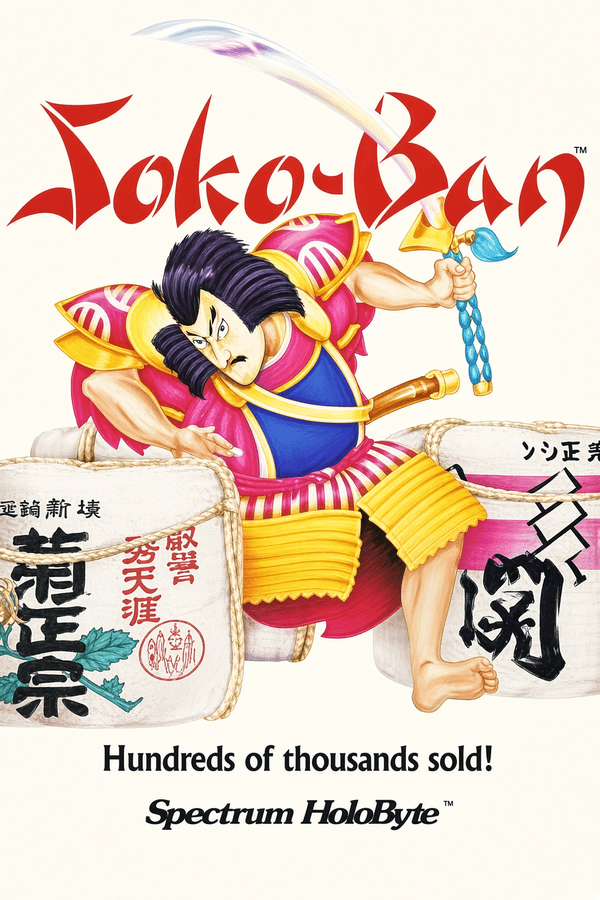
Soko-Ban
aka Sokoban · 倉庫番
Rate this game
- Played
- Often
In Soko-Ban, you are a warehouse keeper working through cramped rooms where one careless shove locks a crate against a wall forever.
The elegant trap of pushing boxes in Soko-Ban
Early computer puzzle games often tried to build challenge through fast action or complicated controls. Hiroyuki Imabayashi took the opposite route in 1982 by stripping everything down to pure spatial logic. The title translates literally to "warehouse keeper" in Japanese. You control a single worker on a top-down grid who must push containers into designated storage spaces.
The rules fit on an index card, but the constraints create endless headaches. You can push a crate forward into an open space, but you can never pull one back. If two crates sit side by side, your character lacks the strength to move both at once. There are no enemies, weapons, timers, or power-up items to rescue a bad run. Every room is a static maze of walls, target spots, and heavy boxes.
That utter simplicity means every puzzle is a tight network of dependencies. Moving one box to clear an aisle often blocks the only path to another target dot. You quickly learn that pushing a crate directly into a blind corner makes the level unsolvable on the spot.
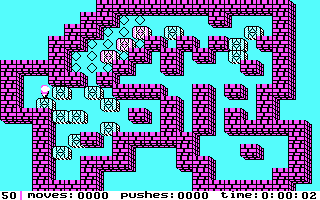
Mistakes are absolute when a crate meets a corner
The real horror of this design lies in its permanence. Because there is no simple undo key, a brief lapse in concentration ruins your progress completely. You might spend ten minutes organizing four boxes perfectly, only to wedge the fifth against a bare wall. When that happens, your only choice is to restart the board from scratch.
Later boards in this puzzle game require you to map out sequences forty steps in advance. Computer scientists eventually took notice of this extreme mathematical density. They proved that solving generalized boards in this franchise belongs to the NP-hard and PSPACE-complete complexity classes. Arranging crates in a digital shed turns out to be as demanding as complex formal logic.
around the game controls added its own layer of tension. Clumsy keyboard presses can occasionally skip your current level or throw your worker off target. You must treat every arrow key press with genuine caution.
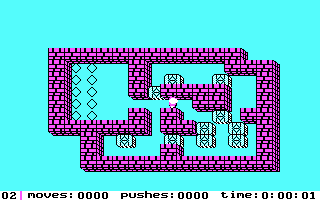
How ASCII Corporation adjusted the formula for western PCs
While Japanese gamers were already familiar with Thinking Rabbit's initial releases, western home computers had to wait. In 1987, ASCII Corporation teamed up with Thinking Rabbit to prepare an international conversion. Published by Spectrum HoloByte, Inc., this MS-DOS release became the first official version exported outside Japan.
The release package combined a curated selection of 50 levels drawn from the original Japanese microcomputer releases and its immediate sequel. To sweeten the deal, the developers included a custom level editor. Players could construct their own grid mazes, place target spots, and save custom puzzle layouts directly to floppy disk.
That inclusion gave the package surprising mileage beyond its initial 50 rooms. Users could challenge their friends with monstrous custom layouts or practice smaller tactical setups.
Critical praise and visual stumbles on release
When the game hit computer store shelves, gaming magazines divided sharply over its presentation. European outlets like Power Play praised the design with a 90% score in late 1987, while Happy Computer awarded it 87% early the next year. The Games Machine gave it an 83% rating, celebrating the clean logic behind the grid mechanics.
Not everyone was so forgiving of the audio and visual package. ACE magazine handed down a muted score of 487 out of 1000, arguing that while the core concept was fine, the presentation was painfully primitive. On standard MS-DOS monitors, the warehouse walls and simple sprites looked dated compared to flashier arcade conversions of the day.

The critics who hated the graphics were not wrong, but they missed why people kept playing. The raw challenge of solving a board surpassed any lack of high-resolution flair. That reliance on pure logic allowed the core mechanics to sell over four million copies across decades of home hardware releases.
Test your grid logic and play Soko-Ban online
Looking back at this Soko-Ban MS-DOS game reveals brilliant engineering alongside harsh early design choices. The absence of an undo command is a frustrating hurdle that will irritate players used to instant rewinds. Yet the satisfaction of finally unknotting a congested grid of crates feels just as sharp now as it did in the eighties.
You can see where every block-sliding title came from without wrestling with vintage hardware configurations. You can enjoy a session to play Soko-Ban online right now, running Soko-Ban free in your browser with nothing to install and no setup required. Step into the warehouse, study the grid layout, and try not to park your first crate in an inescapable corner.
How Soko-Ban is played — the keys the game listens to, grouped by what they do.
- Movement
- Action
- Interface
Highlighted keys are mapped — hover or tap one to see what it does.
Key mapping derived from provided research notes for Soko-Ban (1987) on MS-DOS. The game supports optional joystick control.
Players' controls
Touch and gamepad controls
The on-screen keyboard and gamepad mapping the browser player uses on a phone, a tablet or a controller, as opposed to the real keys above. $PRO members make their own in the player and share them here; anyone can pick one to play with.
Make your own touch controlsPRO
- 1Open the editorSign in below, then pick what to make. The game starts with the editor open over it.
- 2Place your keysAdd keys and drag them where your thumbs rest, or map a controller's buttons. Test plays the game with them; Save keeps them, and you play with them from then on.
- 3Share themShare them right after saving in the game, or name and share them here. Players vote, and the best become this game's controls for everyone.
Go PROSee how it worksSign in+20 XP for sharing · +50 XP if yours become the game's own
- The game's own controlsKeyboardGamepadWhat every player starts with.In use
6 screenshots
From the archive
No reviews yet
Tell the community what you think of Soko-Ban. Reviews are public and tied to your username.
No archived manuals for Soko-Ban yet
No manuals archived for this title yet. Sign in to upload the first scan.
Cheat codes, console commands and memory pokes for Soko-Ban — each one verified and attributed.
Sign in to submitNo cheats yet for this title
Know a working cheat, poke or trainer? Add it with the button above. Moderators check every entry before it goes live.
No archived soundtrack for Soko-Ban yet
No soundtrack archived for this title yet. Sign in to upload the first rip.
No save states for Soko-Ban yet
No save states for this title yet. Sign in to share one.
Discussions
Sign in to post- Threads0
- Total posts0
- Online now6
Community · Soko-Ban
Who's contributing, and what's new
- Reviews0
- Threads0
- Uploadsapproved0
- Contributors0
Recent activity
Nothing here yet
Reviews, discussion threads and approved uploads appear here as members add them.