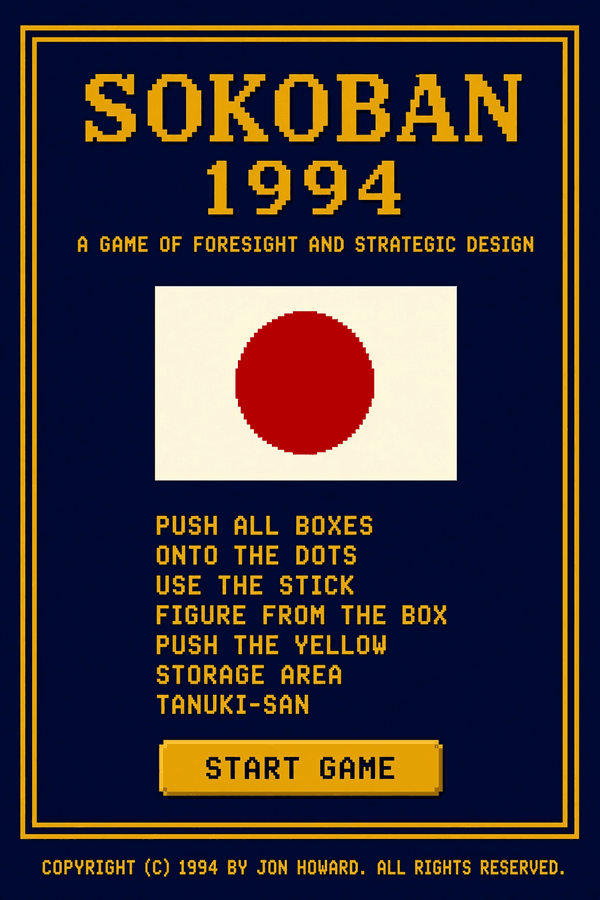
Sokoban 1994
aka Sokoban 94 · Sokoball 94
Rate this game
- Played
- Rarely
Jim Radcliffe released Sokoban 1994 after players of his earlier title Sokoball asked for classic warehouse puzzles paired with clean, high-resolution visual presentation.
A good block-pushing puzzle does not require elaborate setup or complex storytelling. The genre had already been established years earlier, but DOS players in the early nineties were often stuck choosing between raw ASCII text grids or low-resolution EGA graphics. Jim Radcliffe had previously built Sokoball, which wrapped push-puzzle mechanics in high-resolution visual assets, but fans wanted something closer to Hiroyuki Imabayashi original concept. Sokoban actually translates from Japanese as warehouse man, a detail Radcliffe noted directly in his title screen documentation.
To deliver a pure set of challenges, Radcliffe turned directly to the community. Dedicated players gathered public domain puzzle layouts and supplied them for this release, ensuring that the level design leaned heavily into traditional spatial traps rather than simple maze navigation. Released as shareware, it gave puzzle games enthusiasts a sharp, modern environment to test their foresight.
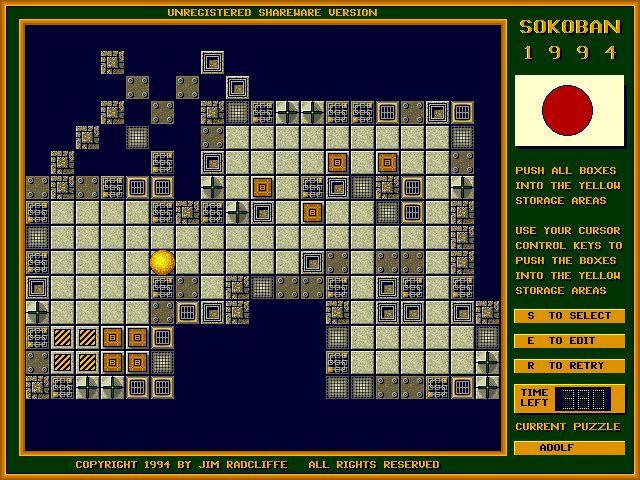
Trapped in the warehouse against the clock in Sokoban 1994
The goal in each stage remains straightforward. You navigate a single worker through a storage facility, pushing crates into designated locations marked by yellow striped tiles. Keyboard controls handle movement, sliding boxes one square at a time whenever you move into them. The fundamental rule of the game is that you can only push boxes forward, never pull them backward.
That single restriction generates every ounce of tension in this 1994 release. Pushing a crate into a dead corner immediately ruins the run, forcing a complete restart of the stage. Maneuvering boxes through tight corridors without blocking your own exit path requires planning four or five moves ahead. Retro readers often cite box lockouts as the primary point of frustration, and this version offers zero forgiveness if you act before thinking.
Visually, the sharp SVGA presentation renders the warehouse floor and crates with clear definition. Some players found the detailed textures a bit busy compared to monochrome visual schemes, but the high resolution makes it easy to read wall boundaries across dense maps.
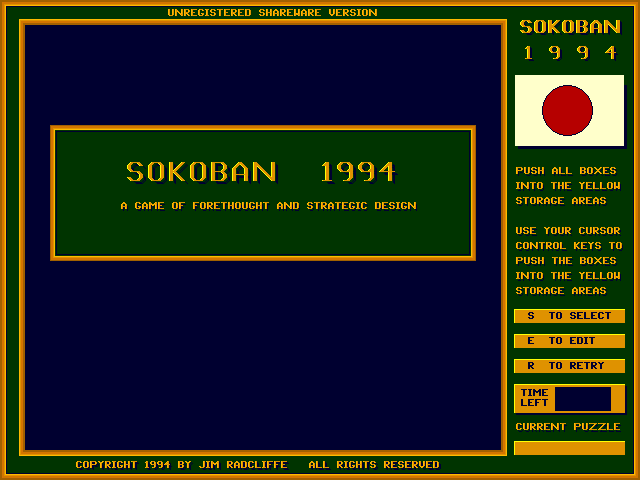
Forty timed shareware puzzles and a locked editor
The shareware distribution of this Jim Radcliffe project packages over forty distinct levels. Unlike casual variants that allow endless deliberation, these puzzles enforce strict time limits. You are not only battling the geometry of the room, you are also racing an unforgiving countdown clock.
Sound design is minimal by design. You will not hear digital music tracks or voice samples. Instead, the audio consists strictly of the mechanical ticking of the countdown timer, keeping pressure constant as you try to plot safe paths through narrow gaps.
The package also includes a built-in level construction tool. Players could draft their own custom grid layouts directly inside the interface. However, in standard shareware fashion, saving your custom level creations was restricted to registered users who mailed in their payment to publisher Jim Radcliffe.
You can play Sokoban 1994 free in your browser right now
The design holds up because the basic rules never needed updating. While later releases added unlimited undo commands or soft hints, the strict setup here demands careful, deliberate play. If you enjoy spatial logic without flashy distractions, it offers a pure test of planning.
You can play Sokoban 1994 online right here in your browser. This Sokoban 1994 MS-DOS game runs directly in your window with no extra files or setup required. The timer ticking down creates a tension that static screenshots cannot convey, so launch the grid, watch your corners, and see if you can clear the warehouse before time runs out.
Players' controls
Touch and gamepad controls
The on-screen keyboard and gamepad mapping the browser player uses on a phone, a tablet or a controller, as opposed to the real keys above. $PRO members make their own in the player and share them here; anyone can pick one to play with.
Make your own touch controlsPRO
- 1Open the editorSign in below, then pick what to make. The game starts with the editor open over it.
- 2Place your keysAdd keys and drag them where your thumbs rest, or map a controller's buttons. Test plays the game with them; Save keeps them, and you play with them from then on.
- 3Share themShare them right after saving in the game, or name and share them here. Players vote, and the best become this game's controls for everyone.
Go PROSee how it worksSign in+20 XP for sharing · +50 XP if yours become the game's own
- The game's own controlsNone yet: played with a real keyboard only.In use
2 screenshots
From the archive
No gameplay video yet
No gameplay video for Sokoban 1994 yet. Sign in to add one.
No reviews yet
Tell the community what you think of Sokoban 1994. Reviews are public and tied to your username.
No archived manuals for Sokoban 1994 yet
No manuals archived for this title yet. Sign in to upload the first scan.
Cheat codes, console commands and memory pokes for Sokoban 1994 — each one verified and attributed.
Sign in to submitNo cheats yet for this title
Know a working cheat, poke or trainer? Add it with the button above. Moderators check every entry before it goes live.
No archived soundtrack for Sokoban 1994 yet
No soundtrack archived for this title yet. Sign in to upload the first rip.
No save states for Sokoban 1994 yet
No save states for this title yet. Sign in to share one.
Discussions
Sign in to post- Threads0
- Total posts0
- Online now6
Community · Sokoban 1994
Who's contributing, and what's new
- Reviews0
- Threads0
- Uploadsapproved0
- Contributors0
Recent activity
Nothing here yet
Reviews, discussion threads and approved uploads appear here as members add them.