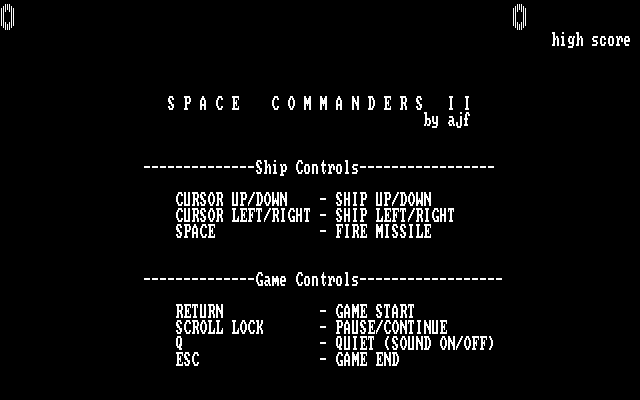
Space Commanders II
Space Commanders II is a 1985 fan-made shooter that strips down an already plain Space Invaders formula into a raw test of thumb endurance. You take control of a single defender with three lives, staring down a screen packed with alien rows that drop lower and accelerate with every target you destroy.
A clone of a clone that threw out colour
Back in 1983, a title named Space Commanders hit PC displays as a standard clone of Taito arcade mechanics. Two years later, a programmer credited only as ajf put together this sequel, releasing it as a freeware release for early PC hardware. Instead of building on what came before, the author made the baffling decision to strip out colour entirely, trading standard graphics for stark monochrome visuals.
You can see the amateur roots in every corner of the layout. The original 1983 release at least tried to fit in with commercial software of its day, but this sequel feels like a homemade project built by someone working late at night on a green-screen monitor. It arrived in 1985 without glossy packaging, retail distribution, or documentation beyond brief text prompts on the display.
I find that strange production history fascinating because it shows how PC software spread before real distribution networks existed. Someone played an early arcade port, decided they could assemble their own iteration at home, and dropped the executable file into the wild. What you get on screen is that exact unedited homebrew design, complete with all its strange compromises.
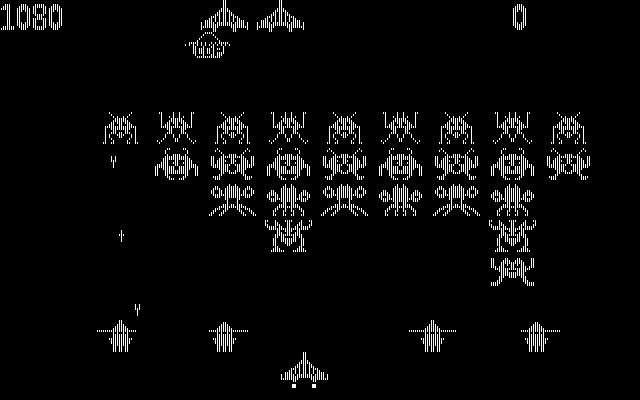
How Space Commanders II handles the march of the alien horde
The core structure of this action game follows the classic arcade grid layout. A large formation of hostile craft sits near the top of the display, shifting horizontally back and forth before dropping down a line when they hit the border. Your base ship stays locked at the bottom, moving left and right while firing vertical shots into the oncoming grid.
Every hit removes an invader, but every victory makes your job harder. As the count of remaining enemies shrinks, the entire grid speeds up, turning the calm opening rhythm into a panicked rush. By the time you are down to the final three or four invaders, they zip across the screen fast enough to make your shots miss repeatedly.
That speed jump puts severe strain on your keyboard hand. Because shots must be timed carefully against high-speed targets, player thumbs will ache after just ten minutes of continuous play. There are no power-ups, extra weapon modes, or smart bombs to relieve the pressure, leaving you with raw manual input to survive each wave.
Cracking under keyboard fatigue and monochrome visuals
When reviewers looked at this release, praise was almost impossible to come by. Sites like GameHippo scored it at a middle-of-the-road 50 percent, pointing out that stripping away colour served no practical purpose. Playing a monochrome shooter in 1985 felt like taking a step backward, especially when PC sound and display standards were advancing quickly.
The lack of visual feedback makes track shots needlessly difficult. Without distinct color coding for different alien rows, every enemy looks identical, making it hard to prioritize targets in the middle of a drop cycle. You have to judge target distance purely by position rather than glance recognition, which adds frustration to an already unforgiving encounter design.
The audio side relies entirely on the internal PC speaker, pushing out harsh single-tone beeps whenever a shot fires or an alien explodes. It offers zero warmth or bass, sounding exactly like early office hardware trying to simulate an arcade hall. After a few failed runs, those sharp frequency spikes become just as tiring as the heavy keyboard tap required to stay alive.
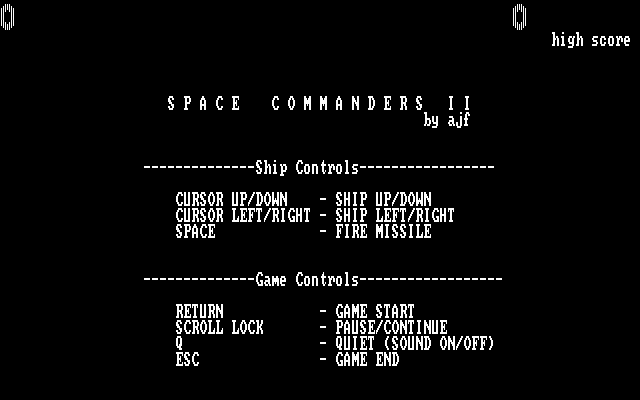
The mechanical loop inside this brutal MS-DOS shooter
A good run in this game comes down to rhythm management. If you clear the bottom rows first, you create a wide gap that lets you dodge incoming fire while keeping your own line of sight open. Leaving a single stray alien on the bottom edge is a fast track to losing a ship, as its shots reach your position almost instantly.
The real danger comes during the final stage of a wave. With only one ship darting across the top row, the game turns into a high-stakes duel where missing a shot leaves you exposed for a full second. Because your ship can only fire one projectile on screen at a time, a bad shot near the top ceiling locks your controls until the missile clears the boundary.
- Focus your early fire on one side of the formation to carve out a safe zone for dodging.
- Avoid shooting randomly when the last alien speeds up, because a miss delays your next attempt.
- Keep your ship slightly off-center to force the descending grid into predictable bounce paths.
That strict single-shot limit defines the entire pacing. You cannot panic-fire your way out of a tight spot like in later space shooters. Every press of the spacebar demands precision, making a clear screen feel like an actual achievement earned through timing rather than luck.
Play Space Commanders II free in your browser right now
This release is far from a polished product, and its stark monochrome presentation will push away anyone looking for smooth arcade flourishes. Yet for players who enjoy raw, unvarnished early PC history, it offers a fascinating look at how hobbyist programmers attempted to bring arcade thrills home. It works best in short bursts, offering an uncompromising difficulty curve that demands immediate reactions.
You can experience this slice of homebrew history without hunting down vintage hardware or configuring old memory limits. You can play Space Commanders II online, free in your browser right now with no setup needed. Fire it up, test your patience against the accelerating alien grid, and see how long your hands hold out against the raw speed of the final wave.