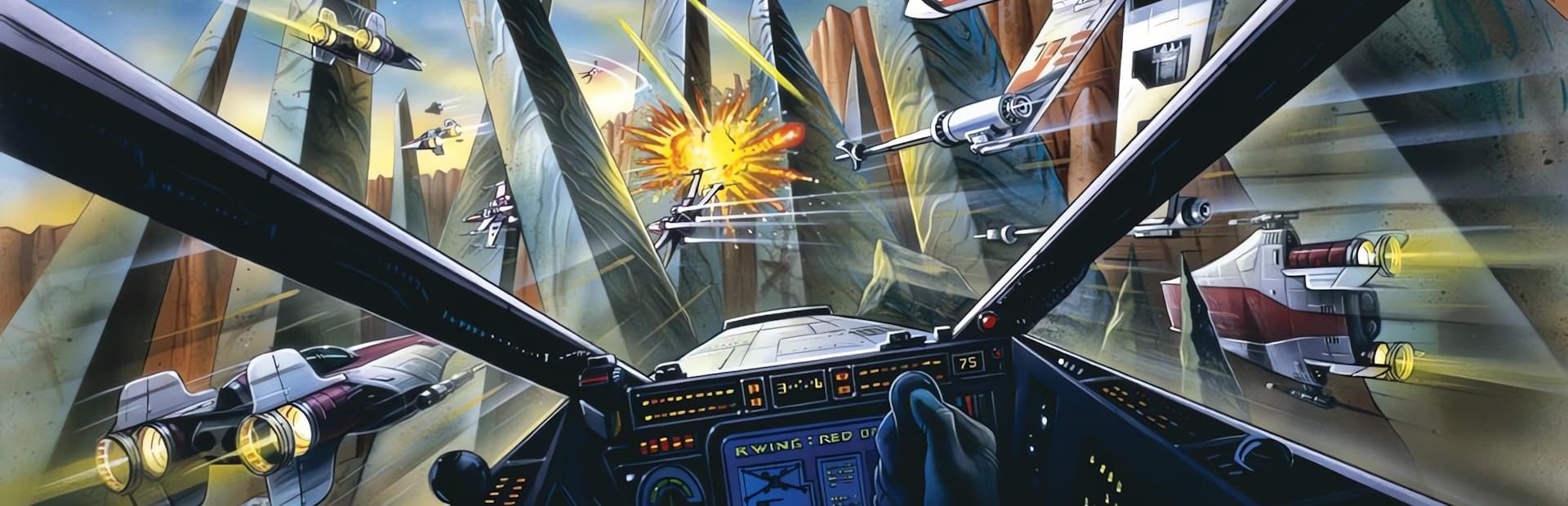

Launching Star Wars: Rebel Assault in 1993 meant watching digitized video stream off an early CD-ROM drive while struggling to keep a twitchy X-wing crosshair on incoming TIE fighters.
How Star Wars: Rebel Assault traded flight freedom for cinematic flair
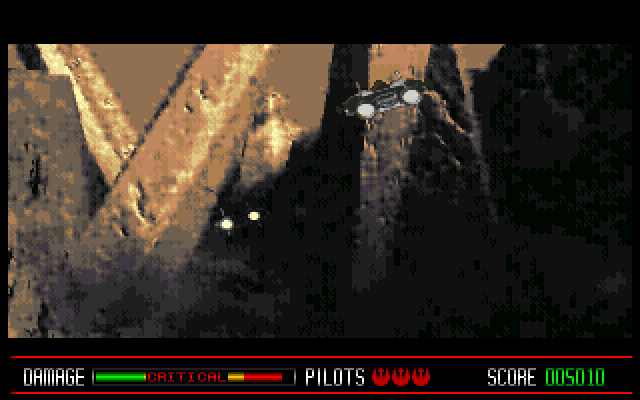
You begin your career in the Rebel Alliance as Rookie One, sitting in the cockpit of a T-16 Skyhopper and banking through the narrow rock passages of Beggar's Canyon. The canyon walls do not exist as rendered 3D polygons. Instead, Vince Lee and his team at LucasArts Entertainment Company, LLC streamed pre-rendered computer animation straight off the disc, forcing your craft along a strictly predetermined path. Your only real task is keeping the ship within the moving visible corridor and aiming a floating cursor at targets that zip past at fixed speeds.
The immediate problem hits the second you move your input device. Pitching up or banking left adjusts your vehicle slightly within the frame, but steering feels slippery and imprecise. Trying to fine-tune your aim with a standard Microsoft mouse feels like trying to push toothpaste back into the tube. You constantly overshoot targets, bump into pre-rendered rock faces, and absorb damage from turrets you spotted three seconds too late. If you steer toward a fork in the canyon, a split-second decision routes the streaming video down an alternate corridor, but you never possess true flight freedom.
That rigid design splits opinion sharply. Contemporary computer magazines argued over whether this interactive movie structure was the future of home entertainment or a simple arcade distraction. French publication Tilt handed down a stellar 90 percent rating, praising the audio and visual presentation as a landmark achievement for PC hardware. Meanwhile, Britain's Edge magazine awarded it a harsh 5 out of 10, correctly pointing out that behind the shiny recorded backgrounds lay an extremely restrictive rail shooter with very shallow mechanics.
The streaming video tech behind LucasArts' CD-ROM gamble
To understand why this game played the way it did, you have to look at the storage hardware of 1993. Floppy disks were far too small to hold minutes of digitized film frames and multi-track digitized sound, so LucasArts made this project their very first release exclusive to CD-ROM. Programmer Vince Lee created custom software known as the INSANE engine (Interactive Streaming Animation Engine), which evolved out of an internal utility called SMUSH. The engine squeezed pre-calculated graphics and audio into data packets small enough to stream continuously off a single-speed CD-ROM drive at up to 15 frames per second.
The sound setup was equally impressive for early 1990s MS-DOS rigs. If you owned a Sound Blaster 16, a Gravis Ultrasound, or a Pro Audio Spectrum card, you heard John Williams' score piped straight through your speakers alongside actual voice acting for pilot chatter. Hearing full speech during dogfights was a huge leap forward from reading green text boxes on a monitor, even if heavy compression left the video looking grainy and pixelated during fast motion. The spectacle was enough to drive hardware upgrades across the entire industry, pushing over 500,000 units by mid-1994 and eventually passing one million total sales.
On-rails precision, cover shooting, and the brutal difficulty wall
The operational flow varies wildly across fifteen distinct levels, changing perspective every time you master a craft. You pilot A-wings through asteroid fields from a third-person rear camera, control X-wings in first-person cockpit view during the Death Star trench run, and handle Y-wings from a top-down overhead perspective while bombing Imperial installations. Level 9 shifts mechanics completely into an on-foot cover shooter at an Imperial base on Imdaar Alpha, forcing you to peek out from behind crates to blast invading Stormtroopers before they drain your life bar.
Because enemy attacks in cockpit mode cannot be dodged through flying maneuvers, survival relies entirely on pattern recognition and memorization. You cannot pull up to evade an incoming TIE fighter's laser fire; you simply have to destroy the enemy ship before its hardcoded attack loop triggers damage on your hull. That design creates massive difficulty spikes, particularly when navigating narrow asteroid belts where a single pixel of overlap with a boulder strips away a heavy chunk of shield.
The game relies on passwords rather than quicksaves, meaning a failed run forces you to start an entire scenario from the beginning. If you grew tired of getting destroyed in early canyon runs, typing specific stick inputs at the opening company logo unlocked a built-in damage tweak, while level passwords allowed you to jump directly to the trench run or victory screens. You can list the primary craft you pilot across the operational campaign:
- T-16 Skyhopper: Used during initial atmospheric flight training inside Beggar's Canyon.
- X-wing Starfighter: Handled during deep-space intercepts, fleet attacks, and the final trench assault.
- A-wing Starfighter: Deployed for high-speed maneuvering through dense asteroid fields.
- Y-wing Starfighter: Utilized in overhead bombing missions against surface targets and turrets.
A flawed arcade snapshot that still delivers quick fun
Looking at the game today reveals clear structural flaws that reviews in Computer Gaming World noted at launch. It is not a true flight simulator like X-Wing, which came out the same year and offered total physical control, complex energy management, and dynamic dogfighting. Once you memorize where enemy formations enter the frame and where the pre-recorded video path turns, a full playthrough takes little more than an hour. The twitchy cursor response never stops feeling clumsy, and the digitized grain of the 15-fps background art shows its age on modern screens.
Yet as an action game, it still hits hard. Crisp laser blasts, screeching TIE engines, and immediate audio feedback carry the sound design, communicating every hit instantly. It works best as an unpretentious laser gallery where you can blast through a few levels, sample early multimedia tech, and blow up a Star Destroyer without reading a sixty-page flight manual.
Play Star Wars: Rebel Assault online in your web browser
You can run this full MS-DOS release right now without installing extra software or hunting down vintage sound drivers. Emulation handles the streaming audio tracks and hardware emulation automatically inside your window, letting you dive directly into the opening training runs.
You can play Star Wars: Rebel Assault online free in your browser right here. When the main title screen appears, grab a joystick or settle on a keyboard setup rather than a mouse to make steering through those tight canyon walls a little less punishing on your first attempt.