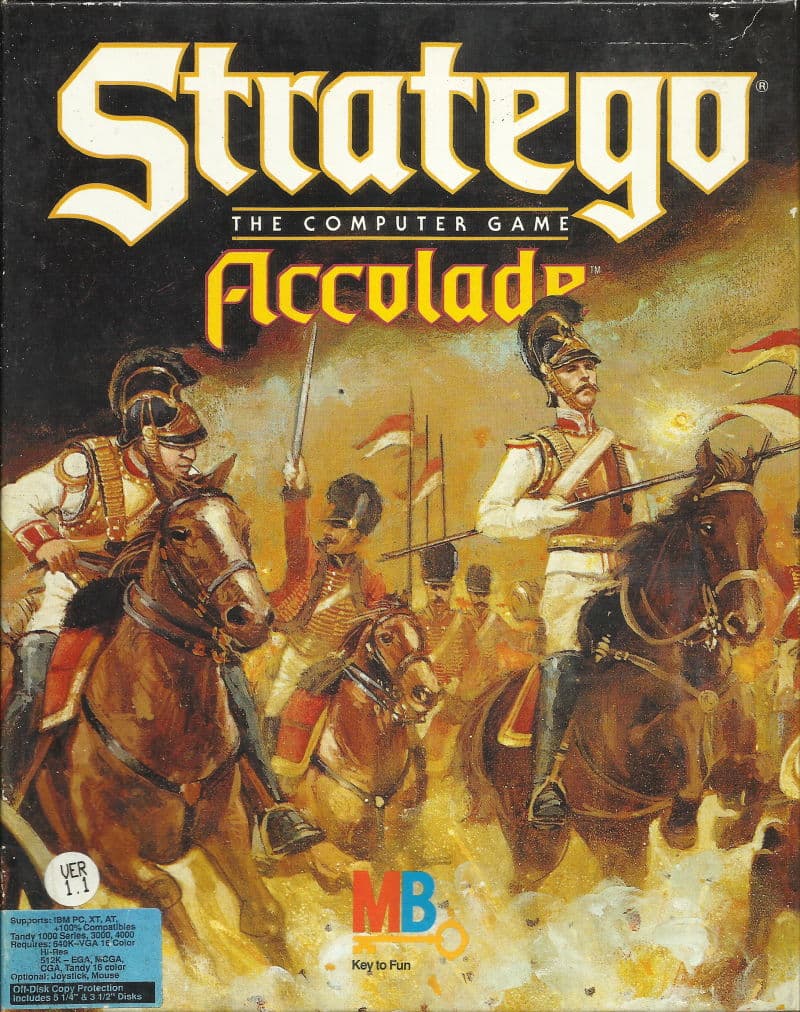
Accolade brought Stratego to MS-DOS in 1990, turning Milton Bradley's plastic battlefield into a tense game of hidden ranks against an unexpectedly stubborn computer opponent.
Setting up your army and reading the AI
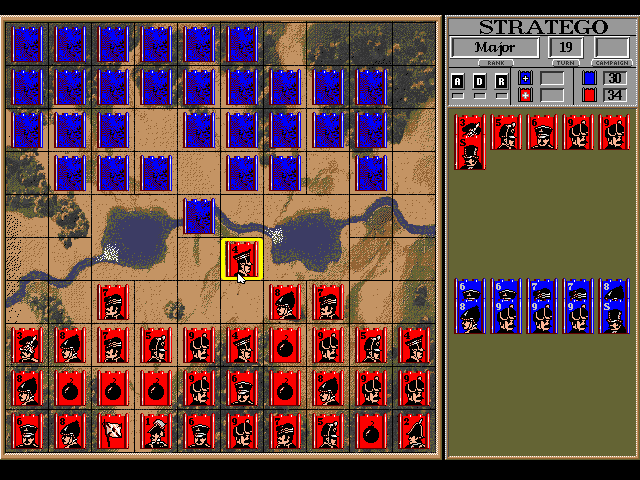
If you grew up setting up plastic pieces on a red grid, the opening moments of this digital adaptation feel immediately familiar, if a little eerie. You sit at a 10x10 board divided by two lakes in the middle, staring at forty blue blocks whose identities are completely hidden from you. You have a single Flag to hide, five immobile Bombs to act as landmines, and thirty-four officers ranging from disposable Scouts up to your single, irreplaceable Marshal. The core tension is identical to the physical board game: every move forward is an act of blind bravery or calculated baiting.
The decision loop in the early turns hinges entirely on piece movement. Scouts can charge across multiple clear squares, making them ideal for probing enemy lines, while every other unit creeps forward one tile at a time. When your Lieutenant bumps into an unknown enemy piece, combat resolves instantly by comparing numbers. The lower rank vanishes from the grid. If you hit a Bomb, your unit dies unless you brought a Miner. If your top-ranked Marshal wanders into the enemy Spy on an attack initiated by that Spy, your main heavy hitter disappears in a single turn.
Because the computer cannot physically cheat by looking over your shoulder, designer Ken McLeod and the programming team at MindSpan Technologies had to write an AI capable of memory and bluffing. On higher difficulty settings, from Sergeant up to Field Marshal, the computer tracks which of your pieces have moved and which have stayed static. An unmoved piece sitting behind a row of units is almost certainly a Bomb or the Flag itself. The AI will occasionally march a low-ranked Captain right up to your defensive line to force you to reveal a General, then pull back to isolate your high-value target.
Rule variations and those controversial Stratego presets
Manually placing forty individual pieces before every single match gets exhausting after a few rounds. To fix this, producer Pam Levins and the development team included thirteen preset army setups right out of the box, including famous layouts like Cyclone Defense and Tempest Defense. These pre-packaged formations caused a genuine stir among physical board game purists at the time, who debated whether placing your Flag in a forward corner behind a wall of Bombs was tactical genius or suicidal folly.
Beyond standard matches, this release packs several modified rule sets that change how you approach the board. The Rescue option lets you recover fallen pieces if you manage to invade the opponent's back row, while Aggressor Advantage breaks tie attacks in favor of the attacker rather than destroying both units. Silent Defense hides the exact identity of defending pieces even after an attack, forcing you to keep track of remaining enemy units purely through deduction.
The included campaign mode ties these variants together across sequential matches, but the fundamental flow remains rooted in classic tactical geometry. If you enjoy this era of digital adaptations, you can browse other strategy tactics titles from the early nineties to see how developers tackled tabletop logic on home computers.
Minimalist graphics and sound left room for real strategy
When the game hit store shelves, magazine critics were quick to point out that it did not push PC hardware very hard. In Computer Gaming World, reviewer Alan Emrich praised the computer opponent's sharp play and flexible rule additions, but dryly noted that the presentation lacked graphic panache and that the last thing anyone needed to play this game was sound card support. He was not wrong: sound effects are virtually nonexistent outside of simple battle beeps and short tunes at the start and end of a round.
The visual presentation, drawn by artists Darren Schebek and Beckett Gladney alongside programmer Dave Kirsch, prioritizes clarity over flair. Pieces are simple geometric blocks stamped with rank icons, laid out against three alternate board color schemes. While it lacks the animated battle cutscenes seen in titles like Battle Chess, the clean interface means you never misread a square or make an accidental move. To pass the startup check, players had to flip through the manual written by Larry Hall to enter copy protection passcodes like victory.
Published by Accolade, Inc. during a busy year for PC software, this conversion was later ported to systems like the Amiga and Atari ST, but the MS-DOS release remains the benchmark for its clean, speedy performance. You can read more about other software from 1990 in our archive.
The missing multiplayer and where to play Stratego online today
The single largest criticism leveled against this adaptation both in 1990 and among retro fans today is the absolute lack of a two-player option. The game is purely a solo venture against the PC. Once you spend a dozen hours learning the computer's specific habits, you will notice patterns in how it places its Miners and protects its back rows. Against a human opponent, psychological bluffs and fake retreats create endless mind games, whereas the AI eventually feels predictable once its routines become clear.
Despite that single-player limit, the game holds up as a brisk, surprisingly tough brainteaser. The speed of digital play solves the tedious physical reset times of the physical board, allowing you to test risky aggressive openings in a fraction of the time. If you want to sample this classic software without hunting down floppy disks or digging up copy protection manuals, you can play Stratego online right in your web browser.
You can run this full release of the classic 1990 Stratego MS-DOS game directly in your browser with no installation needed. It loads fast, keeps the computer opponent sharp, and lets you experience Stratego free in your browser right away. Test out the Cyclone Defense setup on your first round and see if you can lure the computer's Marshal straight into your Spy.
Players' controls
Touch and gamepad controls
The on-screen keyboard and gamepad mapping the browser player uses on a phone, a tablet or a controller, as opposed to the real keys above. $PRO members make their own in the player and share them here; anyone can pick one to play with.
Make your own touch controlsPRO
- 1Open the editorSign in below, then pick what to make. The game starts with the editor open over it.
- 2Place your keysAdd keys and drag them where your thumbs rest, or map a controller's buttons. Test plays the game with them; Save keeps them, and you play with them from then on.
- 3Share themShare them right after saving in the game, or name and share them here. Players vote, and the best become this game's controls for everyone.
Go PROSee how it worksSign in+20 XP for sharing · +50 XP if yours become the game's own
- The game's own controlsNone yet: played with a real keyboard only.In use
2 screenshots
From the archive
No reviews yet
Tell the community what you think of Stratego. Reviews are public and tied to your username.
No archived manuals for Stratego yet
No manuals archived for this title yet. Sign in to upload the first scan.
Cheat codes, console commands and memory pokes for Stratego — each one verified and attributed.
Sign in to submitNo cheats yet for this title
Know a working cheat, poke or trainer? Add it with the button above. Moderators check every entry before it goes live.
No archived soundtrack for Stratego yet
No soundtrack archived for this title yet. Sign in to upload the first rip.
No save states for Stratego yet
No save states for this title yet. Sign in to share one.
Discussions
Sign in to post- Threads0
- Total posts0
- Online now6
Community · Stratego
Who's contributing, and what's new
- Reviews0
- Threads0
- Uploadsapproved0
- Contributors0
Recent activity