
Before official arcade ports reached PC hardware, a single Korean developer built his own version of Street Fighter II: The World Warrior by recording Super Famicom gameplay onto a TV capture card and tearing down the animation frame by frame.
Booting up an unofficial fighting game on MS-DOS usually meant braced expectations. In 1993, PC owners were starved for decent arcade fighting ports, and homebrew attempts generally ran like slideshows with unresponsive keyboard input. Korean programmer Jeong Yeongdeog solved the timing problem through sheer brute force. Working alongside the Game Association of Hitel, he captured footage from the Super Famicom release onto a TV capture card, pulling pixel graphics and tracking character frame data one clip at a time to replicate Capcom's combat flow.
The result is a game that plays far better than it has any right to. Fireball motions register clean quarter-circles, dragon punches break through jump-ins reliably, and normal attacks cancel into specials with legitimate rhythm. The engine even incorporates mid-air special moves, echoing the chaotic illegal arcade hacks floating around street arcades at the time. While the animation runs visibly choppy due to omitted intermediate frames, the input response itself stays snappy compared to rival MS-DOS fighters.
Jeong later documented this entire reverse-engineering process in a Korean book titled Game Development with the Creator of SF-2. His custom engine proved so robust that third-party scene programmers eventually hijacked it to build bootleg crossovers, including the obscure PC hack Street Count 2+.
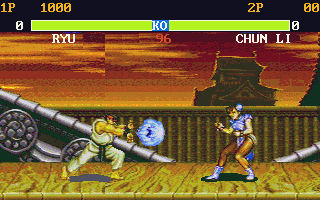
While the mechanical core holds together under pressure, the overall package carries all the rough edges of a bedroom passion project. You pick from the eight main World Warriors, Ryu, Ken, Chun-Li, Guile, Blanka, E. Honda, Zangief, and Dhalsim, but the boss quarter is completely absent as opponents. The boss arenas appear as standard battlegrounds, yet Vega, Balrog, Sagat, and M. Bison never walk out to fight. Depending on which revision of the executable you load, picking Dhalsim simply drops Ken onto the stage instead.
Mirror matches reveal another strange quirk. When two players pick the same character, the game struggles with palette swapping, leaving Player 2 with deeply glitched, ghostly color schemes. The match options menu lets you push boundaries far beyond Capcom standards:
Sound presentation remains hit or miss depending on your setup. The background music relies on rearranged MIDI tracks that play fine over standard synthesizer options, but digitized impact sounds frequently fail to trigger or produce static pops because of corrupted VOC audio files embedded in the original game archive.
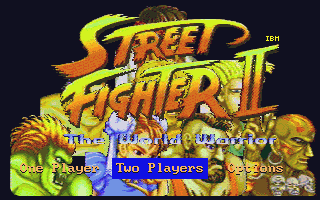
Judged purely as an standard arcade translation, this edition of Street Fighter II: The World Warrior has obvious structural gaps. The missing bosses reduce the single-player arcade ladder to a short loop, and taking a screenshot inside DOSBox instantly crashes the entire application to the desktop. Yet as a piece of pure coding determination from a Jeong Yeongdeog release, it outpaces official commercial fighting games on PC from 1993 in pure control feel.
The priority system honors real matchup logic. Guile can lock down screen space with high-speed Sonic Booms, Chun-Li controls horizontal space with extended kicks, and Zangief punishes lazy sweeps with crushing throw range. It operates as a genuine competitive action game rather than a primitive novelty, provided you can look past the dropped animation frames and broken sound files.
If you want to feel how a single developer solved fighter responsiveness on early PC hardware, you can play Street Fighter II: The World Warrior online right now. The emulation runs directly in your browser with zero installation steps required. Jump into the option screens first to mess with the 99-round setting, lock in Ryu or Guile for the tightest move inputs, and experience one of the most famous fan projects in DOS history.
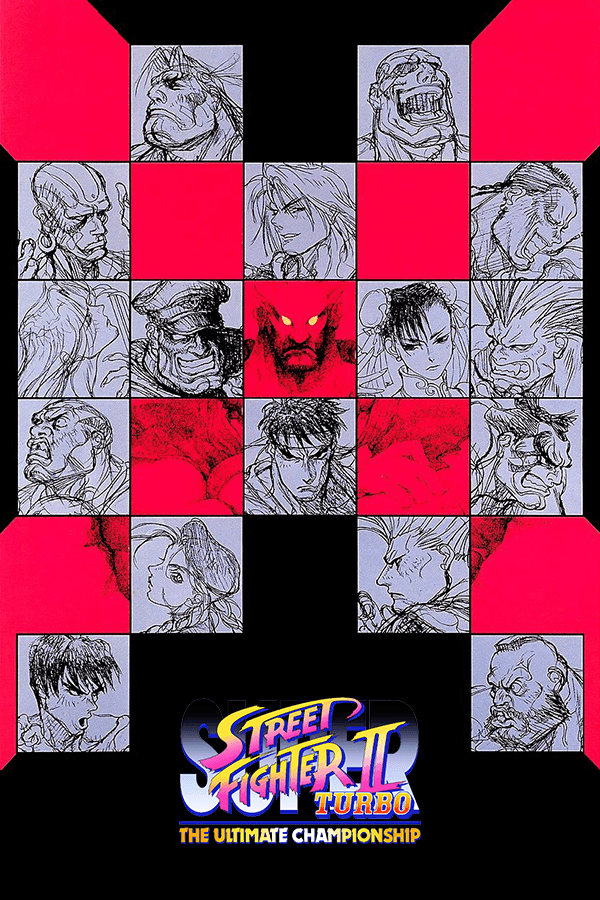
Before official arcade ports reached PC hardware, a single Korean developer built his own version of Street Fighter II: The World Warrior by recording Super Famicom gameplay onto a TV capture card and tearing down the animation frame by frame.
Booting up an unofficial fighting game on MS-DOS usually meant braced expectations. In 1993, PC owners were starved for decent arcade fighting ports, and homebrew attempts generally ran like slideshows with unresponsive keyboard input. Korean programmer Jeong Yeongdeog solved the timing problem through sheer brute force. Working alongside the Game Association of Hitel, he captured footage from the Super Famicom release onto a TV capture card, pulling pixel graphics and tracking character frame data one clip at a time to replicate Capcom's combat flow.
The result is a game that plays far better than it has any right to. Fireball motions register clean quarter-circles, dragon punches break through jump-ins reliably, and normal attacks cancel into specials with legitimate rhythm. The engine even incorporates mid-air special moves, echoing the chaotic illegal arcade hacks floating around street arcades at the time. While the animation runs visibly choppy due to omitted intermediate frames, the input response itself stays snappy compared to rival MS-DOS fighters.
Jeong later documented this entire reverse-engineering process in a Korean book titled Game Development with the Creator of SF-2. His custom engine proved so robust that third-party scene programmers eventually hijacked it to build bootleg crossovers, including the obscure PC hack Street Count 2+.
While the mechanical core holds together under pressure, the overall package carries all the rough edges of a bedroom passion project. You pick from the eight main World Warriors, Ryu, Ken, Chun-Li, Guile, Blanka, E. Honda, Zangief, and Dhalsim, but the boss quarter is completely absent as opponents. The boss arenas appear as standard battlegrounds, yet Vega, Balrog, Sagat, and M. Bison never walk out to fight. Depending on which revision of the executable you load, picking Dhalsim simply drops Ken onto the stage instead.
Mirror matches reveal another strange quirk. When two players pick the same character, the game struggles with palette swapping, leaving Player 2 with deeply glitched, ghostly color schemes. The match options menu lets you push boundaries far beyond Capcom standards:
Sound presentation remains hit or miss depending on your setup. The background music relies on rearranged MIDI tracks that play fine over standard synthesizer options, but digitized impact sounds frequently fail to trigger or produce static pops because of corrupted VOC audio files embedded in the original game archive.
Judged purely as an standard arcade translation, this edition of Street Fighter II: The World Warrior has obvious structural gaps. The missing bosses reduce the single-player arcade ladder to a short loop, and taking a screenshot inside DOSBox instantly crashes the entire application to the desktop. Yet as a piece of pure coding determination from a Jeong Yeongdeog release, it outpaces official commercial fighting games on PC from 1993 in pure control feel.
The priority system honors real matchup logic. Guile can lock down screen space with high-speed Sonic Booms, Chun-Li controls horizontal space with extended kicks, and Zangief punishes lazy sweeps with crushing throw range. It operates as a genuine competitive action game rather than a primitive novelty, provided you can look past the dropped animation frames and broken sound files.
If you want to feel how a single developer solved fighter responsiveness on early PC hardware, you can play Street Fighter II: The World Warrior online right now. The emulation runs directly in your browser with zero installation steps required. Jump into the option screens first to mess with the 99-round setting, lock in Ryu or Guile for the tightest move inputs, and experience one of the most famous fan projects in DOS history.
How Street Fighter II: The World Warrior is played — the keys the game listens to, grouped by what they do.
Highlighted keys are mapped — hover or tap one to see what it does.
Controls can be custom remapped using sf2setup.exe.
The on-screen keyboard and gamepad mapping the browser player uses on a phone, a tablet or a controller, as opposed to the real keys above. $PRO members make their own in the player and share them here; anyone can pick one to play with.
Cheat codes, console commands and memory pokes for Street Fighter II: The World Warrior — each one verified and attributed.
Sign in to submitHow Street Fighter II: The World Warrior is played — the keys the game listens to, grouped by what they do.
Highlighted keys are mapped — hover or tap one to see what it does.
Controls can be custom remapped using sf2setup.exe.
The on-screen keyboard and gamepad mapping the browser player uses on a phone, a tablet or a controller, as opposed to the real keys above. $PRO members make their own in the player and share them here; anyone can pick one to play with.
Cheat codes, console commands and memory pokes for Street Fighter II: The World Warrior — each one verified and attributed.
Sign in to submit
