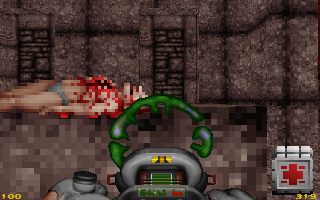

Strife took the fast, bloody technology of early first-person shooters and turned it into a real, conversational role-playing world.
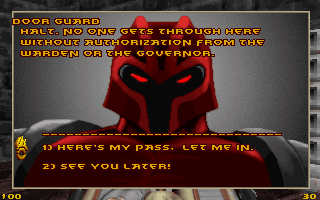
Most shooters in 1996 dropped you in a corridor with a gun and told you to clear the room. Strife hands you a crossbow, points you toward a central town hub called Tarnhill, and asks you to start talking to the locals. You play as an unnamed mercenary who stumbles into a rebellion against the Order, an oppressive religious hierarchy ruling over a ruined planet. Instead of rushing from red keycard to blue keycard, you walk through neutral areas, visit taverns for gossip, and spend gold at shops to stock up on supplies or permanent health upgrades.
The tech under the hood was id Software's engine, but Rogue Entertainment stripped out the linear mission structure. You move back and forth between castle walls, techno-factories, and dirty town streets as you take on assignments for the local resistance. The sound set hits the right balance on a Sound Blaster card, pairing punchy industrial gunfire with distinct full voice acting for every major conversation. It felt vast and open, even if you were ultimately navigating tight engine walls.
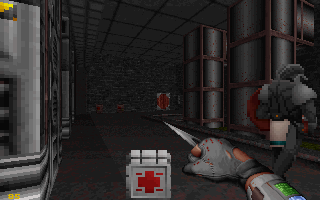
The biggest shift in this hybrid setup is that violence is not always your best first move. The town centers are non-hostile until you draw a weapon or pick the wrong dialogue option. If you talk out of turn to an important figure or accidentally fire a shot in front of a guard, the entire sector lights up. Waves of Templars and Acolytes in heavy power armor will flood the room, usually turning your mercenary into paint before you can find the door.
That design choice made the game famously unforgiving. The dialogue trees are basic by modern standards, but selecting a bad response can instantly trap your character or fail a key storyline objective. Players learned the hard way that strict save management was mandatory. If you killed a critical non-player character because they annoyed you, the plot simply hit a wall, forcing you to reload a manual save from an hour prior.
Navigation could be just as ruthless. Missions often came with sparse directions, telling you to seek out a contact in another district without dropping a marker on your display. You had to pay attention to dialogue text, solve inventory puzzles to drop force fields, and keep track of your own steps through interconnected zones.
The weapon design shows off the team's weird balance of low-tech hardware and high-tech alien gear. You start with basic electric crossbows and assault rifles, but the real hunt revolves around assembling pieces of the Sigil, an alien artifact weapon that drains your health as it annihilates target rooms. The design team, led by Jim Molinets and level designer Tim Willits, pushed the old 2D engine as far as it could go. They even added typing tricks during gameplay, like typing donnytrump to stack cash or lego to instantly grab Sigil pieces.
Yet launching an engine built on 2D sprites in mid-1996 was a brutal business decision by publisher Velocity Inc.. Arriving the exact same year as Duke Nukem 3D and Quake meant that buyers looking for raw graphics tech ignored it. Contemporary write-ups in PC Games noted that despite some rough edges, the game was a clear structural step forward from standard shooters. Online Gaming Review praised the deep storytelling structure, but audiences were chasing real 3D polygons, leaving this ambitious MS-DOS game overlooked on store shelves.

What makes this title worth your time today is how modern its structure feels despite the age of its engine. While early 3D shooters of the same month were focused purely on movement speed and deathmatch arenas, Rogue Entertainment built an interactive hub world with choices that actually change how the story resolves across three separate endings. The source code was lost years later when the studio sold off its server hardware, making preserved releases the primary way to appreciate what they accomplished.
You can play Strife online directly in your web browser with zero hassle. There are no files to unzip and no old system settings to fix before you jump into Tarnhill. Modern players usually expect auto-saves and visible map markers, so remember to manually save your game before talking to key characters. Pick up your crossbow, keep your head down around the town guards, and see how deep this forgotten classic really goes.
Strife took the fast, bloody technology of early first-person shooters and turned it into a real, conversational role-playing world.
Most shooters in 1996 dropped you in a corridor with a gun and told you to clear the room. Strife hands you a crossbow, points you toward a central town hub called Tarnhill, and asks you to start talking to the locals. You play as an unnamed mercenary who stumbles into a rebellion against the Order, an oppressive religious hierarchy ruling over a ruined planet. Instead of rushing from red keycard to blue keycard, you walk through neutral areas, visit taverns for gossip, and spend gold at shops to stock up on supplies or permanent health upgrades.
The tech under the hood was id Software's engine, but Rogue Entertainment stripped out the linear mission structure. You move back and forth between castle walls, techno-factories, and dirty town streets as you take on assignments for the local resistance. The sound set hits the right balance on a Sound Blaster card, pairing punchy industrial gunfire with distinct full voice acting for every major conversation. It felt vast and open, even if you were ultimately navigating tight engine walls.

The biggest shift in this hybrid setup is that violence is not always your best first move. The town centers are non-hostile until you draw a weapon or pick the wrong dialogue option. If you talk out of turn to an important figure or accidentally fire a shot in front of a guard, the entire sector lights up. Waves of Templars and Acolytes in heavy power armor will flood the room, usually turning your mercenary into paint before you can find the door.
That design choice made the game famously unforgiving. The dialogue trees are basic by modern standards, but selecting a bad response can instantly trap your character or fail a key storyline objective. Players learned the hard way that strict save management was mandatory. If you killed a critical non-player character because they annoyed you, the plot simply hit a wall, forcing you to reload a manual save from an hour prior.
Navigation could be just as ruthless. Missions often came with sparse directions, telling you to seek out a contact in another district without dropping a marker on your display. You had to pay attention to dialogue text, solve inventory puzzles to drop force fields, and keep track of your own steps through interconnected zones.

The weapon design shows off the team's weird balance of low-tech hardware and high-tech alien gear. You start with basic electric crossbows and assault rifles, but the real hunt revolves around assembling pieces of the Sigil, an alien artifact weapon that drains your health as it annihilates target rooms. The design team, led by Jim Molinets and level designer Tim Willits, pushed the old 2D engine as far as it could go. They even added typing tricks during gameplay, like typing donnytrump to stack cash or lego to instantly grab Sigil pieces.
Yet launching an engine built on 2D sprites in mid-1996 was a brutal business decision by publisher Velocity Inc.. Arriving the exact same year as Duke Nukem 3D and Quake meant that buyers looking for raw graphics tech ignored it. Contemporary write-ups in PC Games noted that despite some rough edges, the game was a clear structural step forward from standard shooters. Online Gaming Review praised the deep storytelling structure, but audiences were chasing real 3D polygons, leaving this ambitious MS-DOS game overlooked on store shelves.

What makes this title worth your time today is how modern its structure feels despite the age of its engine. While early 3D shooters of the same month were focused purely on movement speed and deathmatch arenas, Rogue Entertainment built an interactive hub world with choices that actually change how the story resolves across three separate endings. The source code was lost years later when the studio sold off its server hardware, making preserved releases the primary way to appreciate what they accomplished.
You can play Strife online directly in your web browser with zero hassle. There are no files to unzip and no old system settings to fix before you jump into Tarnhill. Modern players usually expect auto-saves and visible map markers, so remember to manually save your game before talking to key characters. Pick up your crossbow, keep your head down around the town guards, and see how deep this forgotten classic really goes.
How Strife is played — the keys the game listens to, grouped by what they do.
Highlighted keys are mapped — hover or tap one to see what it does.
Set up for modern play: W A S D move, the mouse turns (this engine has no mouse look, so moving the mouse forward walks), left click fires. The arrow keys still turn. Ctrl and Alt are left free because the browser uses them (Ctrl + W closes the tab).
The on-screen keyboard and gamepad mapping the browser player uses on a phone, a tablet or a controller, as opposed to the real keys above. $PRO members make their own in the player and share them here; anyone can pick one to play with.
Cheat codes, console commands and memory pokes for Strife — each one verified and attributed.
Sign in to submitaka Strife: Quest for the Sigil · Strife: Trust No One
How Strife is played — the keys the game listens to, grouped by what they do.
Highlighted keys are mapped — hover or tap one to see what it does.
Set up for modern play: W A S D move, the mouse turns (this engine has no mouse look, so moving the mouse forward walks), left click fires. The arrow keys still turn. Ctrl and Alt are left free because the browser uses them (Ctrl + W closes the tab).
The on-screen keyboard and gamepad mapping the browser player uses on a phone, a tablet or a controller, as opposed to the real keys above. $PRO members make their own in the player and share them here; anyone can pick one to play with.
Cheat codes, console commands and memory pokes for Strife — each one verified and attributed.
Sign in to submit