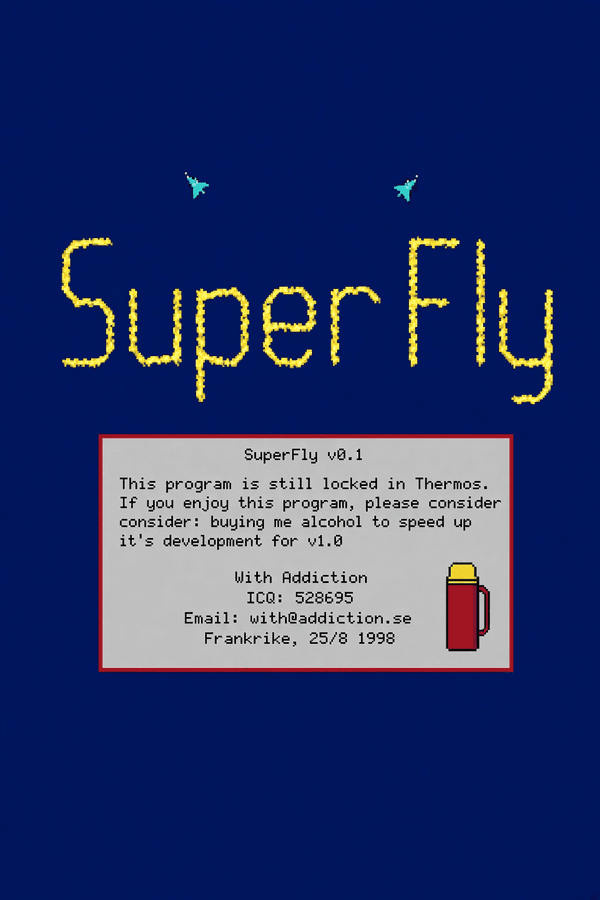
Superfly
aka Super Fly
Rate this game
- Played
- Rarely
In Superfly, your mouse cursor is a fly swatter trapped in a room where every successful kill leaves an impenetrable carcass right where the insect dropped.
The absolute panic of trapped movement in Superfly
You start a round of Superfly with a clean EGA playing field, a mouse under your hand, and a handful of target flies buzzing around the screen. The mechanic is brutally direct: moving your swatter next to a fly instantly crushes it. The catch hits a second later. The dead fly does not vanish; it turns into a permanent, solid block that neither you nor the remaining living flies can cross.
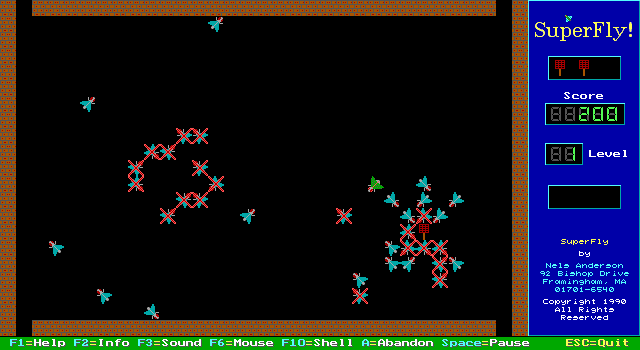
Within thirty seconds, a simple hunt transforms into a claustrophobic puzzle game where your own aggressive clicks build the maze that eventually suffocates you. The preset walls scattered across each stage already limit your movement, but the corpses you leave behind are what turn the map into a minefield. If living bugs or your own trail of dead bodies box your swatter into a corner where no valid moves remain, you lose a life on the spot.
Developer Nels Anderson, working under his sole-developer label Arcanum Computing, built this tension out of an old terminal game he had seen running on mainframe hardware, where flies were simple text asterisks. By porting that concept to the 1990 PC shareware scene, he turned a basic high-score exercise into a sharp test of spatial planning under extreme speed pressure.
Power-ups, the SuperFly boss, and the speed wall
Clear enough of the standard insects and the game spawns the title enemy, a massive boss target that you have to track down to finish the stage. Because the playing field is already choked with static remains by the time it appears, reaching the boss requires careful pathing rather than wild swiping. Power-up bonuses occasionally show up to change your tool, giving you a temporary spray can that dissolves corpses instead of leaving them behind, offering a brief moment to clear out choked choke points.
The escalation curve in this action title catches up with you fast. Early levels give you plenty of room to recover from a bad strike, but the game speed quickens dramatically as you progress through rounds. The controls respond instantly to raw mouse input, but when the movement speed maxes out, a single miscalculated swipe means sealing your own escape route right before the main target zips away.
- Clear initial flies: Target isolated bugs along the perimeter to keep the center of the board clear for as long as possible.
- Collect the spray bonus: Grab the fly spray power-up immediately when it spawns to erase dense clusters of dead flies.
- Hunt the boss: Corner and swat the large boss fly the moment it enters the grid to end the round before room runs out.
High original ideas, quiet shareware sales
Nels Anderson wrote the game in Borland Turbo Pascal using the Borland Graphics Interface, squeezing the binary through LZEXE compression so it could travel light across 1990s Bulletin Board Systems. Arcanum Computing distributed the basic version for free on BBS networks while offering the full registered edition directly on floppy disk for $15. Despite that wide reach, Anderson later noted in an interview that while the game contained perhaps his most original mechanics, it was commercially his least successful project.
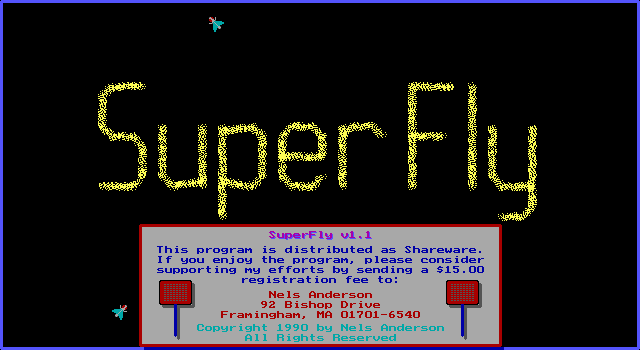
Industry timing had a lot to do with that quiet reception. PC gamers in the early nineties were hungry for detailed VGA visuals, while this title relied on modest 640x350 16-color EGA graphics with basic PC speaker bleeps. Ironically, Nintendo published a nearly identical minigame called Gnat Attack inside Mario Paint on the Super Nintendo two years later, earning widespread praise for a concept Anderson had already refined on MS-DOS.
Where the mechanics wear thin today
The minimal visual presentation is the first thing modern players notice, and it remains the game's clearest weakness. Beyond the bright blue background and simple geometric sprites, there is very little visual flourish to draw you in. It looks like a high-end utility or an educational tool from the era rather than an arcade challenge, which caused many PC players to pass it over for flashier titles on shareware disks.
The difficulty curve can also feel unfair when the random placement of bonus items works against you. If the game drops a spray bonus inside a section of the board you have already blocked off with corpses, you are left to watch your available space shrink with zero chance of recovery. It is a game of fast skill, but its strict collision rules mean a single mistake five seconds into a round can guarantee a game over two minutes later.
How to play Superfly free in your browser
If you want to test your twitch reflexes against this forgotten piece of DOS history, you can play Superfly online directly in your browser. There are no disk images to mount and nothing to set up before you start swatting.
The frantic pace of this Superfly MS-DOS game translates surprisingly well to modern hardware, giving you an immediate look at how tight mouse movement and spatial control could turn simple asterisks and EGA lines into pure panic. Just keep your eye on your escape paths, because the dead bugs you leave behind are far more dangerous than the live ones.
How Superfly is played — the keys the game listens to, grouped by what they do.
- Movement
- Action
- Interface
- Move mouse — Move swatter
Highlighted keys are mapped — hover or tap one to see what it does.
Controls for swatter movement, pause, and abandon swatter can be remapped using F7 during gameplay.
Players' controls
Touch and gamepad controls
The on-screen keyboard and gamepad mapping the browser player uses on a phone, a tablet or a controller, as opposed to the real keys above. $PRO members make their own in the player and share them here; anyone can pick one to play with.
Make your own touch controlsPRO
- 1Open the editorSign in below, then pick what to make. The game starts with the editor open over it.
- 2Place your keysAdd keys and drag them where your thumbs rest, or map a controller's buttons. Test plays the game with them; Save keeps them, and you play with them from then on.
- 3Share themShare them right after saving in the game, or name and share them here. Players vote, and the best become this game's controls for everyone.
Go PROSee how it worksSign in+20 XP for sharing · +50 XP if yours become the game's own
- The game's own controlsKeyboardGamepadWhat every player starts with.In use
2 screenshots
From the archive
No reviews yet
Tell the community what you think of Superfly. Reviews are public and tied to your username.
No archived manuals for Superfly yet
No manuals archived for this title yet. Sign in to upload the first scan.
Cheat codes, console commands and memory pokes for Superfly — each one verified and attributed.
Sign in to submitNo cheats yet for this title
Know a working cheat, poke or trainer? Add it with the button above. Moderators check every entry before it goes live.
No archived soundtrack for Superfly yet
No soundtrack archived for this title yet. Sign in to upload the first rip.
No save states for Superfly yet
No save states for this title yet. Sign in to share one.
Discussions
Sign in to post- Threads0
- Total posts0
- Online now6
Community · Superfly
Who's contributing, and what's new
- Reviews0
- Threads0
- Uploadsapproved0
- Contributors0
Recent activity
Nothing here yet
Reviews, discussion threads and approved uploads appear here as members add them.