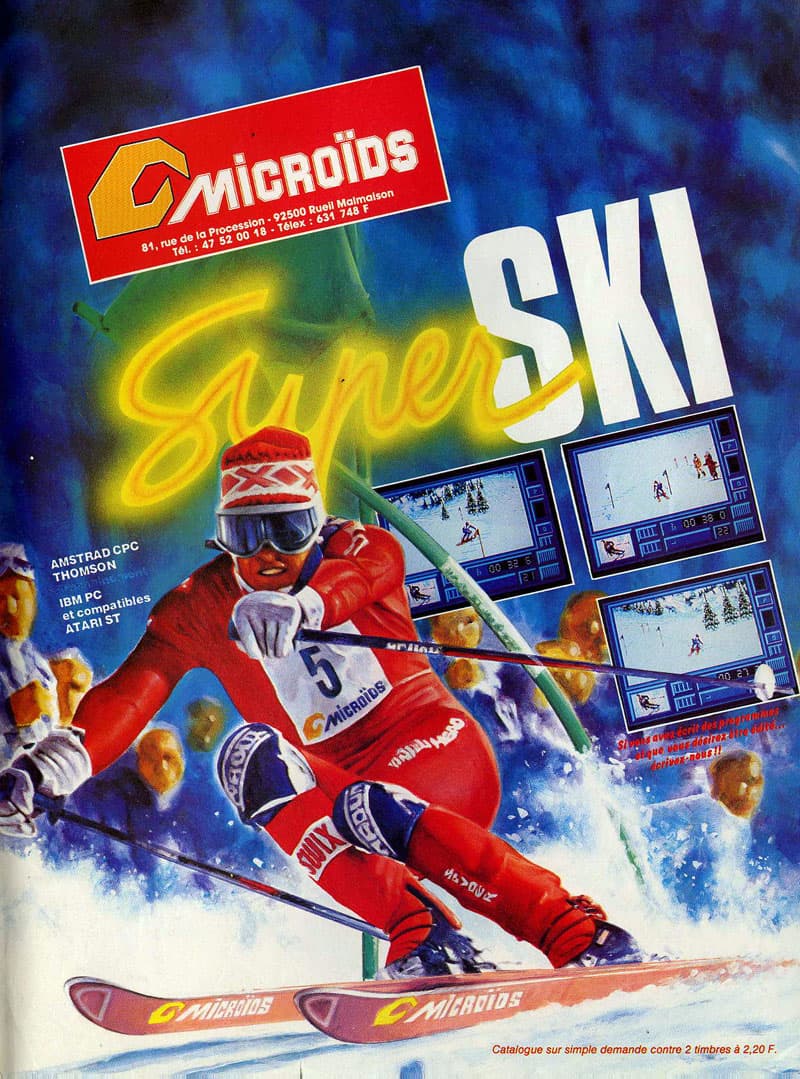
Microïds set a high standard for winter sports simulation in 1988 with SuperSki, delivering fast perspective-shifting downhill runs across four distinct cold-weather events.
Steering into the CGA slope
The moment you launch into your first slope in this sports title, the speed hits you immediately. French developer Microïds built the perspective behind the skier, drawing course markers and terrain features that scale toward you quickly. On a standard MS-DOS PC in 1988, achieving fluid frame rates meant relying heavily on four-color CGA display modes. Cyan, magenta, white, and black might sound harsh on paper, but the high-contrast palette makes snow surfaces and slalom gate posts crisp and readable at high speeds.
Controlling your skier requires tiny adjustments rather than wide key presses. If you lean too hard into a turn while carving down an icy gradient, your athlete tumbles off-screen, costing precious seconds. The sprite animations move smoothly, giving clear visual cues when your skier leans into a turn or prepares to land off a bump. Mastering the slope means learning how early to begin your arc before a turn marker passes your visual horizon.
Four events that test your timing
Rather than focusing solely on downhill speed, the game offers a full tournament spread across four separate disciplines. You can enter individual practice runs to get a feel for each course before committing to a competitive series.
- Downhill: Pure speed down long stretches of snow, where selecting high-speed lines and avoiding course boundaries dictates your final score.
- Slalom: Strict gate navigation requiring fast side-to-side weaves through narrow flag pairings.
- Giant Slalom: Wider gate spacing that allows higher top speeds than standard slalom, demanding wider carving arcs across alternate mountain routes.
- Ski Jump: A quick transition from downhill momentum to precise takeoff timing at the ramp edge to maximize distance and landing form.
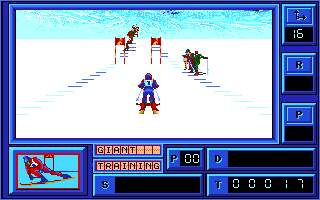
The choice of alternate paths on certain courses gives you genuine tactical decisions during a run. Taking a tight interior route might save half a second on the clock, but it tightens the angle on the next gate, increasing the risk of a wipeout. The slalom modes punish greed quickly; missing a single gate invalidates an otherwise clean run.
Local multiplayer and the Eddie Edwards license
Playing against computer record times works fine, but the design shines when you host up to five players taking turns at the same keyboard. Because every run relies on time trials rather than simultaneous racing, hot-seat tournament play creates tense back-and-forth competition as players trade leader positions after each discipline.
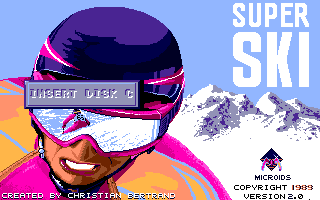
The game saw broad distribution across European and North American markets, leading to several regional identity changes. In the United States, Broderbund Software, Inc. published the title under the name Downhill Challenge. In the United Kingdom, it secured an official license tied to famous British Olympic ski jumper Eddie "The Eagle" Edwards, hitting shelves as Eddie Edwards Super Ski. French publisher Loriciel handled European release duties under the original title.
Where the simulation succeeds and where it stumbles
For an early PC sports sim, the motion physics work as they should, though some structural quirks show their age. SuperSki drops you straight onto the slope without persistent career progression, equipment upgrades, or deep stat tracking. You pick an event, choose your route, and try to beat the course record.
The ski jump event relies heavily on a single key press right at the ramp edge. Miss the window by a fraction of a second, and your skier collapses at the bottom of the hill. While this adds tension, it feels far more unforgiving than the smooth back-and-forth carving of the slalom levels. Despite that strictness, the overall package offers substantial variety across its four core modes.
How to play SuperSki online today
If you want to experience the origin of this series, you can play SuperSki free in your browser right here. There is nothing to install, so you can jump straight into the downhill course or test your skills on the giant slalom flags in seconds.