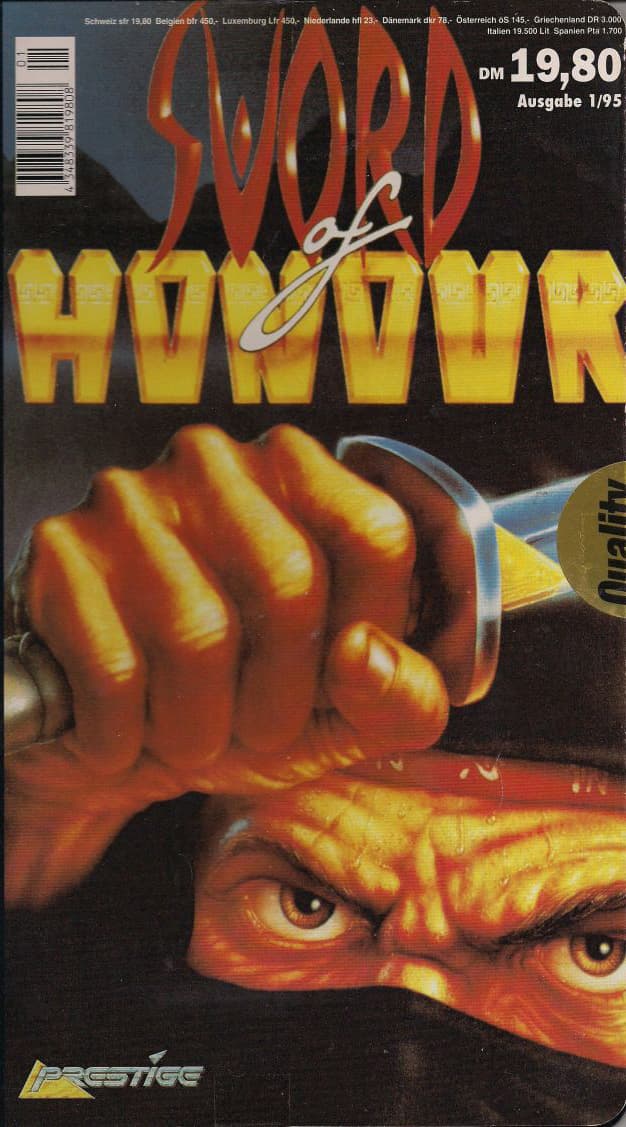
Sword of Honour throws you straight into the sandals of a noble ninja on a mission to retrieve Shogun Yuichiro's stolen blade from the villainous Lord Toranaga before ritual suicide becomes the shogun's only escape.
Ninjas, gear, and screen-by-screen survival
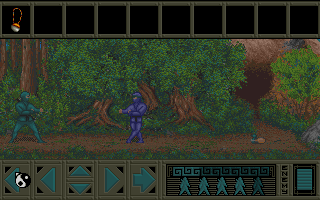
Developed by Dynafield Systems International after almost three years in production, this side-scrolling action game sets a dark, methodical tone right from your first steps out of the local village. You move from left to right across individual screens, managing martial arts combat, lethal floor hazards, and inventory management as you push toward Toranaga's fortress. Instead of the lightning-fast speed of arcade brawlers, progress requires careful positioning and early recognition of enemy attack patterns.
combat mixes bare-handed martial arts strikes with an impressive arsenal of authentic ninja tools. You carry standard weapons like the ninjatō blade, but survival often hinges on specialized gear like throwing shuriken, kunai, climbing tekagi-shuko claw gloves, and the weighted chain of the kusarigama. Facing an armored guard head-on with bare fists usually ends in quick failure, forcing you to pick the right weapon before stepping onto the next screen.
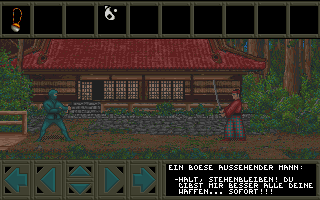
The screen layout split causes the game's most memorable friction. Keyboard controls handle walking, jumping, and picking up floor items, while two mouse buttons trigger your punches, kicks, and item interaction via a dashboard at the bottom of the monitor. Expecting a player to keep one hand on the cursor keys and the other on a mouse during a hectic duel was an ambitious design choice, but in practice, that lower mouse interface panel often feels sluggish when you need an immediate weapon swap.
Taking on Lord Toranaga alongside 1993's PC brawlers
Published by Prestige Softwareentwicklung GmbH as an MS-DOS game from 1993, the title tried to bridge two distinct genres. It wanted the direct combat mechanics of a traditional brawler alongside the narrative depth and key-hunting puzzles of an adventure game. Where contemporary action titles focused purely on fast reflexes and high scores, this journey asked you to converse with characters, search scenery, and gather items to solve structural bottlenecks.
Audio was another area where the PC release attempted to establish its own identity. Composer Thomas Detert provided the sound driver soundtrack for MS-DOS setups, delivering crisp chiptune melodies that punched well above standard PC speaker squeaks when paired with Sound Blaster hardware. The atmospheric music matches the slow tension of crawling through enemy territory, adding weight to every tense encounter with Toranaga's patrol guards.
That hybrid design split opinions sharply when gaming magazines reviewed the home computer releases. *CU Amiga* awarded it an 86% rating, praising its combination of action and deeper adventure elements, while *Amiga Power* handed down a brutal 23% score, writing that it "sets a low standard, and still fails to reach it." That massive divide came down to whether a player tolerated the clunky dual-input control setup in exchange for the detailed world and varied tactical tools.
Mastering weapon selection and avoiding fatal traps
Playing through the campaign demands patience because individual screens rarely give you room to recover from mistakes. Enemies do not drop endless health pickups, and a single missed jump over a hidden pit trap can wipe out hard-earned progress in a second. You quickly learn to scout every new area, holding back to see how guards patrol before committing to an attack.
Success relies heavily on memorizing which weapon counters specific enemy types. Here is how your inventory functions during combat and exploration:
- Ninjatō: Your primary sword for medium-range blade duels against standard guards.
- Kusarigama: A weighted chain weapon ideal for tripping up distant foes before they close in.
- Tekagi-Shuko: Hand claws that assist in reaching ledges while providing close-quarters slashing.
- Shuriken & Kunai: Consumable ranged weapons designed to pick off snipers before taking a step.
If you treat the game as a pure button-masher, you will likely bounce off the combat within ten minutes. The real loop is tactical: enter a screen, recognize the threat, open the bottom panel to equip the optimal tool, and execute clean hits without overextending. When that sequence works, sneaking through Toranaga's defenses feels genuinely rewarding.
Why this MS-DOS brawler deserves a second chance
The main flaw holding this title back is its control panel latency. Trying to manage mouse clicks for item dropping or interaction while holding keyboard directions for movement creates unnecessary physical clumsiness during fight scenes. Beneath that rough interface sits an ambitious action-adventure that rewards methodical players who enjoy careful planning over pure speed.
If you want to experience this peculiar piece of 1990s computer history, you can play Sword of Honour free in your browser right now. You can jump straight into Yuichiro's rescue mission, test out exotic weapons, and explore Toranaga's castle grounds with zero installation hurdles.
Players' controls
Touch and gamepad controls
The on-screen keyboard and gamepad mapping the browser player uses on a phone, a tablet or a controller, as opposed to the real keys above. $PRO members make their own in the player and share them here; anyone can pick one to play with.
Make your own touch controlsPRO
- 1Open the editorSign in below, then pick what to make. The game starts with the editor open over it.
- 2Place your keysAdd keys and drag them where your thumbs rest, or map a controller's buttons. Test plays the game with them; Save keeps them, and you play with them from then on.
- 3Share themShare them right after saving in the game, or name and share them here. Players vote, and the best become this game's controls for everyone.
Go PROSee how it worksSign in+20 XP for sharing · +50 XP if yours become the game's own
- The game's own controlsNone yet: played with a real keyboard only.In use
3 screenshots
From the archive
No gameplay video yet
No gameplay video for Sword of Honour yet. Sign in to add one.
No reviews yet
Tell the community what you think of Sword of Honour. Reviews are public and tied to your username.
No archived manuals for Sword of Honour yet
No manuals archived for this title yet. Sign in to upload the first scan.
Cheat codes, console commands and memory pokes for Sword of Honour — each one verified and attributed.
Sign in to submitNo cheats yet for this title
Know a working cheat, poke or trainer? Add it with the button above. Moderators check every entry before it goes live.
No archived soundtrack for Sword of Honour yet
No soundtrack archived for this title yet. Sign in to upload the first rip.
No save states for Sword of Honour yet
No save states for this title yet. Sign in to share one.
Discussions
Sign in to post- Threads0
- Total posts0
- Online now6
Community · Sword of Honour
Who's contributing, and what's new
- Reviews0
- Threads0
- Uploadsapproved0
- Contributors0
Recent activity