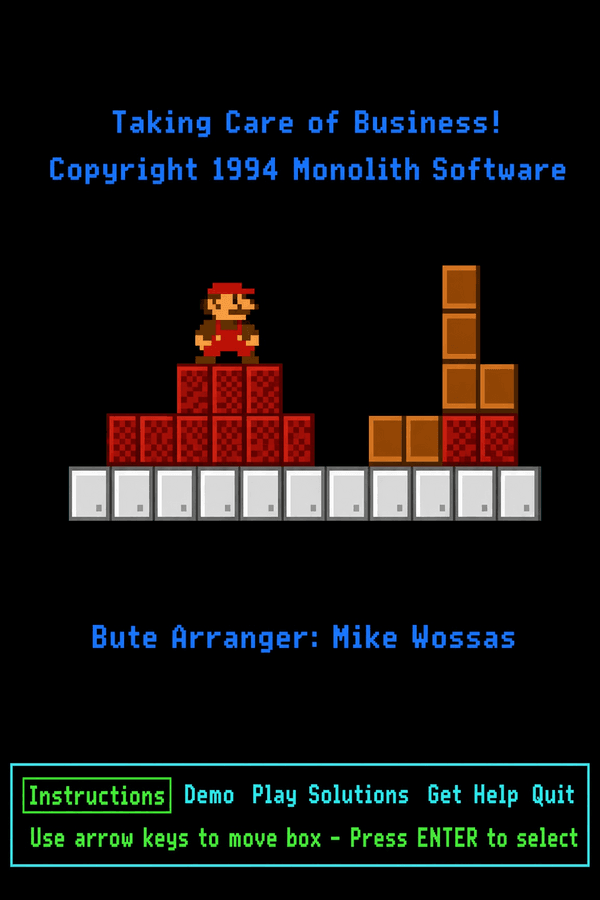
Taking Care of Business
aka Taking Care of Business!
If you drop a crate into a dead corner playing Taking Care of Business, your run is finished before you even reach the exit screen.
Sokoban mechanics meet side-view puzzles in Taking Care of Business
Most 1994 PC titles asked players to run fast and shoot faster. Solo developer Mike Voss took a different route with this title, placing grid-style spatial logic right into side-view platform movement. You play as Demolisher Dirk, a hard-hat worker navigating room after room filled with wooden boxes, high-voltage traps, and locked passages.
Instead of the typical 320x200 VGA presentation of the era, the game runs in a crisp 640x480 resolution mode. The high screen resolution gives every level a clean, clear layout where you can see every obstacle from the moment you enter a chamber. You do not have to clear rooms in a strict linear sequence either, since the game lets you pick puzzle chambers in any order you like.
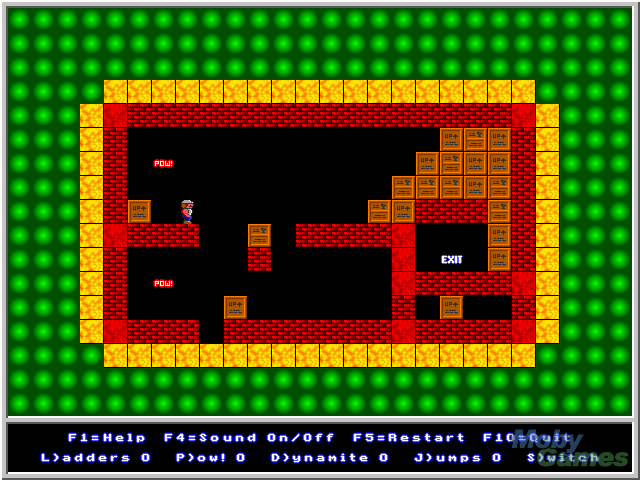
Stacking boxes, blasting walls, and dodging high voltage
The core loop revolves around moving heavy blocks to construct makeshift staircases. If you leave a crate jammed against a low wall without space to push it back, you cannot climb to the higher ledges. That spatial restriction creates a strict puzzle structure akin to Sokoban, only with gravity and jumping thrown into the equation.
Dirk brings real tools alongside his raw muscle to the job site. You collect gear and power-up pick-ups across the 15 shareware stages and 60 registered levels, including:
- Dynamite sticks to clear away stubborn floor sections and masonry blocks.
- Bashing tools that let you smash straight through specific wall obstructions.
- Super-jump labels that temporarily increase your vertical leap.
- One-time ladders for climbing up vertical shafts.
- Teleporters and switches that alter the surrounding room layout.
Hazard management keeps you from taking your time too casually. Electrical arcs snap across key corridors, forcing you to time your crate pushes around live currents. Floating blocks add another layer of mechanical trickery, acting as movable platforms over open space.
Why built-in solutions saved players from total frustration
The layout design in later levels leaves zero room for error. One miscalculated drop or poorly placed dynamite stick ruins the entire stage layout. Because you can trap yourself easily, planning your route several moves ahead is mandatory. There are no boss battles or surprise enemy spawns, so every failure sits entirely on your own planning.
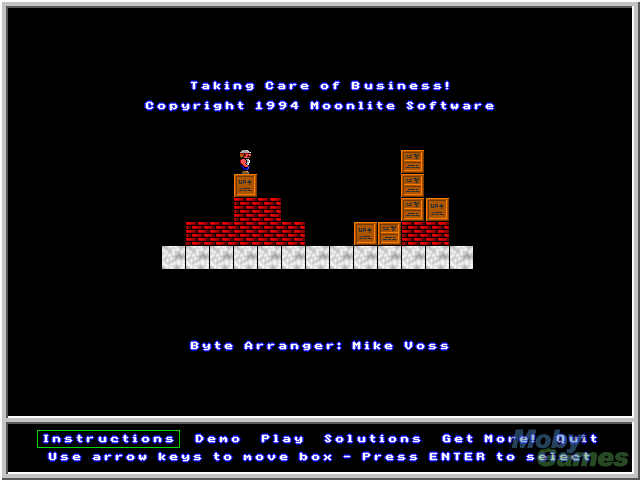
Recognizing how tricky the level design could get, Voss included full level walkthrough solutions directly inside the registered game menu. If a particular room completely stumped you, the built-in playback system demonstrated the exact sequence of moves needed to win. It was a thoughtful inclusion for an era when game guides were hard to come by.
Where this Moonlite Software release sits on the DOS shelf
Published directly by Moonlite Software, the game stood apart from the studio's standard action platformers. The sound design relies on straightforward PC audio cues, and the fixed flip-screen layout lacks the smooth scrolling found in pure action games of the day. Yet the crisp visual layout and deliberate pace give it a distinct flavor.
Voss eventually released the complete registered game as freeware in 2005. That gesture preserved a unique piece of shareware history, giving puzzle fans access to all 60 stages without hassle.
Play Taking Care of Business free in your browser right now
You can play Taking Care of Business online free in your browser right here. There is nothing to install, so you can jump straight into Dirk's block-stacking challenges without setting up a DOS environment. Give the first few levels a spin and see how many staircases you can build before accidentally boxing yourself into a corner.