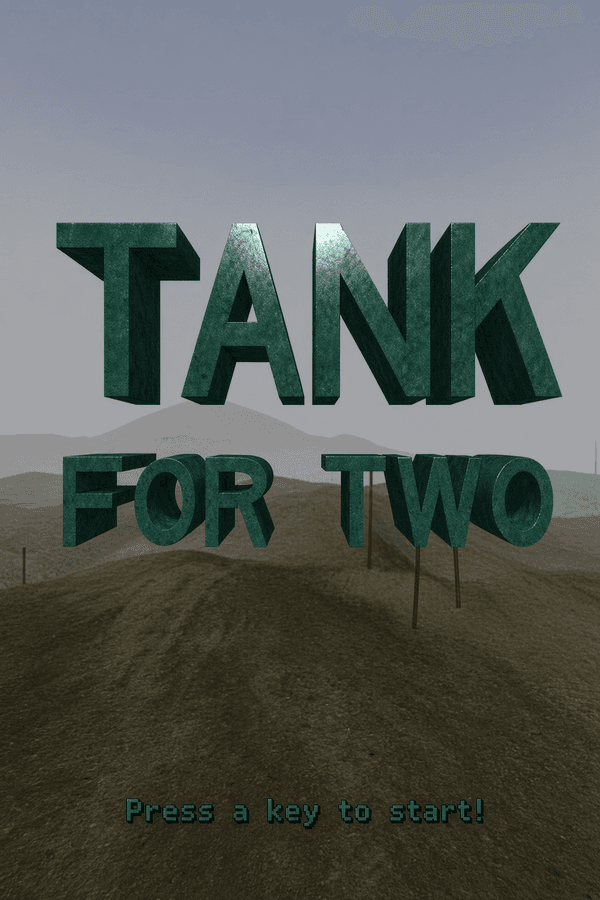
In Tank For Two, you sit at a single keyboard with a friend, lining up bank shots off concrete walls while trying very hard not to accidentally shell your own treads.
The core setup in Tank For Two is simple enough to pick up in ten seconds. You and a rival driver navigate top-down arenas, rotating your armor through eight directions to line up shots. Rather than disappearing into the edges of the screen, fired shells bounce off hard boundaries and obstacles before clearing out. That single mechanical choice turns every firefight into a frantic mental geometry puzzle where wall shots are just as lethal to the shooter as they are to the target.
Positioning means everything when your own ordnance comes flying back at your face. Because shells travel a fixed rebound distance, holding down the trigger without a clear angle usually ends in self-destruction. The pacing in this 1994 release is fast, snappy, and mean. If you park near a corner to trap your opponent, a single missed angle sends your round skimming off a barrier directly into your own hull.
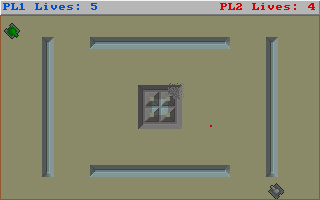
Levels are built out of solid walls and soft, destructible tiles. Blasting through destructible blocks lets you cut new paths through the layout, but it also strips away the cover you were relying on to block enemy fire. A player who aggressively clear-cuts the arena to hunt down their opponent often opens up a straight shot for a sniper waiting on the far side of the map.
The balance of power flips back and forth constantly over a match. One minute you are safely tucked behind a wall calculated to reflect incoming shots away; the next minute a stray round punches through a destructible block and exposes your flank to a direct hits. It keeps matches tight, especially when both players start down to their final life.
Developer Steven Atkinson included a standalone configuration program alongside the main binary. Before launching a match, players can load into this setup menu to tweak the map layouts, modify player starting lives, and dial the available ammunition count up or down. Setting ammo to low counts forces deliberate tactical play, while cranking lives high turns the game into a chaotic attrition battle.
That level of direct control was a massive plus for low-budget PC games of the era distributed through bulletin board systems. As an indie title released through Freeware channels, it provided endless replayability simply by letting users alter the baseline constraints. If a particular map design felt too tight or biased toward one side, you could just hop into the utility and redesign the grid yourself.
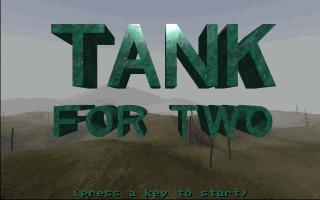
Visually, the game opts for stark clarity over heavy detail. The top-down view ensures both players have complete sight of the arena, which is necessary when calculating shell trajectories off distant surfaces. While it lacks the fancy scrolling or heavy sprite art of big-budget retail games from the same period, the high-contrast tiles make it easy to spot ricocheting rounds instantly.
The audio side keeps things equally functional, delivering sharp cues when bricks crumble or tanks explode. You do not need a beefy setup to enjoy it; it runs crisp and smooth without demanding fancy sound cards or high-end processors. The simplicity keeps the focus squarely on head-to-head competition.
The true test of any local multiplayer title is whether it causes arguments around a shared keyboard, and this one delivers plenty. The constant threat of bouncing shells means victories often come down to a lucky bounce or a desperate, last-second dodge into cover. It captures the pure friction of old-school couch competition perfectly.
You can play Tank For Two free in your browser right now with no setup required. Grab a friend, share the keyboard, and see who ends up driving into their own ricochet first.
In Tank For Two, you sit at a single keyboard with a friend, lining up bank shots off concrete walls while trying very hard not to accidentally shell your own treads.
The core setup in Tank For Two is simple enough to pick up in ten seconds. You and a rival driver navigate top-down arenas, rotating your armor through eight directions to line up shots. Rather than disappearing into the edges of the screen, fired shells bounce off hard boundaries and obstacles before clearing out. That single mechanical choice turns every firefight into a frantic mental geometry puzzle where wall shots are just as lethal to the shooter as they are to the target.
Positioning means everything when your own ordnance comes flying back at your face. Because shells travel a fixed rebound distance, holding down the trigger without a clear angle usually ends in self-destruction. The pacing in this 1994 release is fast, snappy, and mean. If you park near a corner to trap your opponent, a single missed angle sends your round skimming off a barrier directly into your own hull.
Levels are built out of solid walls and soft, destructible tiles. Blasting through destructible blocks lets you cut new paths through the layout, but it also strips away the cover you were relying on to block enemy fire. A player who aggressively clear-cuts the arena to hunt down their opponent often opens up a straight shot for a sniper waiting on the far side of the map.
The balance of power flips back and forth constantly over a match. One minute you are safely tucked behind a wall calculated to reflect incoming shots away; the next minute a stray round punches through a destructible block and exposes your flank to a direct hits. It keeps matches tight, especially when both players start down to their final life.
Developer Steven Atkinson included a standalone configuration program alongside the main binary. Before launching a match, players can load into this setup menu to tweak the map layouts, modify player starting lives, and dial the available ammunition count up or down. Setting ammo to low counts forces deliberate tactical play, while cranking lives high turns the game into a chaotic attrition battle.
That level of direct control was a massive plus for low-budget PC games of the era distributed through bulletin board systems. As an indie title released through Freeware channels, it provided endless replayability simply by letting users alter the baseline constraints. If a particular map design felt too tight or biased toward one side, you could just hop into the utility and redesign the grid yourself.
Visually, the game opts for stark clarity over heavy detail. The top-down view ensures both players have complete sight of the arena, which is necessary when calculating shell trajectories off distant surfaces. While it lacks the fancy scrolling or heavy sprite art of big-budget retail games from the same period, the high-contrast tiles make it easy to spot ricocheting rounds instantly.
The audio side keeps things equally functional, delivering sharp cues when bricks crumble or tanks explode. You do not need a beefy setup to enjoy it; it runs crisp and smooth without demanding fancy sound cards or high-end processors. The simplicity keeps the focus squarely on head-to-head competition.
The true test of any local multiplayer title is whether it causes arguments around a shared keyboard, and this one delivers plenty. The constant threat of bouncing shells means victories often come down to a lucky bounce or a desperate, last-second dodge into cover. It captures the pure friction of old-school couch competition perfectly.
You can play Tank For Two free in your browser right now with no setup required. Grab a friend, share the keyboard, and see who ends up driving into their own ricochet first.
How Tank For Two is played — the keys the game listens to, grouped by what they do.
Highlighted keys are mapped — hover or tap one to see what it does.
Controls documented are hardwired in this version. The mouse is used for the setup program and wall editor.
The on-screen keyboard and gamepad mapping the browser player uses on a phone, a tablet or a controller, as opposed to the real keys above. $PRO members make their own in the player and share them here; anyone can pick one to play with.
Cheat codes, console commands and memory pokes for Tank For Two — each one verified and attributed.
Sign in to submitHow Tank For Two is played — the keys the game listens to, grouped by what they do.
Highlighted keys are mapped — hover or tap one to see what it does.
Controls documented are hardwired in this version. The mouse is used for the setup program and wall editor.
The on-screen keyboard and gamepad mapping the browser player uses on a phone, a tablet or a controller, as opposed to the real keys above. $PRO members make their own in the player and share them here; anyone can pick one to play with.
Cheat codes, console commands and memory pokes for Tank For Two — each one verified and attributed.
Sign in to submit