Terminator 2: Judgment Day - Chess Wars takes the standard rules of chess and wraps them in early pre-rendered 3D animations, pitting John Connor and Sarah Connor against Skynet's legions of Hunter-Killers in a gritty futuristic wasteland.
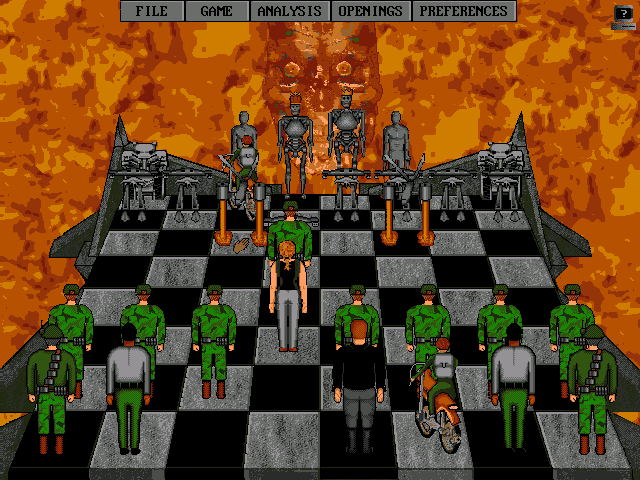
Launching Terminator 2: Judgment Day - Chess Wars drops you straight into a battle between the human Resistance and Skynet. Instead of classical wooden pieces, the board features pre-rendered 3D figures built on early Amiga rendering software. The Resistance side places John Connor as a bishop, Sarah Connor taking her position as Queen, and the T-800 standing in as King, supported by rank-and-file human soldiers as pawns. Across the board, Skynet fields chrome T-800 endoskeletons, floating Hunter-Killers, and liquid-metal T-1000 models.
The core issue reveals itself as soon as you try to plan your opening pawn structure. The view is locked strictly into an isometric angle fixed permanently behind the Resistance side. If you play as Skynet, you are forced to evaluate moves from behind enemy lines without any option to rotate the camera. Even worse, developer IntraCorp, Inc. completely omitted an overhead 2D board view, leaving players to decipher which sharp polygon piece sits on which square amidst cluttered, dark futuristic backgrounds.
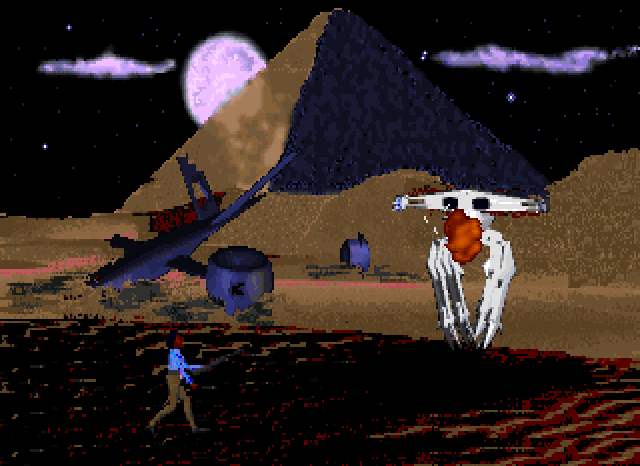
When captures happen, the game abandons the board view entirely and transitions to a separate wasteland arena to display a fully animated fight. Watching a T-800 physically crush a human soldier or seeing Sarah Connor blast an endoskeleton carries novelty for the first five minutes. By turn fifteen, these slow side-court battles disrupt the mental momentum of calculating tactic lines. You can skip the animations, but doing so strips away the central gimmick that publisher Capstone Software relied on to market the title.
Behind the awkward presentation lies a surprisingly competent set of chess mechanics. The developers incorporated standard tournament features that serious players usually expect from traditional computer chess programs of the era. The software tracks performance using official USCF rating scales, offering adjustable computer strength and comprehensive match logging.
If you treat it strictly as a training tool, the game gives you several levers to adjust:
Yet these analytical features feel completely out of sync with the audio-visual presentation. The main interface features a floating, transparent T-800 skull surrounded by low-resolution flames, attempting to recreate the cinematic opening of the film without licensing the famous Brad Fiedel movie theme. Instead, players are treated to short, generic synth loops that quickly grow tedious during longer matches.
Playing the 1993 MS-DOS release highlights a clash between gameplay genres. A strong game of strategy and tactics relies on immediate visual readability, allowing you to scan diagonals, file pins, and knight forks in a fraction of a second. In this title, identifying whether a shiny metallic piece is a bishop or a knight requires constant double-checking, leading to silly blunders merely because a piece disappeared into the dark background board art.
The human animations carry an unintentional hilarity that further undermines the dramatic apocalyptic setting. Human infantry move across the board with awkward, rigid walking cycles that look like wooden marionettes rather than battle-hardened survivalists. Combined with unconvincing chrome rendering on the endoskeletons, the game lacks the visual polish of contemporary board game adaptations like Battle Chess.
For PC audio hardware in 1993, sound card support was broad, ranging from standard PC internal speakers to AdLib, Sound Blaster, Roland MT-32, and Pro Audio Spectrum. Running on standard VGA or SVGA at 320x200 resolution, sound effects like metallic punches and gunshots hit with heavy punch on a Sound Blaster 16, even if the musical tracks remain painfully repetitive.
As a novelty item from Capstone's nineties license lineup, the game is an oddity worth seeing once. It fails to beat dedicated chess software on visual clarity or interface speed, and it fails to deliver a true movie experience due to missing music and awkward animations. The missing 2D view is the fatal design flaw, turning routine middle-game maneuvering into a test of eye strain.
If you want to experience this piece of PC gaming oddity yourself, you can play Terminator 2: Judgment Day - Chess Wars MS-DOS game online, free in your browser right now. Start a single-player match against the AI, set the fight animations to fast, and test whether you can spot a sneaky Skynet knight fork from behind Sarah Connor's back row before your king gets cornered in the wasteland.
Terminator 2: Judgment Day - Chess Wars takes the standard rules of chess and wraps them in early pre-rendered 3D animations, pitting John Connor and Sarah Connor against Skynet's legions of Hunter-Killers in a gritty futuristic wasteland.
Launching Terminator 2: Judgment Day - Chess Wars drops you straight into a battle between the human Resistance and Skynet. Instead of classical wooden pieces, the board features pre-rendered 3D figures built on early Amiga rendering software. The Resistance side places John Connor as a bishop, Sarah Connor taking her position as Queen, and the T-800 standing in as King, supported by rank-and-file human soldiers as pawns. Across the board, Skynet fields chrome T-800 endoskeletons, floating Hunter-Killers, and liquid-metal T-1000 models.
The core issue reveals itself as soon as you try to plan your opening pawn structure. The view is locked strictly into an isometric angle fixed permanently behind the Resistance side. If you play as Skynet, you are forced to evaluate moves from behind enemy lines without any option to rotate the camera. Even worse, developer IntraCorp, Inc. completely omitted an overhead 2D board view, leaving players to decipher which sharp polygon piece sits on which square amidst cluttered, dark futuristic backgrounds.
When captures happen, the game abandons the board view entirely and transitions to a separate wasteland arena to display a fully animated fight. Watching a T-800 physically crush a human soldier or seeing Sarah Connor blast an endoskeleton carries novelty for the first five minutes. By turn fifteen, these slow side-court battles disrupt the mental momentum of calculating tactic lines. You can skip the animations, but doing so strips away the central gimmick that publisher Capstone Software relied on to market the title.
Behind the awkward presentation lies a surprisingly competent set of chess mechanics. The developers incorporated standard tournament features that serious players usually expect from traditional computer chess programs of the era. The software tracks performance using official USCF rating scales, offering adjustable computer strength and comprehensive match logging.
If you treat it strictly as a training tool, the game gives you several levers to adjust:
Yet these analytical features feel completely out of sync with the audio-visual presentation. The main interface features a floating, transparent T-800 skull surrounded by low-resolution flames, attempting to recreate the cinematic opening of the film without licensing the famous Brad Fiedel movie theme. Instead, players are treated to short, generic synth loops that quickly grow tedious during longer matches.
Playing the 1993 MS-DOS release highlights a clash between gameplay genres. A strong game of strategy and tactics relies on immediate visual readability, allowing you to scan diagonals, file pins, and knight forks in a fraction of a second. In this title, identifying whether a shiny metallic piece is a bishop or a knight requires constant double-checking, leading to silly blunders merely because a piece disappeared into the dark background board art.
The human animations carry an unintentional hilarity that further undermines the dramatic apocalyptic setting. Human infantry move across the board with awkward, rigid walking cycles that look like wooden marionettes rather than battle-hardened survivalists. Combined with unconvincing chrome rendering on the endoskeletons, the game lacks the visual polish of contemporary board game adaptations like Battle Chess.
For PC audio hardware in 1993, sound card support was broad, ranging from standard PC internal speakers to AdLib, Sound Blaster, Roland MT-32, and Pro Audio Spectrum. Running on standard VGA or SVGA at 320x200 resolution, sound effects like metallic punches and gunshots hit with heavy punch on a Sound Blaster 16, even if the musical tracks remain painfully repetitive.
As a novelty item from Capstone's nineties license lineup, the game is an oddity worth seeing once. It fails to beat dedicated chess software on visual clarity or interface speed, and it fails to deliver a true movie experience due to missing music and awkward animations. The missing 2D view is the fatal design flaw, turning routine middle-game maneuvering into a test of eye strain.
If you want to experience this piece of PC gaming oddity yourself, you can play Terminator 2: Judgment Day - Chess Wars MS-DOS game online, free in your browser right now. Start a single-player match against the AI, set the fight animations to fast, and test whether you can spot a sneaky Skynet knight fork from behind Sarah Connor's back row before your king gets cornered in the wasteland.
aka Terminator 2: Cyber Chess
How Terminator 2: Judgment Day - Chess Wars is played — the keys the game listens to, grouped by what they do.
Highlighted keys are mapped — hover or tap one to see what it does.
Control map is incomplete based on available documentation. Moves can also be typed directly using standard chess notation.
The on-screen keyboard and gamepad mapping the browser player uses on a phone, a tablet or a controller, as opposed to the real keys above. $PRO members make their own in the player and share them here; anyone can pick one to play with.
Cheat codes, console commands and memory pokes for Terminator 2: Judgment Day - Chess Wars — each one verified and attributed.
Sign in to submitHow Terminator 2: Judgment Day - Chess Wars is played — the keys the game listens to, grouped by what they do.
Highlighted keys are mapped — hover or tap one to see what it does.
Control map is incomplete based on available documentation. Moves can also be typed directly using standard chess notation.
The on-screen keyboard and gamepad mapping the browser player uses on a phone, a tablet or a controller, as opposed to the real keys above. $PRO members make their own in the player and share them here; anyone can pick one to play with.
Cheat codes, console commands and memory pokes for Terminator 2: Judgment Day - Chess Wars — each one verified and attributed.
Sign in to submit
The Terminator: Future Shock1995