


Spectrum HoloByte introduced Tetris Classic in 1992 to give PC players 256-color VGA graphics, MT-32 audio support, and side-by-side multiplayer modes while keeping the core puzzle formula untouched.
When Spectrum HoloByte set out to overhaul their original 1988 PC release, they did not alter how tetrominoes drop or rotate. Designers and programmers Rebecca Ang and Heather Mace preserved the central mechanics intact. You control the position and rotation of falling four-square pieces, assembling complete horizontal lines to clear them from an empty pit before blocks reach the top.
What changed was the surrounding presentation, built specifically to take advantage of VGA graphics cards and modern PC sound hardware. Artists Charlie Aquilina, Chuck Butler, and Kathleen Thornton replaced the basic text-mode frames with illustrations styled after traditional Russian lacquerware boxes. These background paintings depict scenes from Alexander Pushkin's epic poem Ruslan and Ludmila.
Composer Paul Mogg adapted Mikhail Glinka's opera score for the soundtrack. Playing the game with a Roland MT-32 synthesizer card offered rich synth instrument arrangements, while Sound Blaster and PC Speaker options ensured standard desktop hardware played the music reliably. This 1992 release loaded crisp visuals onto monitors while keeping the action familiar. If you were searching for a puzzle title that looked refined next to standard DOS utilities, this was the release to pick up.
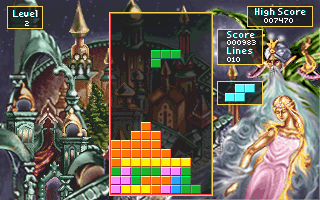
The main additions to the package sit inside the options menu. Beyond standard single-player clearing, Spectrum HoloByte added five distinct play configurations. You can play locally with a friend or launch a head-to-head match over a dial-up modem or a Novell-compatible network.
Multiplayer modes let two people compete in separate side-by-side playfields, share single-pit competitive scoring, or work together. In dual-pit setups, players can enable an option to push garbage lines to their opponent whenever they clear rows. The cooperative mode widens the pit significantly to accommodate two sets of falling pieces simultaneously.
Managing an extra-wide pit requires constant communication between both players. Dropping a long straight bar in your partner's designated column shuts down their landing spot instantly. You have to monitor your teammate's piece orientation as closely as your own to keep the broad floor clean.
Despite the presentation upgrades, player feedback highlights a specific shift in how points accumulate. Instead of granting massive bonuses for clearing four lines simultaneously, the scoring logic awards points for hard drops and stack height. Fast drops executed near the top of the pit pad your score far more than patient construction near the bottom.
This scoring design alters how a competitive match unfolds. You end up slamming pieces down aggressively from high positions to maximize point output, rather than holding out for a single straight bar to wipe four lines at once. It turns methodical planning into a fast-paced drop race.
Configuring starting options helps skip the slow early pace. You can set the starting speed anywhere from level 1 up to level 10, pre-fill the pit with garbage blocks, or establish strict game time limits before dropping your first piece.

Players who push past level 10 encounter technical errors embedded in the original code. Once you cross into level 11, graphical glitches and mechanical bugs begin to corrupt the playfield. Pieces drop unpredictably or fail to register complete horizontal lines as the speed calculation overflows.
Most casual sessions end long before reaching those extreme speeds, but high-score runs encounter a sudden wall when the engine malfunctions. That code limitation cuts high-level survival short, contrasting with the polished visual presentation framing the pit.
Despite the unusual point system and late-level speed bugs, this Tetris Classic MS-DOS game offers a complete multiplayer package. The combination of side-by-side garbage battles, custom pit configurations, and Glinka's classical soundtrack gives every match a distinct rhythm.
You can play Tetris Classic free in your browser right now, with nothing to install and no setup required. Start a single-player round or launch a dual-pit match to see how hard drop scoring changes your block-stacking tactics.
Spectrum HoloByte introduced Tetris Classic in 1992 to give PC players 256-color VGA graphics, MT-32 audio support, and side-by-side multiplayer modes while keeping the core puzzle formula untouched.
When Spectrum HoloByte set out to overhaul their original 1988 PC release, they did not alter how tetrominoes drop or rotate. Designers and programmers Rebecca Ang and Heather Mace preserved the central mechanics intact. You control the position and rotation of falling four-square pieces, assembling complete horizontal lines to clear them from an empty pit before blocks reach the top.
What changed was the surrounding presentation, built specifically to take advantage of VGA graphics cards and modern PC sound hardware. Artists Charlie Aquilina, Chuck Butler, and Kathleen Thornton replaced the basic text-mode frames with illustrations styled after traditional Russian lacquerware boxes. These background paintings depict scenes from Alexander Pushkin's epic poem Ruslan and Ludmila.
Composer Paul Mogg adapted Mikhail Glinka's opera score for the soundtrack. Playing the game with a Roland MT-32 synthesizer card offered rich synth instrument arrangements, while Sound Blaster and PC Speaker options ensured standard desktop hardware played the music reliably. This 1992 release loaded crisp visuals onto monitors while keeping the action familiar. If you were searching for a puzzle title that looked refined next to standard DOS utilities, this was the release to pick up.
The main additions to the package sit inside the options menu. Beyond standard single-player clearing, Spectrum HoloByte added five distinct play configurations. You can play locally with a friend or launch a head-to-head match over a dial-up modem or a Novell-compatible network.
Multiplayer modes let two people compete in separate side-by-side playfields, share single-pit competitive scoring, or work together. In dual-pit setups, players can enable an option to push garbage lines to their opponent whenever they clear rows. The cooperative mode widens the pit significantly to accommodate two sets of falling pieces simultaneously.
Managing an extra-wide pit requires constant communication between both players. Dropping a long straight bar in your partner's designated column shuts down their landing spot instantly. You have to monitor your teammate's piece orientation as closely as your own to keep the broad floor clean.
Despite the presentation upgrades, player feedback highlights a specific shift in how points accumulate. Instead of granting massive bonuses for clearing four lines simultaneously, the scoring logic awards points for hard drops and stack height. Fast drops executed near the top of the pit pad your score far more than patient construction near the bottom.
This scoring design alters how a competitive match unfolds. You end up slamming pieces down aggressively from high positions to maximize point output, rather than holding out for a single straight bar to wipe four lines at once. It turns methodical planning into a fast-paced drop race.
Configuring starting options helps skip the slow early pace. You can set the starting speed anywhere from level 1 up to level 10, pre-fill the pit with garbage blocks, or establish strict game time limits before dropping your first piece.
Players who push past level 10 encounter technical errors embedded in the original code. Once you cross into level 11, graphical glitches and mechanical bugs begin to corrupt the playfield. Pieces drop unpredictably or fail to register complete horizontal lines as the speed calculation overflows.
Most casual sessions end long before reaching those extreme speeds, but high-score runs encounter a sudden wall when the engine malfunctions. That code limitation cuts high-level survival short, contrasting with the polished visual presentation framing the pit.
Despite the unusual point system and late-level speed bugs, this Tetris Classic MS-DOS game offers a complete multiplayer package. The combination of side-by-side garbage battles, custom pit configurations, and Glinka's classical soundtrack gives every match a distinct rhythm.
You can play Tetris Classic free in your browser right now, with nothing to install and no setup required. Start a single-player round or launch a dual-pit match to see how hard drop scoring changes your block-stacking tactics.
How Tetris Classic is played — the keys the game listens to, grouped by what they do.
Highlighted keys are mapped — hover or tap one to see what it does.
Key mapping compiled from search notes based on standard keyboard controls for Tetris Classic. Map is incomplete.
The on-screen keyboard and gamepad mapping the browser player uses on a phone, a tablet or a controller, as opposed to the real keys above. $PRO members make their own in the player and share them here; anyone can pick one to play with.
Cheat codes, console commands and memory pokes for Tetris Classic — each one verified and attributed.
Sign in to submitHow Tetris Classic is played — the keys the game listens to, grouped by what they do.
Highlighted keys are mapped — hover or tap one to see what it does.
Key mapping compiled from search notes based on standard keyboard controls for Tetris Classic. Map is incomplete.
The on-screen keyboard and gamepad mapping the browser player uses on a phone, a tablet or a controller, as opposed to the real keys above. $PRO members make their own in the player and share them here; anyone can pick one to play with.
Cheat codes, console commands and memory pokes for Tetris Classic — each one verified and attributed.
Sign in to submit