Sun Tzu's L'Art de la Guerre
In The Ancient Art of War, winning a battle comes down to basic unit positioning, march speed, and managing three troop types against opponents who command armies with distinct historical styles.
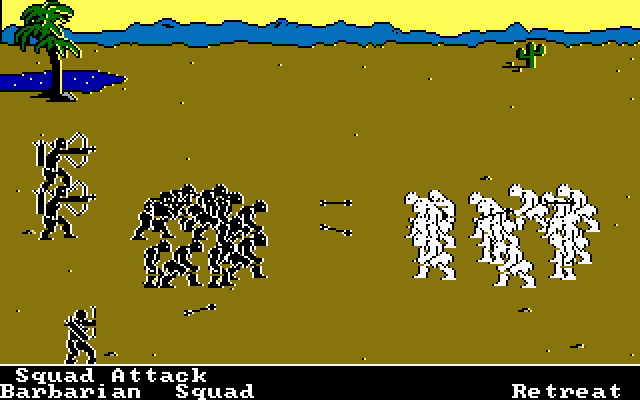
You start on a top-down tactical map watching small rectangular squads move across rivers, hills, and mountain passes. When two forces meet, the screen cuts to a side perspective where up to fourteen soldiers clash in real time based on your basic direct orders. Knights crush Barbarians in direct hand-to-hand fights, Barbarians outrun and butcher ranged Archers, and Archers rain arrows onto slow Knights before they ever reach melee distance. That three-way dynamic is the core engine of combat, supported by non-combat Spies who scout ahead when campaign rules allow them.
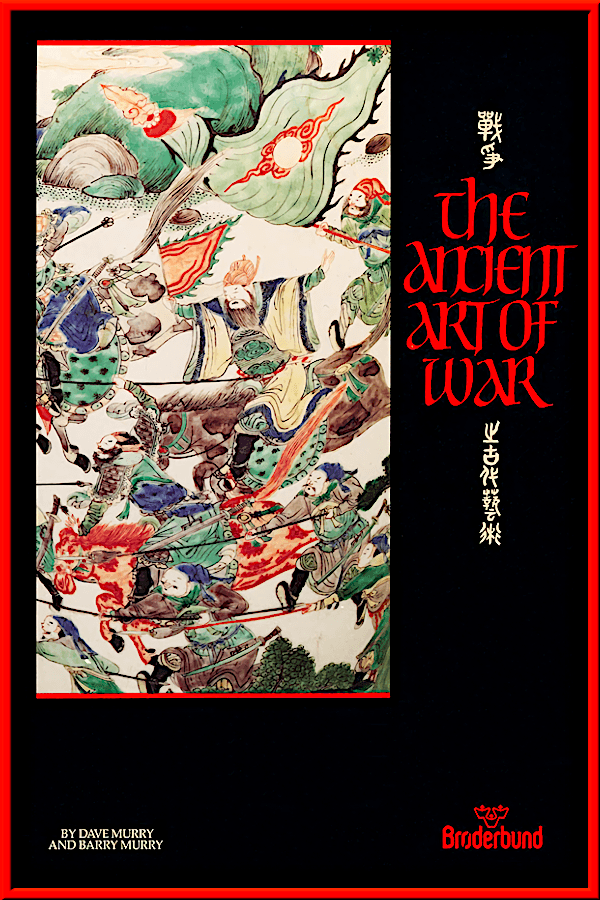
Brothers Dave Murry and Barry Murry created this structure for their studio Evryware, creating a blueprint for command that predated modern real-time strategy titles. Published by Brøderbund Software, Inc., the 1984 original relies on crisp tactical rules rather than complex resource management. Sound is handled entirely through simple PC speaker beeps, giving combat a sharp acoustic punch every time a squad collides or retreats.
Instead of facing a generic computer script, you choose your opponent from eight historical and mythical military commanders. Crazy Ivan sits at the easiest end of the spectrum, charging recklessly forward without regard for formation or terrain. On the opposite end stands Sun Tzu, who falls back to defensive terrain, sets ambushes, and punishes every single miscalculated march route you execute.
The campaign roster covers eleven built-in battle scenarios across various geographical layouts, including maps set in Ancient Rome, Sherwood Forest, Asgaard, Napoleon's France, Ancient China, the Appalachians, Mongolia, and Custer's Last Command. Each scenario presents specific victory conditions, ranging from total elimination of opposing forces to flag capture missions that force you to spread your forces thin.
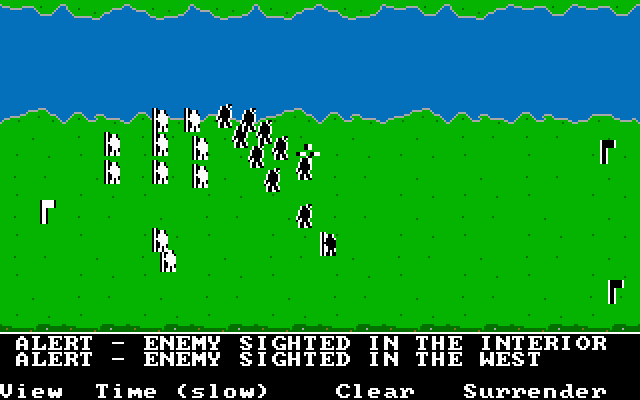
Success on the field requires constantly balancing movement speed against fatigue. Starving or exhausted squads fight poorly, meaning a hasty forced march across a mountain range can leave your heavily armored Knights vulnerable to a smaller squad of Barbarians. You can adjust the simulation speed on the main map or pause time completely to survey troop movements and queue up new march vectors.
The built-in scenario editor gave this release real staying power on original hardware. Players could paint custom terrain, set troop distributions, and author custom mission goals long before level editors became standard fixtures in home strategy software. The main mechanical shortcoming is the lack of a true overarching campaign mode; every scenario runs as a self-contained battle, so losses do not carry long-term consequences into the next map.
The difficulty wall in The Ancient Art of War hits hardest when you move past moderate commanders like Alexander the Great or Julius Caesar and take on Genghis Khan, Geronimo, or Sun Tzu. Sun Tzu in particular reads your march paths instantly, baiting your heavy troops into long marches while sending fast Barbarians around your flanks to seize your supply bases or flags.
Because the combat screen limits fighting squads to fourteen soldiers, larger armies must feed reserves into the fray piecemeal. If you misjudge the initial clash and send Archers headlong into approaching Barbarians without a frontline of Knights, the squad gets wiped out before your reinforcements can cross the battle field. That unforgiving pace turns late-game mistakes into swift, complete collapses.
As an early MS-DOS strategy game, it still plays well because its mechanics are stripped down to pure tactical positioning. The interface is responsive, the tactical map rewards clear foresight, and the unit combat system takes about five minutes to learn on your first map.
You can play The Ancient Art of War online right now in your browser with no installation needed. If you want to sample The Ancient Art of War free in your browser, start with a straightforward map against Athena or Crazy Ivan to master squad formations before attempting to survive against Sun Tzu.
In The Ancient Art of War, winning a battle comes down to basic unit positioning, march speed, and managing three troop types against opponents who command armies with distinct historical styles.
You start on a top-down tactical map watching small rectangular squads move across rivers, hills, and mountain passes. When two forces meet, the screen cuts to a side perspective where up to fourteen soldiers clash in real time based on your basic direct orders. Knights crush Barbarians in direct hand-to-hand fights, Barbarians outrun and butcher ranged Archers, and Archers rain arrows onto slow Knights before they ever reach melee distance. That three-way dynamic is the core engine of combat, supported by non-combat Spies who scout ahead when campaign rules allow them.
Brothers Dave Murry and Barry Murry created this structure for their studio Evryware, creating a blueprint for command that predated modern real-time strategy titles. Published by Brøderbund Software, Inc., the 1984 original relies on crisp tactical rules rather than complex resource management. Sound is handled entirely through simple PC speaker beeps, giving combat a sharp acoustic punch every time a squad collides or retreats.
Instead of facing a generic computer script, you choose your opponent from eight historical and mythical military commanders. Crazy Ivan sits at the easiest end of the spectrum, charging recklessly forward without regard for formation or terrain. On the opposite end stands Sun Tzu, who falls back to defensive terrain, sets ambushes, and punishes every single miscalculated march route you execute.
The campaign roster covers eleven built-in battle scenarios across various geographical layouts, including maps set in Ancient Rome, Sherwood Forest, Asgaard, Napoleon's France, Ancient China, the Appalachians, Mongolia, and Custer's Last Command. Each scenario presents specific victory conditions, ranging from total elimination of opposing forces to flag capture missions that force you to spread your forces thin.
Success on the field requires constantly balancing movement speed against fatigue. Starving or exhausted squads fight poorly, meaning a hasty forced march across a mountain range can leave your heavily armored Knights vulnerable to a smaller squad of Barbarians. You can adjust the simulation speed on the main map or pause time completely to survey troop movements and queue up new march vectors.
The built-in scenario editor gave this release real staying power on original hardware. Players could paint custom terrain, set troop distributions, and author custom mission goals long before level editors became standard fixtures in home strategy software. The main mechanical shortcoming is the lack of a true overarching campaign mode; every scenario runs as a self-contained battle, so losses do not carry long-term consequences into the next map.
The difficulty wall in The Ancient Art of War hits hardest when you move past moderate commanders like Alexander the Great or Julius Caesar and take on Genghis Khan, Geronimo, or Sun Tzu. Sun Tzu in particular reads your march paths instantly, baiting your heavy troops into long marches while sending fast Barbarians around your flanks to seize your supply bases or flags.
Because the combat screen limits fighting squads to fourteen soldiers, larger armies must feed reserves into the fray piecemeal. If you misjudge the initial clash and send Archers headlong into approaching Barbarians without a frontline of Knights, the squad gets wiped out before your reinforcements can cross the battle field. That unforgiving pace turns late-game mistakes into swift, complete collapses.
As an early MS-DOS strategy game, it still plays well because its mechanics are stripped down to pure tactical positioning. The interface is responsive, the tactical map rewards clear foresight, and the unit combat system takes about five minutes to learn on your first map.
You can play The Ancient Art of War online right now in your browser with no installation needed. If you want to sample The Ancient Art of War free in your browser, start with a straightforward map against Athena or Crazy Ivan to master squad formations before attempting to survive against Sun Tzu.
How The Ancient Art of War is played — the keys the game listens to, grouped by what they do.
Highlighted keys are mapped — hover or tap one to see what it does.
Key mapping documentation from primary sources is incomplete. Keyboard is the primary control scheme.
The on-screen keyboard and gamepad mapping the browser player uses on a phone, a tablet or a controller, as opposed to the real keys above. $PRO members make their own in the player and share them here; anyone can pick one to play with.
Cheat codes, console commands and memory pokes for The Ancient Art of War — each one verified and attributed.
Sign in to submitHow The Ancient Art of War is played — the keys the game listens to, grouped by what they do.
Highlighted keys are mapped — hover or tap one to see what it does.
Key mapping documentation from primary sources is incomplete. Keyboard is the primary control scheme.
The on-screen keyboard and gamepad mapping the browser player uses on a phone, a tablet or a controller, as opposed to the real keys above. $PRO members make their own in the player and share them here; anyone can pick one to play with.
Cheat codes, console commands and memory pokes for The Ancient Art of War — each one verified and attributed.
Sign in to submit