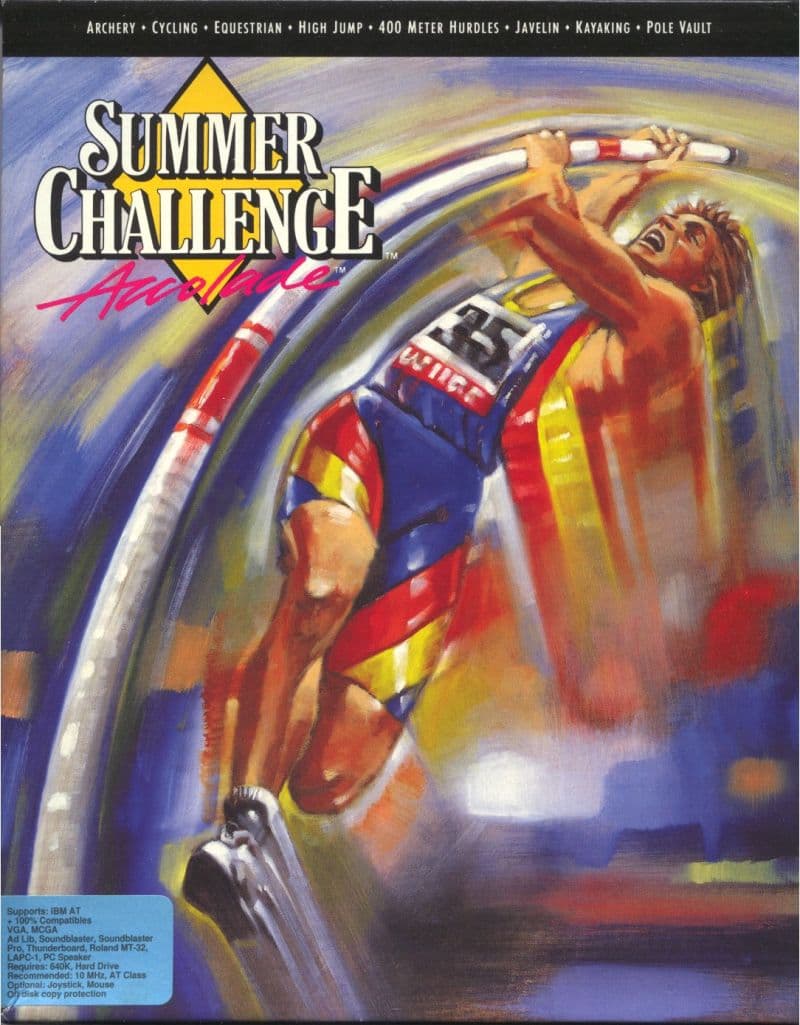
Accolade and MindSpan followed up their winter sports hit with The Games: Summer Challenge, swapping frozen slopes for track lanes, velodromes, and white-water kayak gates.
Eight events and the brutal reality of key mashing
Running through an athletic tournament on a 1990s PC usually meant destroying a keyboard or developing blistered hands within fifteen minutes. MindSpan took that core track-and-field formula and split it across eight distinct sports, asking players to balance raw speed against narrow timing windows.
The event design forces you to adapt your fingers to completely different rhythm demands from one contest to the next:
- 400m Hurdles: You mash the run button to build momentum, then tap jump right before the hurdle; hit it off-tempo and your runner tumbles across the dirt.
- High Jump and Pole Vault: Speed builds up the run-up track, but clearing the bar requires holding the action key until the athlete twists into the right body posture above the bar.
- Kayak: Downhill river navigation where missing a gate or scraping against the river bank tacks penalty seconds onto your finish time.
- Archery: A sweeping crosshair sways constantly while you align the shot against wind forces and pull the trigger.
- Equestrian: Steering a horse over walls where a single mistimed leap prompts an immediate refusal or outright removal from the event.
- Javelin: Sprints down the runway need to transition into a hold-and-release sequence to lock in an release angle between 40 and 45 degrees.
- Cycling: Track racing inside a indoor velodrome where hugging the inner lane saves precious fractions of a second without sliding out.
While pounding the ENTER key repeatedly is often enough to sweep early heats, events like equestrian and hurdles punish blind button hammering. Tap jump a fraction of a second too late at the water jump and your horse halts dead in its tracks, instantly wiping out your tournament run.
Polygons, sound cards, and the Genesis port
MindSpan built this tournament using the same hybrid rendering engine they created for The Games: Winter Challenge. The background tracks, stadium walls, and velodrome bends use flat-shaded 3D polygons, while the athletes themselves are scaled bitmap sprites moving within the space.
The tech stack delivered smooth scaling on a 386 processor. When you play MindSpan titles from this era, you can see how heavily they relied on clever camera angles to mask the hardware limits of 1992.
Audio design got equal attention from composer Alistair Hirst. While the built-in IBM PC Speaker offered basic chirps for crowd noise, plugging in an AdLib or Sound Blaster card transformed the arena. On a Sound Blaster Pro, footsteps on the track and the deep thud of vaulting poles hitting the box sound punchy and crisp.
The core design team of Mike Benna, Jeff Sember, John Boechler, and Taunya Shiffer crafted a package that Accolade, Inc. brought to DOS computers before porting the title to the Sega Genesis in 1993. If you played the DOS version of sports games back then, you likely spent hours configuring sound IRQ settings just to hear the crowd roar.
What happens when you edit the game files
Back in 1992, players who attempted to alter hex values in game executables ran into a notorious anti-tamper trap. Instead of crashing out to the DOS prompt with an error code, the game allowed you to boot up normally while secretly sabotaging your entire play session.
If the internal files failed their integrity check, the code quietly locked you out of top podium finishes. No matter how perfectly you timed your javelin release or cleared the hurdles, the game silently prevented you from earning a gold medal. In several track events, modified games would force the athlete sprite to veer directly into the boundary wall.
This anti-tamper measure baffled plenty of early hex-editor enthusiasts who thought they had cracked the high score tables. You can read more about vintage software preservation and anti-copy mechanics on Wikipedia, where community documentation tracks these early developer tricks.
Why timing beats button hammering in the long run
Many classic 1992 computer games relied purely on how fast a player could alternate two keys on a mechanical board. While speed matters during the sprinting phases of this title, precision remains the real gatekeeper for world records.
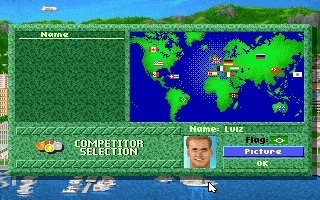
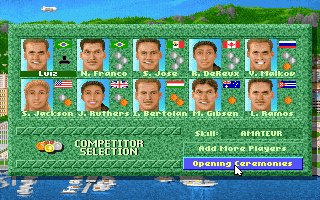
Computer opponents in the ten-player tournament modes do not make simple execution errors on higher difficulty settings. To beat the top computer athletes, you have to memorize exact jump points down to individual animation frames. The game allows up to ten human players to pass the keyboard around, which turns local multiplayer sessions into noisy shouting matches.
The combination of high-stakes timing and local multiplayer tournament scoring gives the game its staying power. You can train on individual sports to perfect your release angles before jumping into a full multi-stage championship run against friends.
Jump onto the track right now
If you remember losing track heat matches because your fingers cramped up on the spacebar, you can test your timing again right now. You can play The Games: Summer Challenge free in your browser right here, with no need to set up old hardware configs or adjust Sound Blaster drivers.
Modern players often assume that pounding the run button as fast as possible guarantees victory, only to crash hard into the very first hurdle. Launch the track events, get a feel for the jump timing before you push for maximum speed, and see if you can finally land gold on the equestrian course today.