In The Great War 1914-1918, developer Blue Byte adapted the simultaneous turn mechanics of its earlier hit Battle Isle to the industrial battles of the Western Front. Instead of directing sci-fi hovercraft, you maneuver regiments across hexagon grids through two-month historical intervals to capture enemy headquarters or obliterate every unit in sight.
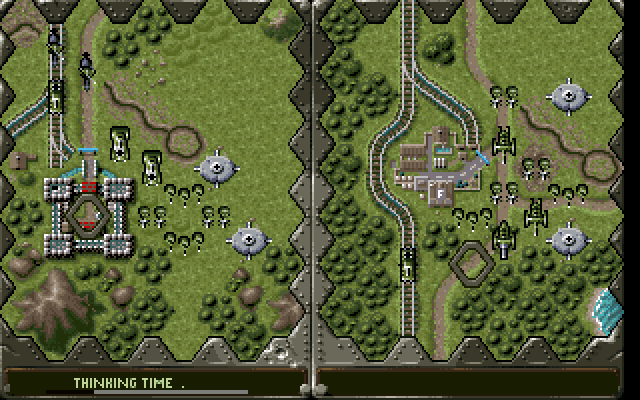
Most turn-based strategy games from 1992 made players sit idle during the opponent turn, but this engine divides the monitor horizontally into two independent views. While you choose move orders on your panel, your opponent executes attacks on theirs. On the following turn, those roles flip, turning each combat phase into a guessing game of where artillery shells will fall before your infantry reach their targets.
A typical scenario opens with light infantry and cavalry charging across open summer fields. Terrain type dictates defense values, while changing seasons turn grassy paths into mud that grinds heavy artillery to a crawl. As years advance across the 24 campaign maps, early horse units give way to bunker networks, Voisin III biplanes, and land dreadnoughts like the German A7V and British Mark IV.
Battles resolve on dedicated tactical cutscenes accompanied by FM synth sound effects through an AdLib or Sound Blaster card. Watching line infantry exchange fire on a tiny combat window adds dramatic flavor, though you will quickly skip those animations during long engagements with dozens of regiments active at once.
Period magazines praised the title upon release for balancing tactical depth with approachable rules. Computer Gaming World noted that the game managed to be simple to play while providing a genuinely aggressive computer AI. Period reviewers at French outlet Gen4 gave it a 90% score, emphasizing how accessible its combat system felt compared to complex table-top war simulations of the era.
Yet anyone expecting an authentic simulation of Western Front stalemate might feel confused by how the engine rewards movement. Because capturing factories and supply depots yields reinforcements, success depends on sweeping flank maneuvers and pressing the attack rather than sitting inside defensive trenches. It plays far more like a mobile wargame than a static war of attrition.
Between missions, the pace drops completely to deliver illustrated history lessons. The game opens with a detailed sequence showing the 1914 assassination of Archduke Franz Ferdinand in Sarajevo, followed by an in-game encyclopedia detailing period firearms, siege engines, and military vehicles unlocked after every victory.
The single biggest hurdle today is the control scheme. German studio Blue Byte Software GmbH originally designed the interface around directional cursors mapped to joysticks or keyboard keys. Navigating nested menus to confirm simple movement paths feels clunky and slow compared to point-and-click DOS games from the same vintage.
Progress saving is another quirk that takes getting used to. You cannot save mid-battle during a two-hour battle. Campaign progress relies entirely on five-letter scenario passwords entered at the main menu:
Losing an end-game scenario on map 24 means re-entering code STERN and restarting the entire battle from turn one. North American publisher Strategic Simulations, Inc. kept this identical system for the state-side release, keeping the challenge intact but frustrating players who miscalculated a single troop transport move.
Despite awkward keyboard navigation, the core tactical loop stays tense. Managing unit fuel, ammo supplies, and terrain advantages over split-screen multiplayer offers a style of head-to-head strategy that few wargames ever attempted afterward. It works best when played against a human opponent sitting next to you, where double-blind movement phases turn basic troop movements into mind games.
You can play The Great War 1914-1918 online right now, running the complete The Great War 1914-1918 MS-DOS game free in your browser without setting up old hardware. If you want to sample this era of strategy, start with the single-player map 01 password PULSE to master basic artillery support before tackling two-player head-to-head matches.
In The Great War 1914-1918, developer Blue Byte adapted the simultaneous turn mechanics of its earlier hit Battle Isle to the industrial battles of the Western Front. Instead of directing sci-fi hovercraft, you maneuver regiments across hexagon grids through two-month historical intervals to capture enemy headquarters or obliterate every unit in sight.
Most turn-based strategy games from 1992 made players sit idle during the opponent turn, but this engine divides the monitor horizontally into two independent views. While you choose move orders on your panel, your opponent executes attacks on theirs. On the following turn, those roles flip, turning each combat phase into a guessing game of where artillery shells will fall before your infantry reach their targets.
A typical scenario opens with light infantry and cavalry charging across open summer fields. Terrain type dictates defense values, while changing seasons turn grassy paths into mud that grinds heavy artillery to a crawl. As years advance across the 24 campaign maps, early horse units give way to bunker networks, Voisin III biplanes, and land dreadnoughts like the German A7V and British Mark IV.

Battles resolve on dedicated tactical cutscenes accompanied by FM synth sound effects through an AdLib or Sound Blaster card. Watching line infantry exchange fire on a tiny combat window adds dramatic flavor, though you will quickly skip those animations during long engagements with dozens of regiments active at once.
Period magazines praised the title upon release for balancing tactical depth with approachable rules. Computer Gaming World noted that the game managed to be simple to play while providing a genuinely aggressive computer AI. Period reviewers at French outlet Gen4 gave it a 90% score, emphasizing how accessible its combat system felt compared to complex table-top war simulations of the era.
Yet anyone expecting an authentic simulation of Western Front stalemate might feel confused by how the engine rewards movement. Because capturing factories and supply depots yields reinforcements, success depends on sweeping flank maneuvers and pressing the attack rather than sitting inside defensive trenches. It plays far more like a mobile wargame than a static war of attrition.
Between missions, the pace drops completely to deliver illustrated history lessons. The game opens with a detailed sequence showing the 1914 assassination of Archduke Franz Ferdinand in Sarajevo, followed by an in-game encyclopedia detailing period firearms, siege engines, and military vehicles unlocked after every victory.

The single biggest hurdle today is the control scheme. German studio Blue Byte Software GmbH originally designed the interface around directional cursors mapped to joysticks or keyboard keys. Navigating nested menus to confirm simple movement paths feels clunky and slow compared to point-and-click DOS games from the same vintage.
Progress saving is another quirk that takes getting used to. You cannot save mid-battle during a two-hour battle. Campaign progress relies entirely on five-letter scenario passwords entered at the main menu:
Losing an end-game scenario on map 24 means re-entering code STERN and restarting the entire battle from turn one. North American publisher Strategic Simulations, Inc. kept this identical system for the state-side release, keeping the challenge intact but frustrating players who miscalculated a single troop transport move.
Despite awkward keyboard navigation, the core tactical loop stays tense. Managing unit fuel, ammo supplies, and terrain advantages over split-screen multiplayer offers a style of head-to-head strategy that few wargames ever attempted afterward. It works best when played against a human opponent sitting next to you, where double-blind movement phases turn basic troop movements into mind games.
You can play The Great War 1914-1918 online right now, running the complete The Great War 1914-1918 MS-DOS game free in your browser without setting up old hardware. If you want to sample this era of strategy, start with the single-player map 01 password PULSE to master basic artillery support before tackling two-player head-to-head matches.
How The Great War 1914-1918 is played — the keys the game listens to, grouped by what they do.
Highlighted keys are mapped — hover or tap one to see what it does.
Keyboard controls can be customized via the main menu options.
The on-screen keyboard and gamepad mapping the browser player uses on a phone, a tablet or a controller, as opposed to the real keys above. $PRO members make their own in the player and share them here; anyone can pick one to play with.
Cheat codes, console commands and memory pokes for The Great War 1914-1918 — each one verified and attributed.
Sign in to submitaka Historyline: 1914-1918 · Historyline: 1914-1918 - Die War-line von Blue Byte
How The Great War 1914-1918 is played — the keys the game listens to, grouped by what they do.
Highlighted keys are mapped — hover or tap one to see what it does.
Keyboard controls can be customized via the main menu options.
The on-screen keyboard and gamepad mapping the browser player uses on a phone, a tablet or a controller, as opposed to the real keys above. $PRO members make their own in the player and share them here; anyone can pick one to play with.
Cheat codes, console commands and memory pokes for The Great War 1914-1918 — each one verified and attributed.
Sign in to submit