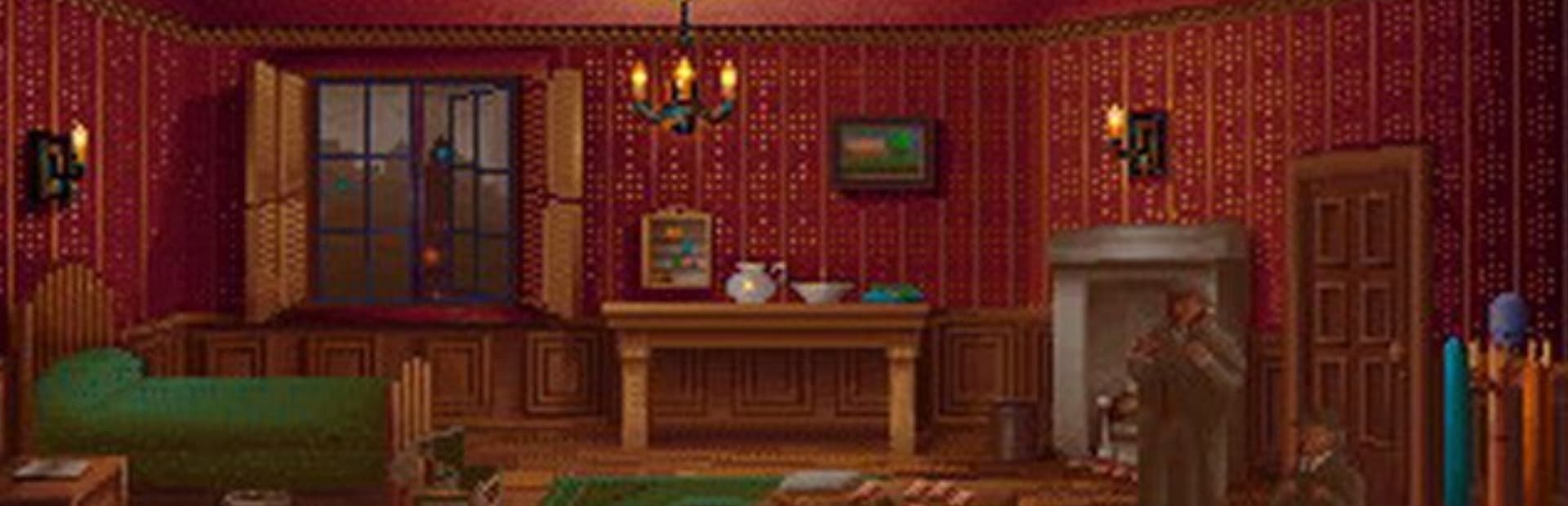
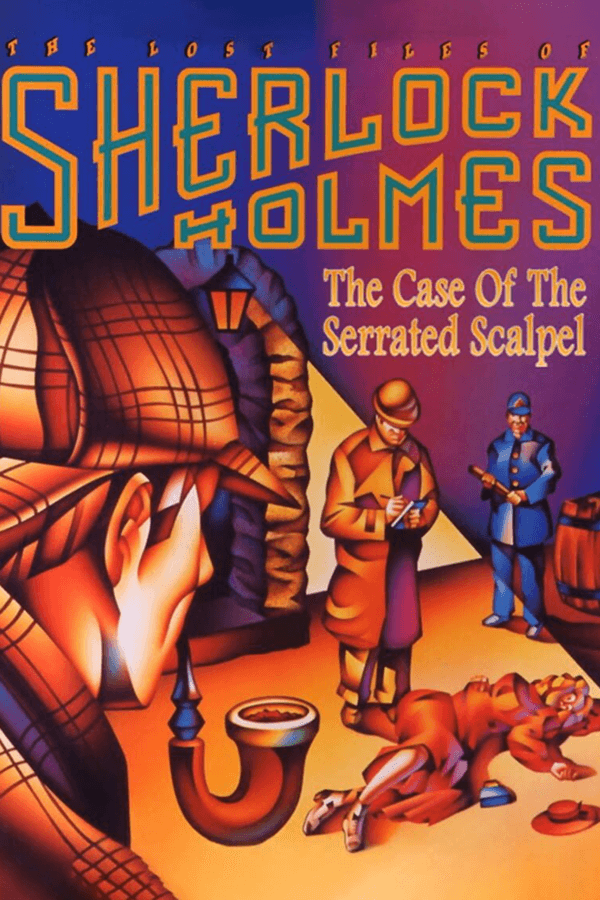

Playing The Lost Files of Sherlock Holmes: The Case of the Serrated Scalpel puts you straight into the wet cobblestones of 1888 London to prove a slaughtered actress was not another victim of Jack the Ripper. It exchanges the typical fantasy quests of 1992 point-and-click games for methodical crime scene analysis, witness interrogations, and laboratory work.
Electronic Arts did not initially set out to publish a narrative detective game. The project began as an internal proposal for a computerized board game, until technical writer Eric Lindstrom suggested turning the concept into a story-driven graphic adventure instead. Development team Mythos Software, Inc. put together a working prototype in under two weeks, proving the concept could work on PC hardware.
Producer Christopher Erhardt and designer R. J. Berg turned that prototype into a massive undertaking. Berg, who was already writing technical documentation for EA while harboring a deep knowledge of Arthur Conan Doyle's fiction, wrote a dark plot starting with the murder of Sarah Carroway behind the Regency Theatre. Programmer Scott Cronce built the engine, while artist Scott Mavor and composer Rob Hubbard supplied the 256-color VGA visuals and digital audio scores.
Rather than relying on fairy-tale logic or slapstick humor, the team crafted realistic crime scenes rendered in 320x200 resolution. When Electronic Arts, Inc. shipped the game, it stood apart from competing Sierra and LucasArts titles by taking Victorian forensic science seriously.
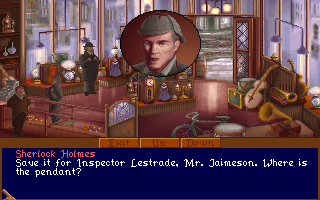
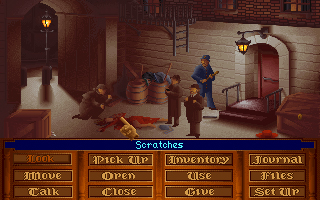
Your investigation starts in the dark alley where Carroway died, but the scope expands quickly across a map featuring over twenty distinct locations. You move Holmes around the screen using a traditional verb bar containing actions like Look, Take, Open, and Talk. Progress relies on gathering physical items and asking precise questions rather than fighting enemies or managing health bars.
The core gameplay relies on a clean set of investigative tools:
Dialogue forms the spine of every case file. You interview suspects ranging from theatrical staff to street urchins, often calling on Wiggins and the Irregulars to gather intelligence Scotland Yard misses. Inspector Lestrade and Inspector Gregson offer official police reports, but Holmes must synthesize those facts himself. For a change of pace, you can step inside a local pub and play an interactive game of darts, a feature so distinct that the game executable even includes a command-line parameter to launch directly into the dart match.
At release, critical reactions reflected the game's ambitious design choices. Computer Games Strategy Plus named it the Best Adventure of 1992, specifically highlighting its oppressive Victorian atmosphere. Conversely, Charles Ardai wrote a brief review for Computer Gaming World arguing that the title tried too hard to be an interactive movie rather than a smooth game. Years later, retrospectives on sites like Adventure Gamers highlighted its plot as one of the best told in adventure history.
Playing the game today reveals where those early criticisms came from. Searching rooms often devolves into frustrating pixel hunts across dark background art, where tiny objects like a stray thread or small key easily hide in plain sight. Certain puzzles also enforce strict narrative sequencing: Holmes will flatly refuse to examine or combine crucial inventory items until you have triggered a specific line of dialogue on the other side of London.
Technical quirks can also disrupt the experience on modern hardware. Running the original executable under standard DOSBox 0.74 configurations often causes sound stuttering or DMA wrapping crashes right during the animated intro sequence. Gamers running the title on PC emulators usually have to drop back to DOSBox 0.73 or switch over to ScummVM to avoid those memory crashes.
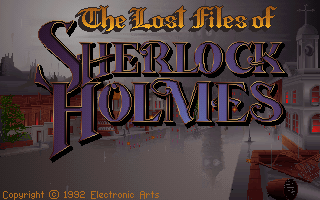
Despite occasional pixel-hunting hurdles, the game sold over 100,000 units during its original commercial run and earned every one of those sales. It captures the methodical pace of Doyle's original fiction, rewarding players who pay attention to detail instead of clicking randomly. The digitized speech in cutscenes and Rob Hubbard's musical backing give 1888 London a distinct weight that few contemporary PC titles matched.
You can play The Lost Files of Sherlock Holmes: The Case of the Serrated Scalpel free in your browser right now without downloading extra files or configuring settings. Load up this MS-DOS adventure game directly, head straight for Baker Street to run chemical tests on your lab bench, and see if your deductions can clear Jack the Ripper of a crime he did not commit.
Playing The Lost Files of Sherlock Holmes: The Case of the Serrated Scalpel puts you straight into the wet cobblestones of 1888 London to prove a slaughtered actress was not another victim of Jack the Ripper. It exchanges the typical fantasy quests of 1992 point-and-click games for methodical crime scene analysis, witness interrogations, and laboratory work.
Electronic Arts did not initially set out to publish a narrative detective game. The project began as an internal proposal for a computerized board game, until technical writer Eric Lindstrom suggested turning the concept into a story-driven graphic adventure instead. Development team Mythos Software, Inc. put together a working prototype in under two weeks, proving the concept could work on PC hardware.
Producer Christopher Erhardt and designer R. J. Berg turned that prototype into a massive undertaking. Berg, who was already writing technical documentation for EA while harboring a deep knowledge of Arthur Conan Doyle's fiction, wrote a dark plot starting with the murder of Sarah Carroway behind the Regency Theatre. Programmer Scott Cronce built the engine, while artist Scott Mavor and composer Rob Hubbard supplied the 256-color VGA visuals and digital audio scores.
Rather than relying on fairy-tale logic or slapstick humor, the team crafted realistic crime scenes rendered in 320x200 resolution. When Electronic Arts, Inc. shipped the game, it stood apart from competing Sierra and LucasArts titles by taking Victorian forensic science seriously.

Your investigation starts in the dark alley where Carroway died, but the scope expands quickly across a map featuring over twenty distinct locations. You move Holmes around the screen using a traditional verb bar containing actions like Look, Take, Open, and Talk. Progress relies on gathering physical items and asking precise questions rather than fighting enemies or managing health bars.
The core gameplay relies on a clean set of investigative tools:
Dialogue forms the spine of every case file. You interview suspects ranging from theatrical staff to street urchins, often calling on Wiggins and the Irregulars to gather intelligence Scotland Yard misses. Inspector Lestrade and Inspector Gregson offer official police reports, but Holmes must synthesize those facts himself. For a change of pace, you can step inside a local pub and play an interactive game of darts, a feature so distinct that the game executable even includes a command-line parameter to launch directly into the dart match.

At release, critical reactions reflected the game's ambitious design choices. Computer Games Strategy Plus named it the Best Adventure of 1992, specifically highlighting its oppressive Victorian atmosphere. Conversely, Charles Ardai wrote a brief review for Computer Gaming World arguing that the title tried too hard to be an interactive movie rather than a smooth game. Years later, retrospectives on sites like Adventure Gamers highlighted its plot as one of the best told in adventure history.
Playing the game today reveals where those early criticisms came from. Searching rooms often devolves into frustrating pixel hunts across dark background art, where tiny objects like a stray thread or small key easily hide in plain sight. Certain puzzles also enforce strict narrative sequencing: Holmes will flatly refuse to examine or combine crucial inventory items until you have triggered a specific line of dialogue on the other side of London.
Technical quirks can also disrupt the experience on modern hardware. Running the original executable under standard DOSBox 0.74 configurations often causes sound stuttering or DMA wrapping crashes right during the animated intro sequence. Gamers running the title on PC emulators usually have to drop back to DOSBox 0.73 or switch over to ScummVM to avoid those memory crashes.

Despite occasional pixel-hunting hurdles, the game sold over 100,000 units during its original commercial run and earned every one of those sales. It captures the methodical pace of Doyle's original fiction, rewarding players who pay attention to detail instead of clicking randomly. The digitized speech in cutscenes and Rob Hubbard's musical backing give 1888 London a distinct weight that few contemporary PC titles matched.
You can play The Lost Files of Sherlock Holmes: The Case of the Serrated Scalpel free in your browser right now without downloading extra files or configuring settings. Load up this MS-DOS adventure game directly, head straight for Baker Street to run chemical tests on your lab bench, and see if your deductions can clear Jack the Ripper of a crime he did not commit.
How The Lost Files of Sherlock Holmes: The Case of the Serrated Scalpel is played — the keys the game listens to, grouped by what they do.
Highlighted keys are mapped — hover or tap one to see what it does.
Key mapping is incomplete as full documentation was unavailable. Keyboard shortcuts generally trigger using the first letter of the target verb/option name.
The on-screen keyboard and gamepad mapping the browser player uses on a phone, a tablet or a controller, as opposed to the real keys above. $PRO members make their own in the player and share them here; anyone can pick one to play with.
Cheat codes, console commands and memory pokes for The Lost Files of Sherlock Holmes: The Case of the Serrated Scalpel — each one verified and attributed.
Sign in to submitaka Los archivos secretos de Sherlock Holmes: el caso del escalpelo mellado · The Lost Files of Sherlock Holmes
How The Lost Files of Sherlock Holmes: The Case of the Serrated Scalpel is played — the keys the game listens to, grouped by what they do.
Highlighted keys are mapped — hover or tap one to see what it does.
Key mapping is incomplete as full documentation was unavailable. Keyboard shortcuts generally trigger using the first letter of the target verb/option name.
The on-screen keyboard and gamepad mapping the browser player uses on a phone, a tablet or a controller, as opposed to the real keys above. $PRO members make their own in the player and share them here; anyone can pick one to play with.
Cheat codes, console commands and memory pokes for The Lost Files of Sherlock Holmes: The Case of the Serrated Scalpel — each one verified and attributed.
Sign in to submit