
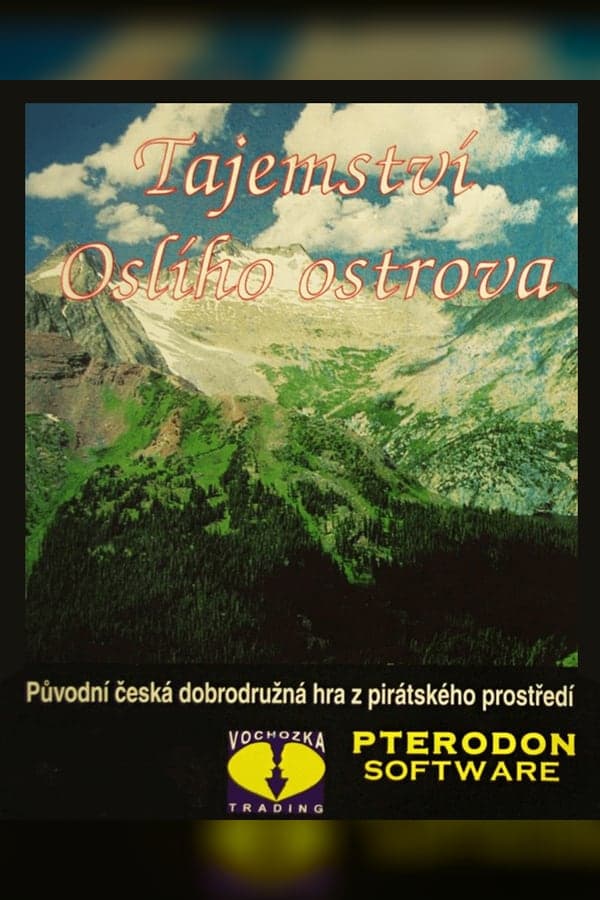
aka Tajemství Oslího ostrova · Donkey Island
In The Secret of Donkey Island, you play as hero Gajbraš Trípvůd after the ghost pirate's brother LeGek wrecks your galleon and leaves you stranded on a strange, hazardous shore. Created by two Czech high schoolers on school computers, this point-and-click comedy parodies LucasArts while testing your patience with mandatory walking animations on every misclicked item.
Before this title hit floppy disks, commercial Czech PC development barely existed. High school classmates Jarek Kolář and Petr Vlček built the project between 1992 and 1994 under the team name Pterodon Software, taking advantage of the computer lab at their Brno gymnasium. When publisher Petr Vochozka released it through Vochozka Trading in June 1994, it became the first commercial Czech game for MS-DOS, proving that local developers could turn high school computer access into a boxed retail product.
The entire production relied on aggressive borrowing. Rather than creating every backdrop and character frame from scratch, the young team pulled graphics assets directly from existing adventure games and assembled them into a full satire. You can see pieces of other commercial titles scattered across the island, recontextualized to house a goofy plot about escaping LeGek and finding a way home.
The premise flips pirate fiction on its head with shameless Czech humor. You navigate Gajbraš through three main island regions: a dense tropical jungle, an active lava field, and a towering crystal spire. Every area packs in visual gags, though reaching the end screen requires navigating some of the most unforgiving interface choices of the 1994 PC budget scene.
Anyone who spent time with early graphic adventures knows the pain of trial and error puzzle solving, but this design takes interface punishment a step further. The Secret of Donkey Island gameplay relies on a classic verb coin and inventory system, yet it lacks basic quality of life shortcuts. Once you click an action or item combine command, you cannot cancel it.
The real frustration comes from character pathfinding. If you attempt an incorrect action on an object across the screen, Gajbraš does not simply give a line of dialogue from where he stands. Instead, the game forces him to physically walk all the way over to the target spot before playing a long, unskippable failure animation. Try five wrong verbs on a locked door, and you will spend two full minutes watching Gajbraš slowly amble back and forth across the dirt.
This penalty on basic experimentation quickly discourages standard point and click curiosity. Players who like to test every item on every hotspot end up trapped in endless walking cycles, making progress feel tedious whenever the logical path forward stalls out.
Beyond the slow movement, the puzzle logic frequently devolves into brute force verb matching. Certain screens hide progress behind arbitrary item applications where logic offers zero guidance, forcing you to exhaust every option in your bag. The lack of clean feedback makes it hard to tell whether a puzzle requires a different item or if you simply used the right object with the wrong action verb.
To make matters worse, softlocks are a real threat. It is entirely possible to miss an essential pickup, travel to a new zone, and lock yourself out of finishing the game without any warning. I spent half an hour searching the crystal tower before realizing a missing inventory piece from the starting beach had permanently ruined the run.
Technical rough edges aside, the presentation works for anyone who likes crude 90s DOS art. The stolen sprites and customized pixel art fit together surprisingly well, and the writing delivers genuine chuckles if you appreciate silly slapstick and direct parodies of classic LucasArts tropes.
The developers officially released the game as freeware in 2000, and an official fan translation in 2023 finally made the script accessible to English speakers without a dictionary. While the interface design has aged poorly, experiencing this DOS title offers a fascinating look at how small European teams improvised with limited tools during the home computer boom.
You should not expect a polished quest on par with the games it parodies, but dedicated adventure fans will find plenty to appreciate in its historical context and irreverent humor. The raw ambition of two high schoolers publishing a full scale comedy adventure makes it worth inspecting, even if you keep a walkthrough nearby to avoid the worst pathfinding traps.
Keeping obscure releases like this documented ensures that early digital history is not forgotten. Preserving metadata, digital box copy, original screenshots, and community translation efforts keeps the story of local PC development scenes alive for future generations of players.
The on-screen keyboard and gamepad mapping the browser player uses on a phone, a tablet or a controller, as opposed to the real keys above. $PRO members make their own in the player and share them here; anyone can pick one to play with.
Cheat codes, console commands and memory pokes for The Secret of Donkey Island — each one verified and attributed.
Sign in to submitThe on-screen keyboard and gamepad mapping the browser player uses on a phone, a tablet or a controller, as opposed to the real keys above. $PRO members make their own in the player and share them here; anyone can pick one to play with.
Cheat codes, console commands and memory pokes for The Secret of Donkey Island — each one verified and attributed.
Sign in to submit