aka Shadow of Yserbius · Yserbius
Cracking open Ybarra Productions' 1991 dungeon crawler The Shadow of Yserbius meant stepping into a 16x16 grid packed with liches, hell wolves, and unforgiving mechanics. Designed as a flagship graphical multi-user dungeon, this MS-DOS game forced players to learn its brutal combat rules or perish beneath a volcano.
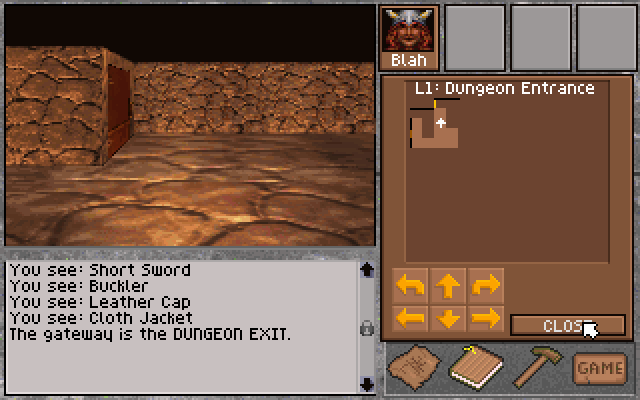
Before you even step foot inside the volcanic labyrinth of Yserbius, you have to build a hero capable of surviving it. The character creation screen hands you a choice of familiar fantasy races - Humans, Elves, Orcs, Trolls, and Dwarves - alongside core professions like the Barbarian, Knight, Thief, Ranger, Cleric, and Wizard. If you go in with a squishy solo caster, the initial floors will make you regret it immediately. The game drops your custom hero straight into a first-person perspective, navigating tight dungeon corridors mapped on a strict 16x16 3D step-grid.
The early floor zones, starting at the Dungeon Entrance and pushing into the Soldiers' Quarters, do not offer a gentle tutorial. You walk step-by-step through line-drawn corridors, turning in crisp ninety-degree angles, while managing a heavy mouse-driven interface. Every action, from opening inventory windows to casting spells, demands constant clicking around the screen frames. When an encounter triggers, you face packs of ghouls or troll rangers that can butcher an unprepared lone character in two turns. Survival means mastering defensive spells early; casting Poison Cloud to soften up enemy lines becomes a crucial tactic just to keep your health bar intact past the lower halls.
When published by Sierra On-Line on The Sierra Network (later renamed The ImagiNation Network), this title was designed as an online social hub. Guilds like the Kingdom of Yserbius (KoY), Soldiers of Fortune (SoF), and KAAOS ran the corridors together, trading tips and coordinating four-player co-op combat encounters. In that online space, macro tools like "VitaminF" became famous among players looking to automate grinding or gain an edge in player-versus-player skirmishes. Reviewers at the time lauded the shared experience, praising the lasting friendships formed while diving into the volcano together.
The offline release, however, stripped all of that away, exposing a fundamental balancing flaw. As reviewer Bernie Yee pointed out in his 1994 evaluation for Computer Gaming World, playing the single-player release felt like wandering an empty amusement park after hours. Because the combat math and high-tier dungeons were balanced for cooperative parties, tackling the deep levels alone demands hours of tedious grinding. Without three online companions absorbing hits or slinging supporting magic, progressing through late areas like the Mines and the Mausoleum requires immense patience and repetitive battle loops.
Progression through the lower levels demands more than beating down monsters; it requires solving explicit structural puzzles scattered across key floors like the Hall of Doors. To reach the deepest chambers, you have to hunt down specific relic items tied to ancient lore: King Cleowyn's scepter, robe, and crown. The puzzle design is precise and punishing if you fail to read the clues.
Placing these items out of order fails to unlock the path forward, blocking access to the ultimate threat lurking in the molten heart of the mountain: the evil elemental creature En-li-Kil. Defeating this boss ends your entire run, yet the reward hits a strange anti-climax. Once the final blow lands on En-li-Kil, the game offers no grand victory cinematic or elaborate story resolution. The battle simply ends, leaving players baffled by the abrupt halt after dozens of hours of intense dungeon mapping.
On the sound side, the game made great use of the early nineties PC audio hardware. If you ran the 1991 MS-DOS game on a Sound Blaster or an AdLib card, you got punchy synthesized crunch during combat, but booting it up with a Roland MT-32 module yielded far richer musical arrangements for the dark dungeon atmosphere. The technical groundwork laid here spawned two direct follow-ups, The Fates of Twinion in 1993 and The Ruins of Cawdor in 1995.
The original network environment eventually met a sudden end when corporate shifts took over. AT&T acquired the network service before selling it to America Online for a reported $40 million. AOL promptly shut the platform down in 1996 to remove competition for its own title, Neverwinter Nights. That shutdown left the standalone disk version as the primary way for retro enthusiasts to experience Ybarra's design.
Despite the heavy mouse interface and the brutal difficulty spike for solo adventurers, this title is a fascinating specimen of early role-playing design. It bridges traditional first-person dungeon crawls with early online multiplayer concepts. For players who enjoy tough grid-based mappers, exploring these halls provides a genuine challenge that rewards careful resource management.
You can play The Shadow of Yserbius free in your browser right here, with zero installation hassle. When you roll your first character, opt for a tough hybrid class like a Knight or Ranger to survive the early floors of the Dungeon Entrance. Pay close attention to enemy grouping during your first turn in battle, keep your defensive buffs active, and see if you have what it takes to conquer En-li-Kil's lair.
Cracking open Ybarra Productions' 1991 dungeon crawler The Shadow of Yserbius meant stepping into a 16x16 grid packed with liches, hell wolves, and unforgiving mechanics. Designed as a flagship graphical multi-user dungeon, this MS-DOS game forced players to learn its brutal combat rules or perish beneath a volcano.
Before you even step foot inside the volcanic labyrinth of Yserbius, you have to build a hero capable of surviving it. The character creation screen hands you a choice of familiar fantasy races - Humans, Elves, Orcs, Trolls, and Dwarves - alongside core professions like the Barbarian, Knight, Thief, Ranger, Cleric, and Wizard. If you go in with a squishy solo caster, the initial floors will make you regret it immediately. The game drops your custom hero straight into a first-person perspective, navigating tight dungeon corridors mapped on a strict 16x16 3D step-grid.
The early floor zones, starting at the Dungeon Entrance and pushing into the Soldiers' Quarters, do not offer a gentle tutorial. You walk step-by-step through line-drawn corridors, turning in crisp ninety-degree angles, while managing a heavy mouse-driven interface. Every action, from opening inventory windows to casting spells, demands constant clicking around the screen frames. When an encounter triggers, you face packs of ghouls or troll rangers that can butcher an unprepared lone character in two turns. Survival means mastering defensive spells early; casting Poison Cloud to soften up enemy lines becomes a crucial tactic just to keep your health bar intact past the lower halls.
When published by Sierra On-Line on The Sierra Network (later renamed The ImagiNation Network), this title was designed as an online social hub. Guilds like the Kingdom of Yserbius (KoY), Soldiers of Fortune (SoF), and KAAOS ran the corridors together, trading tips and coordinating four-player co-op combat encounters. In that online space, macro tools like "VitaminF" became famous among players looking to automate grinding or gain an edge in player-versus-player skirmishes. Reviewers at the time lauded the shared experience, praising the lasting friendships formed while diving into the volcano together.
The offline release, however, stripped all of that away, exposing a fundamental balancing flaw. As reviewer Bernie Yee pointed out in his 1994 evaluation for Computer Gaming World, playing the single-player release felt like wandering an empty amusement park after hours. Because the combat math and high-tier dungeons were balanced for cooperative parties, tackling the deep levels alone demands hours of tedious grinding. Without three online companions absorbing hits or slinging supporting magic, progressing through late areas like the Mines and the Mausoleum requires immense patience and repetitive battle loops.
Progression through the lower levels demands more than beating down monsters; it requires solving explicit structural puzzles scattered across key floors like the Hall of Doors. To reach the deepest chambers, you have to hunt down specific relic items tied to ancient lore: King Cleowyn's scepter, robe, and crown. The puzzle design is precise and punishing if you fail to read the clues.
Placing these items out of order fails to unlock the path forward, blocking access to the ultimate threat lurking in the molten heart of the mountain: the evil elemental creature En-li-Kil. Defeating this boss ends your entire run, yet the reward hits a strange anti-climax. Once the final blow lands on En-li-Kil, the game offers no grand victory cinematic or elaborate story resolution. The battle simply ends, leaving players baffled by the abrupt halt after dozens of hours of intense dungeon mapping.
On the sound side, the game made great use of the early nineties PC audio hardware. If you ran the 1991 MS-DOS game on a Sound Blaster or an AdLib card, you got punchy synthesized crunch during combat, but booting it up with a Roland MT-32 module yielded far richer musical arrangements for the dark dungeon atmosphere. The technical groundwork laid here spawned two direct follow-ups, The Fates of Twinion in 1993 and The Ruins of Cawdor in 1995.
The original network environment eventually met a sudden end when corporate shifts took over. AT&T acquired the network service before selling it to America Online for a reported $40 million. AOL promptly shut the platform down in 1996 to remove competition for its own title, Neverwinter Nights. That shutdown left the standalone disk version as the primary way for retro enthusiasts to experience Ybarra's design.
Despite the heavy mouse interface and the brutal difficulty spike for solo adventurers, this title is a fascinating specimen of early role-playing design. It bridges traditional first-person dungeon crawls with early online multiplayer concepts. For players who enjoy tough grid-based mappers, exploring these halls provides a genuine challenge that rewards careful resource management.
You can play The Shadow of Yserbius free in your browser right here, with zero installation hassle. When you roll your first character, opt for a tough hybrid class like a Knight or Ranger to survive the early floors of the Dungeon Entrance. Pay close attention to enemy grouping during your first turn in battle, keep your defensive buffs active, and see if you have what it takes to conquer En-li-Kil's lair.
How The Shadow of Yserbius is played — the keys the game listens to, grouped by what they do.
Highlighted keys are mapped — hover or tap one to see what it does.
Requires a Microsoft-compatible mouse driver in DOS. Menu navigation, combat, inventory, and spellcasting rely primarily on point-and-click mouse controls.
The on-screen keyboard and gamepad mapping the browser player uses on a phone, a tablet or a controller, as opposed to the real keys above. $PRO members make their own in the player and share them here; anyone can pick one to play with.
Cheat codes, console commands and memory pokes for The Shadow of Yserbius — each one verified and attributed.
Sign in to submitHow The Shadow of Yserbius is played — the keys the game listens to, grouped by what they do.
Highlighted keys are mapped — hover or tap one to see what it does.
Requires a Microsoft-compatible mouse driver in DOS. Menu navigation, combat, inventory, and spellcasting rely primarily on point-and-click mouse controls.
The on-screen keyboard and gamepad mapping the browser player uses on a phone, a tablet or a controller, as opposed to the real keys above. $PRO members make their own in the player and share them here; anyone can pick one to play with.
Cheat codes, console commands and memory pokes for The Shadow of Yserbius — each one verified and attributed.
Sign in to submit