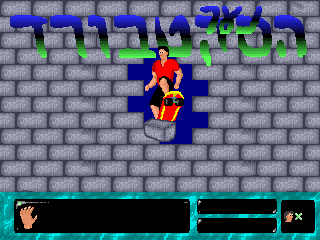
aka נער הסקייטבורד · נער הסקטבורד
Cruising through the streets of Rehovot on a deck while dodging witches and hurling knives sounds like a fever dream, but The Skateboard Kid turns that exact setup into an uncompromising side-scrolling platformer.
Most action platformers from the early nineties gave you a clear direction: run right, jump over pits, and smack whatever stands in your way. The Skateboard Kid takes a far more chaotic approach by dumping you directly onto suburban streets swarming with undead spellcasters and skeletons without explaining what item opens which building. You are handed five hearts on the HUD, and you will burn through every single one of them in the first three minutes just figuring out how momentum works on your board.
The movement carries a distinct weight that takes getting used to. Rolling forward builds speed, but stopping on a dime to toss a knife at an incoming witch usually results in getting knocked off your board. Jumping allows you to grab hold of overhead structures and hang from ledges, which becomes vital when the ground level turns into a wall-to-wall parade of monsters. You start with a basic knife attack, but picking up a boomerang changes your combat range entirely, allowing you to hit enemies that linger just past the edge of the screen.
The central conflict pits your unnamed teen hero against an evil sorcerer who has placed a deadly curse over Rehovot. Instead of abstract fantasy zones, you are fighting through residential blocks, leaping past fences, and searching for keys while under constant fire. It turns what could have been a standard arcade clone into something far stranger and much more aggressive.
Progress in this 1992 platformer depends heavily on environmental interaction rather than raw speed running. You cannot simply sprint to the far right of the map and trigger a level transition. Instead, you have to scour the sidewalks and alleyways for specific tools required to bypass hard roadblocks, such as finding a hammer to break through structural barriers or hunting down keys to open locked doors.
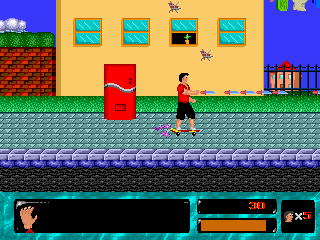
Scattered throughout the levels are NPCs, including an old man standing on the sidewalk who offers cryptic hints when approached. Ignoring these clues usually means wandering into dead ends where monsters spawn indefinitely. Health recovery comes in the form of fast food items like burgers and fries, which you will need to grab the moment they appear to offset the oversized hitboxes of the local skeleton population.
The structural layout of each stage relies heavily on trial and error, a design choice that split players at the time. You will frequently collect an item, realize you missed the door it opens three screens back, and have to fight your way through respawned enemies to test your theory. The game rewards patience and memory far more than pure reflexes.
Designed by Udi Aharoni alongside Yuval Aharoni, the project was released through BUG Multisystem Ltd., an Israeli retail and publishing company active throughout the PC expansion period. Placing a 2D action game in the city of Rehovot gave the title a distinct local flavor compared to the generic American and European backdrops common on MS-DOS at the time.
The Aharoni brothers were part of a small group of creators building original software for the local market, with Yuval also responsible for titles like Super Kof. The distribution through BUG Games meant the title found its way onto plenty of home PCs across the region, quickly earning a reputation as a brutal weekend killer. The Skateboard Kid MS-DOS game was built during an era when local developers had to engineer their own tools and art pipelines from scratch to get action games running smoothly on standard ISA-bus hardware.
You can see those technical choices clearly in how the engine handles sprite movement and collision. The board mechanics require tight timing, particularly when transitioning between riding on flat asphalt and leaping upward to grab onto hanging cables or roof edges to avoid incoming projectiles.
Decades after its release, the game holds up as a challenging slice of regional gaming history. The lack of an in-game save system means a single careless sequence can wipe out your whole run, forcing you to memorize enemy placements and item locations down to the tile. If you enjoy early nineties DOS platformers that refuse to hold your hand, it is still a rewarding title to master.
The primary issue remains the opaque goal design. You will spend a lot of time dying simply because you did not realize a specific building required a hammer found on the far side of the map. Yet once you establish a rhythm, learn the flight path of the boomerang, and figure out which street NPCs actually help you, clearing a neighborhood yields a genuine rush of accomplishment.
You can play The Skateboard Kid free in your browser right now with no setup required. Launch the emulation direct from this page, grab your keyboard, and see if you can survive the wizard's curse long enough to figure out what that boomerang is actually good for.
Cruising through the streets of Rehovot on a deck while dodging witches and hurling knives sounds like a fever dream, but The Skateboard Kid turns that exact setup into an uncompromising side-scrolling platformer.
Most action platformers from the early nineties gave you a clear direction: run right, jump over pits, and smack whatever stands in your way. The Skateboard Kid takes a far more chaotic approach by dumping you directly onto suburban streets swarming with undead spellcasters and skeletons without explaining what item opens which building. You are handed five hearts on the HUD, and you will burn through every single one of them in the first three minutes just figuring out how momentum works on your board.
The movement carries a distinct weight that takes getting used to. Rolling forward builds speed, but stopping on a dime to toss a knife at an incoming witch usually results in getting knocked off your board. Jumping allows you to grab hold of overhead structures and hang from ledges, which becomes vital when the ground level turns into a wall-to-wall parade of monsters. You start with a basic knife attack, but picking up a boomerang changes your combat range entirely, allowing you to hit enemies that linger just past the edge of the screen.
The central conflict pits your unnamed teen hero against an evil sorcerer who has placed a deadly curse over Rehovot. Instead of abstract fantasy zones, you are fighting through residential blocks, leaping past fences, and searching for keys while under constant fire. It turns what could have been a standard arcade clone into something far stranger and much more aggressive.
Progress in this 1992 platformer depends heavily on environmental interaction rather than raw speed running. You cannot simply sprint to the far right of the map and trigger a level transition. Instead, you have to scour the sidewalks and alleyways for specific tools required to bypass hard roadblocks, such as finding a hammer to break through structural barriers or hunting down keys to open locked doors.
Scattered throughout the levels are NPCs, including an old man standing on the sidewalk who offers cryptic hints when approached. Ignoring these clues usually means wandering into dead ends where monsters spawn indefinitely. Health recovery comes in the form of fast food items like burgers and fries, which you will need to grab the moment they appear to offset the oversized hitboxes of the local skeleton population.
The structural layout of each stage relies heavily on trial and error, a design choice that split players at the time. You will frequently collect an item, realize you missed the door it opens three screens back, and have to fight your way through respawned enemies to test your theory. The game rewards patience and memory far more than pure reflexes.
Designed by Udi Aharoni alongside Yuval Aharoni, the project was released through BUG Multisystem Ltd., an Israeli retail and publishing company active throughout the PC expansion period. Placing a 2D action game in the city of Rehovot gave the title a distinct local flavor compared to the generic American and European backdrops common on MS-DOS at the time.
The Aharoni brothers were part of a small group of creators building original software for the local market, with Yuval also responsible for titles like Super Kof. The distribution through BUG Games meant the title found its way onto plenty of home PCs across the region, quickly earning a reputation as a brutal weekend killer. The Skateboard Kid MS-DOS game was built during an era when local developers had to engineer their own tools and art pipelines from scratch to get action games running smoothly on standard ISA-bus hardware.
You can see those technical choices clearly in how the engine handles sprite movement and collision. The board mechanics require tight timing, particularly when transitioning between riding on flat asphalt and leaping upward to grab onto hanging cables or roof edges to avoid incoming projectiles.
Decades after its release, the game holds up as a challenging slice of regional gaming history. The lack of an in-game save system means a single careless sequence can wipe out your whole run, forcing you to memorize enemy placements and item locations down to the tile. If you enjoy early nineties DOS platformers that refuse to hold your hand, it is still a rewarding title to master.
The primary issue remains the opaque goal design. You will spend a lot of time dying simply because you did not realize a specific building required a hammer found on the far side of the map. Yet once you establish a rhythm, learn the flight path of the boomerang, and figure out which street NPCs actually help you, clearing a neighborhood yields a genuine rush of accomplishment.
You can play The Skateboard Kid free in your browser right now with no setup required. Launch the emulation direct from this page, grab your keyboard, and see if you can survive the wizard's curse long enough to figure out what that boomerang is actually good for.
The on-screen keyboard and gamepad mapping the browser player uses on a phone, a tablet or a controller, as opposed to the real keys above. $PRO members make their own in the player and share them here; anyone can pick one to play with.
Cheat codes, console commands and memory pokes for The Skateboard Kid — each one verified and attributed.
Sign in to submitThe on-screen keyboard and gamepad mapping the browser player uses on a phone, a tablet or a controller, as opposed to the real keys above. $PRO members make their own in the player and share them here; anyone can pick one to play with.
Cheat codes, console commands and memory pokes for The Skateboard Kid — each one verified and attributed.
Sign in to submit