
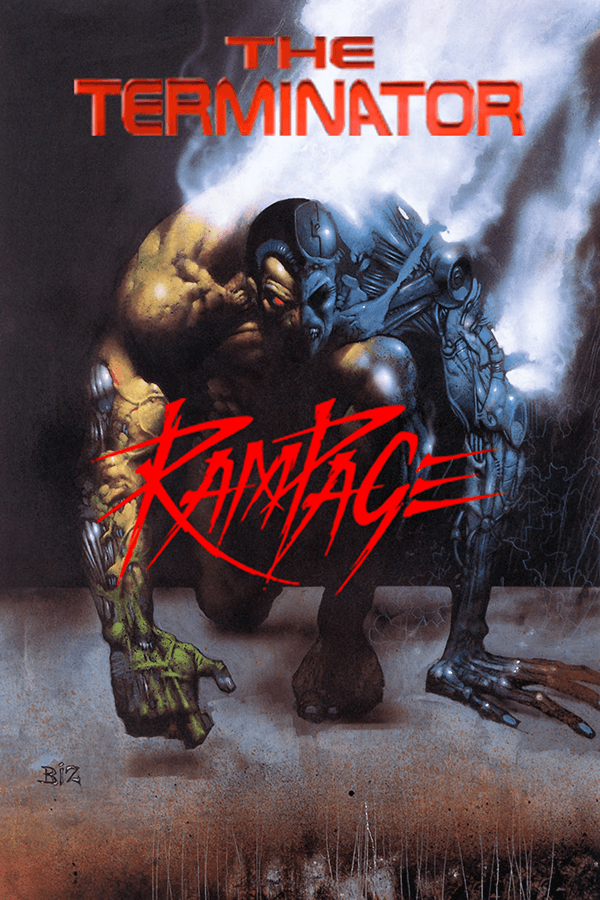

If you want to survive The Terminator: Rampage, you have to spend 32 sprawling floors hunting for security keycards and plasma weapon parts while fighting off Cyberdyne combat units.
Bethesda built a gargantuan maze just as the genre changed forever
Before full texture mapping and free-look turning became standard, The Terminator: Rampage committed to a sheer scale that few shooters of its day dared to attempt. Released in late 1993 by Bethesda Softworks LLC, the game drops you directly into Cyberdyne's Cheyenne Mountain installation. A rogue SkyNet machine called the Meta-Node has taken over the military base to assemble a factory for killer cyborgs. Your job as a Resistance commando sent back to 1984 is simple on paper: reach the bottom floor and destroy the node before SkyNet takes root.
In practice, that mission means surviving thirty-two massive grid-based levels. While other shooters focused on tight arena combat, this title leaned hard into tedious navigation. You wander right-angled corridors, checking every dead end for keycards and ammo clips while checking your map constantly. It shared a raycasting foundation with Bethesda's earlier The Terminator 2029, upgraded to fill the whole display with detailed artwork. Yet because it hit store shelves almost simultaneously with Doom, its flat floors and rigid grid geometry instantly looked like a holdover from a passing era.
Navigating the Cheyenne Mountain complex turns into a test of patience
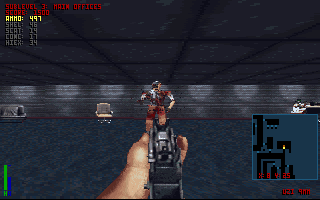
Every floor in Cheyenne Mountain acts as a separate labyrinth. You start with basic access clearances, unlocking doors one clearance level at a time. The core loop forces you to sweep every hallway for supplies, health packs, and clearance upgrades to access deeper sub-levels. The map layout never lets you run through on autopilot. You frequently hit locked doors that require retracing your steps across half the level just to find a single colored keycard hidden in a side room.
The primary sub-quest across the entire campaign is gathering components for the V-TEC phased plasma weapon. Without this assembleable prototype rifle, taking down the final Meta-Node boss is practically impossible. Finding these scattered parts gives you a reason to search every corner, though it also turns the late game into a scavenger hunt if you miss a piece ten floors back. It was an ambitious design for 1993, forcing players to think about long-term resource management across a single mega-dungeon.
The campaign pacing can grind you down quickly if you rush. Enemies spawn down long corridors, and the strict ammo economy means every wasted shot hurts. You quickly learn to check corners carefully rather than sprinting blindly into new rooms.
Firepower, bullet sponges, and sluggish tactical movement
Your arsenal expands as you descend deeper into the bunker. You start with light firearms before finding heavy military hardware. Here is what you carry into combat:
- Beretta 9mm handgun for early target practice and clearing light drones
- Uzi 9mm and AK-47 assault rifle for rapid suppressive fire against groups
- SPAS-12 shotgun for close-quarters firefights in tight doorways
- HK-95 minicannon for chewing through armored units
- M-30 grenade launcher to hit stationary defense turrets
- V-TEC plasma rifle assembled from components found throughout the base
Combat hits a immediate snag in how targets react to hits. Heavy mechanical units and disguised human cyborgs act as brutal bullet sponges, taking dozens of rounds before dropping. Drones hover smoothly into view, but your own movement feels sluggish whether you use keyboard or mouse controls. Turning ninety degrees takes a fraction of a second too long, making close-range ambushes frustrating.
There is also a odd visual glitch that retro fans always notice. Wall decorations like pipes or structural monitors do not rotate properly with the raycasting camera. As you turn, these flat sprites skew out of alignment, breaking the illusion of a solid 3D world. Yet when a disguised cyborg strips away its skin to reveal a shiny endoskeleton beneath, the detailed pixel art still manages to impress.
Audio punch and the technical guts behind the game
If you played this action game when it came out, you likely remember how impressive it sounded. Composer Eric Heberling provided a heavy, pulsing soundtrack that matched the dark metallic corridors. Bethesda included audio drivers for almost every major expansion card available at the time. Hearing the dark synthesizer soundtrack on a Roland MT-32 or General MIDI setup gave the facility an oppressive tone that the PC speaker simply could not match. Even Sound Blaster users got crisp digitized gunshots and metallic clangs.
Under the hood, programmer Craig Walton and producer Christopher Weaver built the engine around an archiver format using `.bsa` container files. If that extension sounds familiar, it is because Bethesda reused that exact same data architecture shortly after to build The Elder Scrolls: Arena. The tech team was actively experimenting with how to stream large game assets off floppy disks and early CD-ROMs without overloading system RAM.
That architectural setup allowed for massive level maps, but it heavily taxed 486 processors of the period. Frame rates dropped quickly when multiple flying drones and cyborgs filled the corridor at once, leading contemporary reviewers to complain about choppy performance during big firefights.
How to tackle this shooter today and play The Terminator: Rampage online
Gaming magazines split wildly on this release. Outlets like Génération 4 awarded high marks for the impressive graphics, while PC Player scored it down sharply for its repetitive level design. It shows how early shooters experimented before the genre settled on a standard format. If you enjoy mapping out complex grid dungeons and managing strict ammunition reserves, there is genuine enjoyment in conquering all thirty-two floors.
You can play The Terminator: Rampage free in your browser right now without setting up complex configuration files. When you boot up this classic The Terminator: Rampage MS-DOS game, start by remapping your movement keys for strafing. Your first move upon entering floor one should be finding the Beretta and checking the surrounding walls for low-level clearance cards. Learn to conserve shotgun shells for endoskeletons early on, keep an eye out for plasma rifle parts, and enjoy a distinct piece of Bethesda's early shooter history.