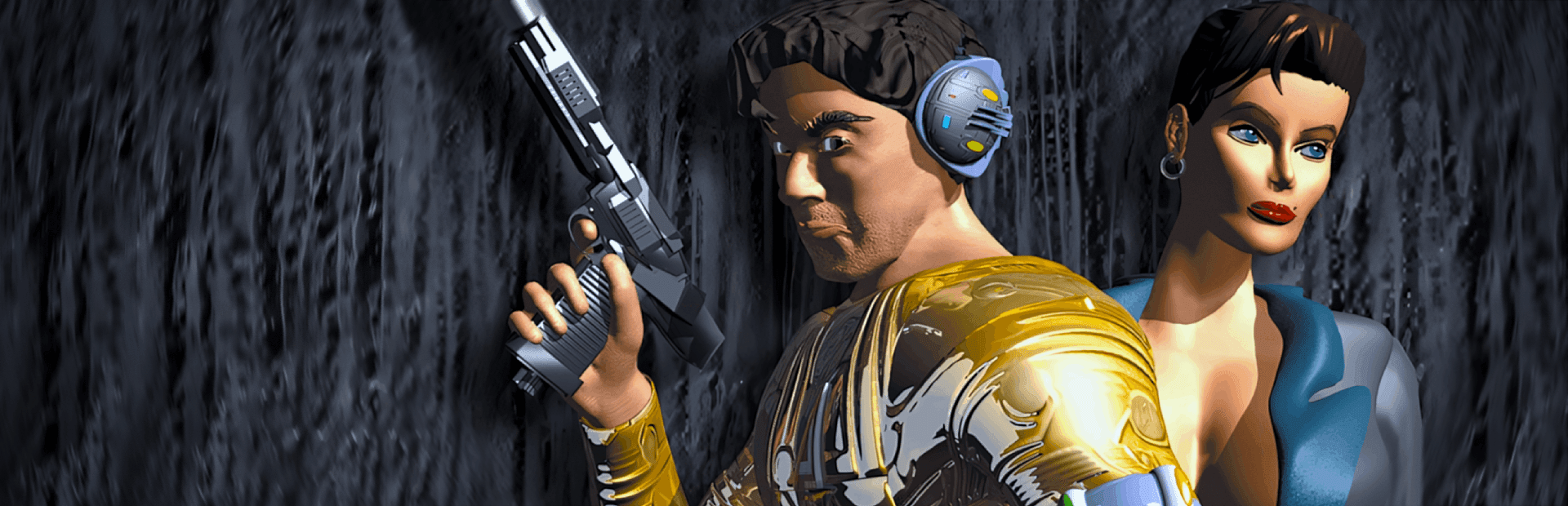
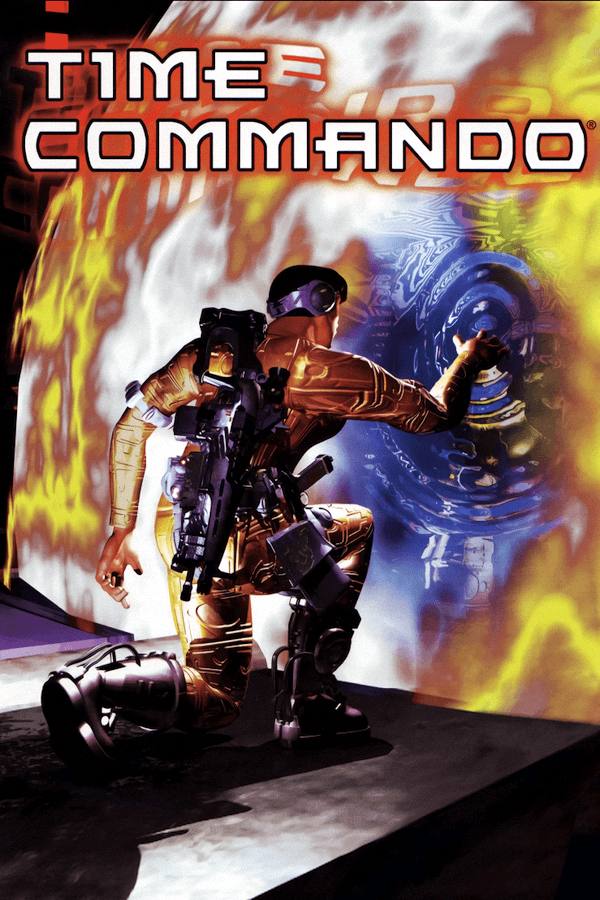

Stanley Opar steps into a time-distortion vortex in Time Commando, picking up rocks, katanas, and laser rifles to halt a digital plague before a military supercomputer melts down.
A race against the Predator Virus across eight eras
Adeline Software International took a bizarre premise and turned it into an arcade gauntlet. A military supercomputer designed to simulate tactical combat accidentally gets infected by the "Predator Virus," creating a rogue spatial vortex that threatens to consume reality. As Special Action for Virus Elimination operative Stanley Opar, your mission is simple: jump directly into the digital anomaly, survive human history from the dawn of man to the far future, and purge the infection at its source.
Unlike standard action titles released for PC hardware in 1996, the enemies are only half your problem; the rest is a constantly ticking infection meter. Every enemy you defeat drops glowing blue memory chips. You carry these chips through moving levels, searching for orb terminals where you can dump your collection to drain the virus meter and reset your countdown timer. If you hoard chips too long without finding a terminal, or if you take too long fighting off a wave of gladiators, the supercomputer crashes and your run ends immediately.
This constant pressure fundamentally changes how you approach combat in this action game. You cannot afford to play defensively or retreat to safe ground. Standing still means watching the blue virus gauge fill the top of your screen, forcing you to charge headfirst into every encounter regardless of your remaining health.
Why fighting in Time Commando feels like steering a lawnmower
The movement in Time Commando relies on rigid, tank-style character orientation familiar to anyone who survived early survival horror titles. Stanley moves relative to his own shoulders: pushing up steps forward, while pressing left or right turns him in place like a small treaded vehicle. Trying to align a swinging club with a leaping saber-toothed tiger while the pre-rendered video background scrolls diagonally requires a jarring adjustment in spatial judgment.
Combat offers a surprisingly deep array of era-appropriate gear, giving Stanley distinct attack options depending on what he has picked up off the ground. You have three attack moves and a block at your disposal, with the reach and speed of your strikes altering drastically across history:
- Prehistoric: Crude rocks, bone knives, and heavy wooden clubs for close-quarters bashing.
- Roman Empire: Gladius swords, trident spears, and heavy tower shields designed for disciplined blocking.
- Feudal Japan: Curved katanas, throwing shurikens, and martial arts staves with long combat reach.
- Medieval: Broadswords, morningstars, and cross-bows built to punch through heavy plate armor.
- Conquistador: Rapier blades and early flintlock pistols that sacrifice fire rate for heavy damage.
- Wild West: Quick-draw revolvers, double-barreled shotguns, and dynamite bundles.
- Modern Wars: Bolt-action rifles, automatic machine guns, hand grenades, and mortar rockets across world wars.
- Future: High-tech energy blasters, plasma rifles, and alien cyber-weapons.
Choosing the wrong weapon for a fast-moving target will leave you swinging at thin air while an enemy slowly whittles down your life bar. The hitboxes are precise, meaning a missed swinging sword leaves Stanley entirely open to counterattacks. Mastering weapon switches on the fly becomes just as critical as timing your blocking commands.
Adeline Software's technical marvel and its visual cost
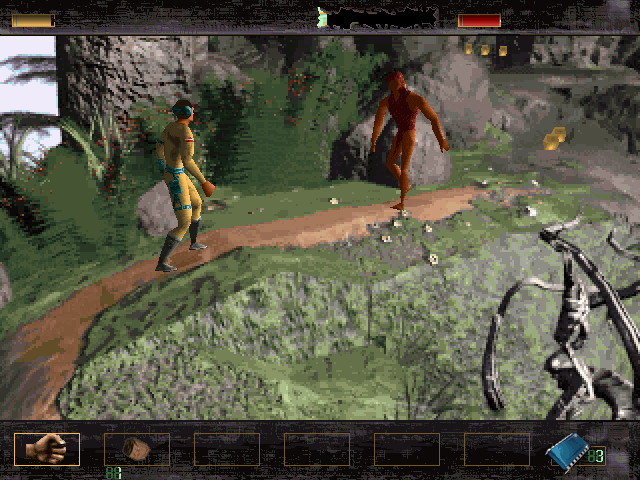
Director Frédérick Raynal built the engine on the foundation of his studio's earlier work on Little Big Adventure, pushing real-time 3D polygonal models onto fully streaming pre-rendered video backgrounds. In 1996, this allowed the developer to display cinematic visual detail that real-time hardware could not dream of rendering on its own. The MS-DOS version ran natively in crisp 640x480 SVGA resolution, producing clean character silhouettes against detailed historical scenes.
To match the visuals, composer Philippe Vachey produced an incredible industrial synth soundtrack that adapts as Stanley moves from ancient caves to futuristic starships. The crunch of iron swords clashing against shields alongside heavy synthesized beats provided an energetic audio backdrop that pushed players forward through every difficult section.
The visual technique, however, introduced significant structural headaches. Because the background video streams along a fixed path, camera angles change dynamically as Stanley advances, often flipping the perspective right in the middle of a tight duel. Aiming a revolver or landing a hit with a katana becomes a exercise in frustration when the view abruptly jumps from a close-up side perspective to a distant overhead angle.
What holds up today and where the design falls flat
When Activision, Inc. brought the game to PC displays, contemporary gaming magazines split down the middle. Computer and Video Games lauded the absurd variety of equipment, pointing out that players wielded more distinct weapons throughout the campaign than almost any competing title on the market. GameSpot awarded it an 8.2/10, highlighting its depth and creative level design. Meanwhile, PC Gamer settled on a 75%, complaining that behind the wild visual settings lay a repetitive beat-'em-up core.
Those complaints hold ground when playing today. While the rapid shift in environments from Roman arenas to World War I trenches keeps the presentation fresh, the core mechanical loop rarely changes. You march forward, lock into a tank-control stance against two or three aggressive foes, pick up dropped blue chips, and scramble for the nearest memory terminal before the clock runs out.
The absolute hardest moments come from sheer enemy placement near environmental drops. Getting hit knocks Stanley backward, which often sends you tumbling off narrow bridges in the Medieval era or into lava pits during the Prehistoric stages, forcing a full section restart. It is a stiff game that demands mechanical memorization over quick reflexes.
Play Time Commando free in your browser right now
Despite the rigid tank movement and strict countdown timers, the game leans hard into creative mid-nineties PC design. The rapid-fire progression through dozens of weapons ensures that even when a level frustrates you, the promise of seeing what absurd arsenal awaits in the next historical period keeps you pressing forward.
If you want to experience this classic 1996 title, you can play Time Commando free in your browser right here without downloading software or adjusting setup options. The browser emulation loads fast and lets you dive straight into Stanley's time-hopping cleanup mission. Try learning the block command early in the Prehistoric level, because trying to tank hits from saber-toothed tigers will drain your life bar before you ever get your hands on a medieval broadsword.