
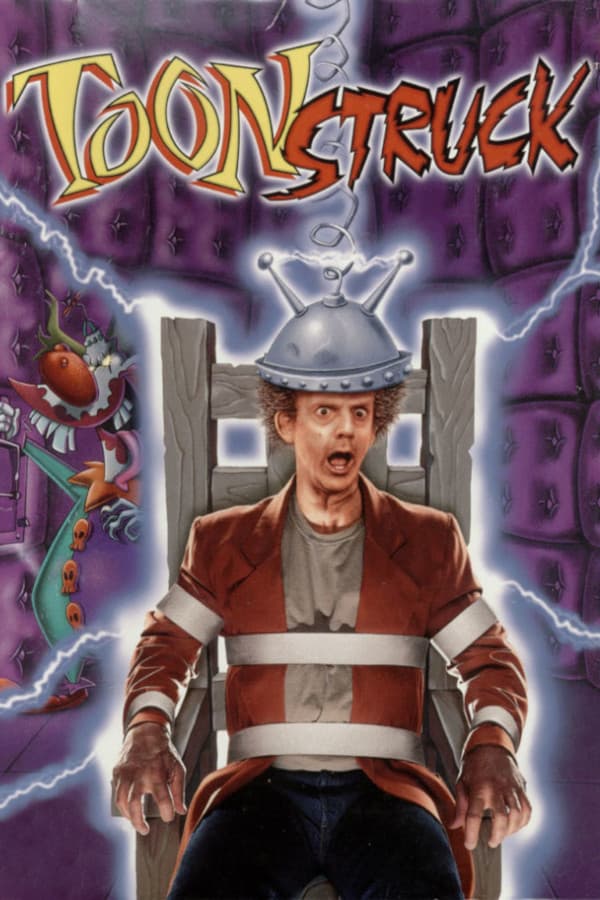

In Toonstruck, you guide actor Christopher Lloyd through a hand-drawn cartoon world by using a sarcastic purple creature directly as an inventory item to solve environmental puzzles.
Before you ever point a cursor at an inventory item, the sheer scale of the production jumps off the screen. Development started in 1993 as a game for kids before pivoting toward an older crowd. That pivot sent production costs soaring past eight million dollars, making it one of the most expensive PC titles of its year. Burst ran through changing game engines and hired animation houses Nelvana and Rainbow Animation to produce hours of cel animation before the underlying interactive design was locked down.
You play as Drew Blanc, a burned-out animator trapped in a decade-long rut creating cute rabbits for his employer. His real passion project is Flux Wildly, a sarcastic purple sidekick who gets sidelined by Drew's boss, Sam Schmaltz. After passing out at his desk, Drew wakes to find his television pulling him straight into Cutopia, a pastel kingdom populated by his own cartoon creations.
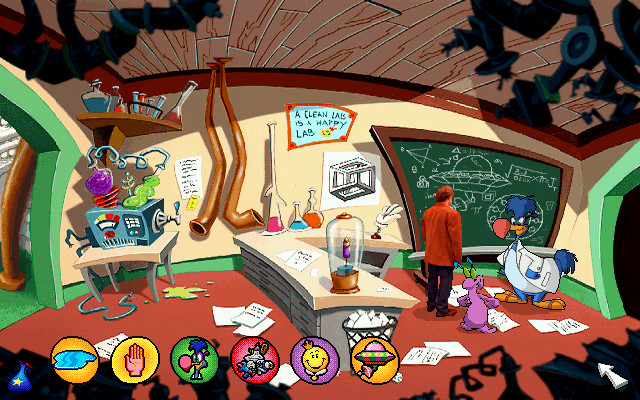
The tech stack was built to support that visual jump. digitized live-action footage of Christopher Lloyd was compressed and composited into two-dimensional hand-drawn backgrounds. To back up those visuals, the sound code supported everything from standard Sound Blaster chips to Gravis Ultrasound, Roland MT-32, and General MIDI hardware.
The core loop follows standard third-person graphic adventure mechanics. You point Drew around 2D scrolling backgrounds, search for items, and talk to locals. The main mechanical twist is Flux Wildly himself, who sits in your inventory as an interactive tool. When a normal item will not fix a mechanical hurdle, picking up Flux and applying him directly to the environment usually triggers a joke or a solution.
Your main task involves stopping Count Nefarious, a villain voiced by Tim Curry. Nefarious builds the Malevolator, a flying weapon designed to mutate Cutopia into a dark, mean landscape. To stop him, Drew must trek through three distinct territories: the sweet lands of Cutopia, the slapstick zone of Zanydu, and the dangerous Malevolands.
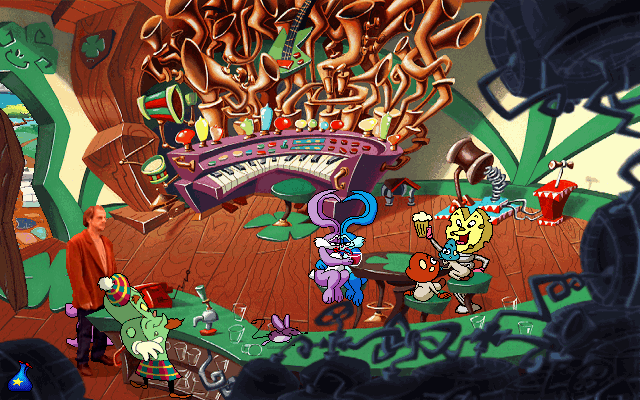
The audio work carries much of the experience. Alongside Lloyd and Curry, the voice cast features Dan Castellaneta as Flux, Dom DeLuise, David Ogden Stiers, Tress MacNeille, and Ben Stein. Hearing seasoned actors deliver lines gives the dialogue a layer of professional comedic timing that few games from 1996 managed to hit.
Not every puzzle in the campaign lands cleanly. Several inventory combinations rely on obscure pun logic and English wordplay that can stonewall players who do not pick up on specific colloquialisms. When you hit one of these walls, progress grinds to a halt as you try every item on every hot spot across three distinct regions.
The biggest issue players hit is the narrative ending. The main story stops on a sudden cliffhanger designed to setup an immediate second chapter. Because sales were a major financial disappointment for publisher Virgin Interactive Entertainment, Inc., that second chapter was cancelled. Content was left on the cutting room floor, including a rotating door and a secret room in the robot maker's shop.
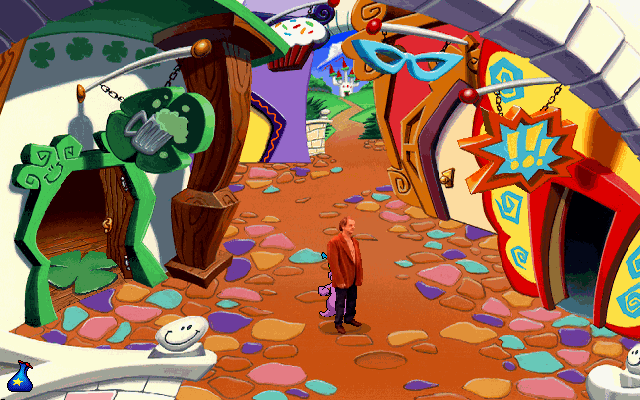
Despite critical praise from magazines at release, developer Burst never got to assemble those cut assets into a proper conclusion. You are left with a cliffhanger that resolves the immediate regional conflict while leaving the broader escape unresolved.
If you enjoy classic graphic adventure games, the high production values make this point-and-click journey worth exploring. The cel animation holds up visually because hand-drawn art avoids the early 3D polygons that aged rapidly from that console generation. The contrast between Lloyd's live-action performance and the animated world remains fun to watch throughout the campaign.
You can see how it stacks up against other releases from 1996. The puzzles cause friction when the wordplay gets obscure, but the absurd character interactions keep things moving. It shows exactly what happened when high-budget FMV met traditional two-dimensional animation software during the mid-nineties PC boom.
You can play Toonstruck online right here without downloading extra files or configuring system settings. It runs free in your browser, giving you instant access to the full classic DOS experience in seconds.
Fire up the game and play through the opening sequence just to see Christopher Lloyd drop into Cutopia for the first time. Watching a live actor interact with animated character rigs on a standard web page takes less than two minutes to load and shows exactly why this project stood out on store shelves.
In Toonstruck, you guide actor Christopher Lloyd through a hand-drawn cartoon world by using a sarcastic purple creature directly as an inventory item to solve environmental puzzles.
Before you ever point a cursor at an inventory item, the sheer scale of the production jumps off the screen. Development started in 1993 as a game for kids before pivoting toward an older crowd. That pivot sent production costs soaring past eight million dollars, making it one of the most expensive PC titles of its year. Burst ran through changing game engines and hired animation houses Nelvana and Rainbow Animation to produce hours of cel animation before the underlying interactive design was locked down.
You play as Drew Blanc, a burned-out animator trapped in a decade-long rut creating cute rabbits for his employer. His real passion project is Flux Wildly, a sarcastic purple sidekick who gets sidelined by Drew's boss, Sam Schmaltz. After passing out at his desk, Drew wakes to find his television pulling him straight into Cutopia, a pastel kingdom populated by his own cartoon creations.
The tech stack was built to support that visual jump. digitized live-action footage of Christopher Lloyd was compressed and composited into two-dimensional hand-drawn backgrounds. To back up those visuals, the sound code supported everything from standard Sound Blaster chips to Gravis Ultrasound, Roland MT-32, and General MIDI hardware.
The core loop follows standard third-person graphic adventure mechanics. You point Drew around 2D scrolling backgrounds, search for items, and talk to locals. The main mechanical twist is Flux Wildly himself, who sits in your inventory as an interactive tool. When a normal item will not fix a mechanical hurdle, picking up Flux and applying him directly to the environment usually triggers a joke or a solution.
Your main task involves stopping Count Nefarious, a villain voiced by Tim Curry. Nefarious builds the Malevolator, a flying weapon designed to mutate Cutopia into a dark, mean landscape. To stop him, Drew must trek through three distinct territories: the sweet lands of Cutopia, the slapstick zone of Zanydu, and the dangerous Malevolands.
The audio work carries much of the experience. Alongside Lloyd and Curry, the voice cast features Dan Castellaneta as Flux, Dom DeLuise, David Ogden Stiers, Tress MacNeille, and Ben Stein. Hearing seasoned actors deliver lines gives the dialogue a layer of professional comedic timing that few games from 1996 managed to hit.
Not every puzzle in the campaign lands cleanly. Several inventory combinations rely on obscure pun logic and English wordplay that can stonewall players who do not pick up on specific colloquialisms. When you hit one of these walls, progress grinds to a halt as you try every item on every hot spot across three distinct regions.
The biggest issue players hit is the narrative ending. The main story stops on a sudden cliffhanger designed to setup an immediate second chapter. Because sales were a major financial disappointment for publisher Virgin Interactive Entertainment, Inc., that second chapter was cancelled. Content was left on the cutting room floor, including a rotating door and a secret room in the robot maker's shop.
Despite critical praise from magazines at release, developer Burst never got to assemble those cut assets into a proper conclusion. You are left with a cliffhanger that resolves the immediate regional conflict while leaving the broader escape unresolved.
If you enjoy classic graphic adventure games, the high production values make this point-and-click journey worth exploring. The cel animation holds up visually because hand-drawn art avoids the early 3D polygons that aged rapidly from that console generation. The contrast between Lloyd's live-action performance and the animated world remains fun to watch throughout the campaign.
You can see how it stacks up against other releases from 1996. The puzzles cause friction when the wordplay gets obscure, but the absurd character interactions keep things moving. It shows exactly what happened when high-budget FMV met traditional two-dimensional animation software during the mid-nineties PC boom.
You can play Toonstruck online right here without downloading extra files or configuring system settings. It runs free in your browser, giving you instant access to the full classic DOS experience in seconds.
Fire up the game and play through the opening sequence just to see Christopher Lloyd drop into Cutopia for the first time. Watching a live actor interact with animated character rigs on a standard web page takes less than two minutes to load and shows exactly why this project stood out on store shelves.
How Toonstruck is played — the keys the game listens to, grouped by what they do.
Highlighted keys are mapped — hover or tap one to see what it does.
Configuration settings can be altered by running SETUP.EXE in the game directory.
The on-screen keyboard and gamepad mapping the browser player uses on a phone, a tablet or a controller, as opposed to the real keys above. $PRO members make their own in the player and share them here; anyone can pick one to play with.
Cheat codes, console commands and memory pokes for Toonstruck — each one verified and attributed.
Sign in to submitHow Toonstruck is played — the keys the game listens to, grouped by what they do.
Highlighted keys are mapped — hover or tap one to see what it does.
Configuration settings can be altered by running SETUP.EXE in the game directory.
The on-screen keyboard and gamepad mapping the browser player uses on a phone, a tablet or a controller, as opposed to the real keys above. $PRO members make their own in the player and share them here; anyone can pick one to play with.
Cheat codes, console commands and memory pokes for Toonstruck — each one verified and attributed.
Sign in to submit