


If you loaded up Ultima Underworld II: Labyrinth of Worlds expecting a quick victory lap after defeating the Guardian in Ultima VII, you were instead locked in a basement sewer under Castle Britannia with a handful of torches and a tiny viewport.
How nine months of crunch turned Ultima Underworld II: Labyrinth of Worlds into a simulation beast
The development cycle for this sequel was an absurd sprint. Starting in April 1992, Looking Glass Technologies built the entire game in just nine months under director Paul Neurath and producer Warren Spector. Lead programmer Doug Church upgraded the original engine to support sloped floors, dynamic height checks, and an expanded 3D view window, while writer Austin Grossman stitched eight distinct parallel dimensions into the main Ultima lore. Sound designers Dan Schmidt and Seamus Blackley tuned the Audio File driver to push rich MIDI compositions through Roland MT-32, LAPC-I, and Sound Blaster cards, giving each dimension its own stark acoustic character.
That extreme pace took a heavy toll on the team, causing severe burnout across the studio. It also meant that when publisher ORIGIN Systems, Inc. shipped the 1993 release on store shelves alongside Ultima VII Part Two: Serpent Isle, sales wound up split between two massive RPG games from the same publisher. Yet for players sitting in front of a 386 or 486 MS-DOS PC, the actual simulation inside Castle Britannia felt unmatched in scale.
Managing weight, magic, and spatial puzzles across eight dimensions
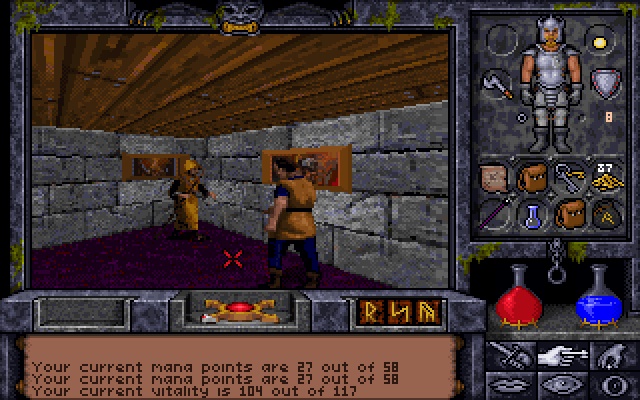
You play as the Avatar, trapped alongside Lord British and his entire court inside a giant shell of blackrock summoned by the Guardian. To break the barrier, you must descend into the sewers below the castle, locate a smaller blackrock gem, and use it as a portal hub to visit eight conquered worlds. The sheer variety of locations keeps you guessing, ranging from the icy caverns of Anodunos and the floating platforms of the Ethereal Void to the bizarre, alien biological structures of Talorus.
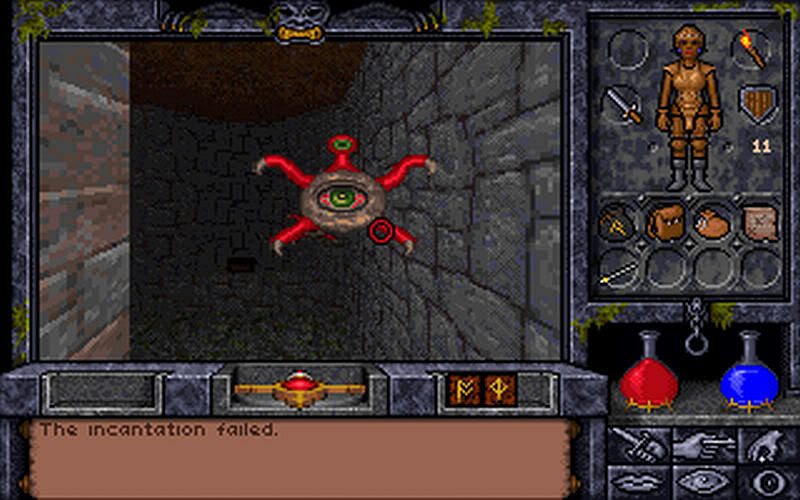
In practice, survival relies heavily on managing your physical constraints and resources. You spend a staggering amount of time opening your inventory pouch to check torch burn rates, weight limits, and food supplies. Movement requires precise mouse-clicks or keyboard controls, which turn precision platforming over lava pits into a nervous exercise. Casting spells can be done via runic stones from your spellbook, though typing shortcuts like Ctrl + Alt + <letter> directly on the keyboard speeds up incantations during real-time combat against gaze hounds, headhunters, and brain creatures.
Where the design grinds and where players get stuck
For all its atmospheric depth, the game hands out brutally sharp difficulty spikes that stop players dead in their tracks. The most infamous bottleneck is the Dam Control puzzle in the Ice World of Anodunos, where a physics-driven sequence of levers, switches, and water flow rules forces almost everyone to hunt down a walkthrough guide. Backtracking across multiple dimensions to talk to NPCs in Killorn Keep, Scintillus Academy, or the Pits of Carnage adds long stretches of wandering when you miss a single subtle dialogue prompt.
The interface can be equally merciless if you lack patience:
- Directional movement requires clicking small interface arrows or holding key combinations while managing vertical mouse look.
- Inventory encumbrance slows your character down dramatically if you carry too many spare swords or heavy armor pieces.
- Weapons degrade through repeated hits, making bartering and repair tools vital during long excursions.
- Obscure puzzle triggers require scanning dark level geometry for tiny hidden switches or fake walls.
Back in 1993, magazines like Computer Gaming World celebrated the depth while warning that low-end hardware would struggle with choppy frame rates in heavy 3D spaces. Today, the physics modeling and open-ended quest logic remain deeply satisfying, even if the jumping mechanics feel stiff.

The lasting verdict on Ultima Underworld II: Labyrinth of Worlds
The reactive level design established systems that Looking Glass later built on to create System Shock and Thief. The friction of its inventory system and the precision required by its mouse-look interface will test modern patience, but the freedom to solve problems through magic, stealth, or pure combat makes every breakthrough feel earned. Few MS-DOS games offer this much depth.
You can play Ultima Underworld II: Labyrinth of Worlds online right now in your browser, completely free with zero setup required. Jump straight into the lower sewers beneath Castle Britannia, type in your rune combinations on the fly, and experience one of the most uncompromising dungeon crawling simulations ever built.