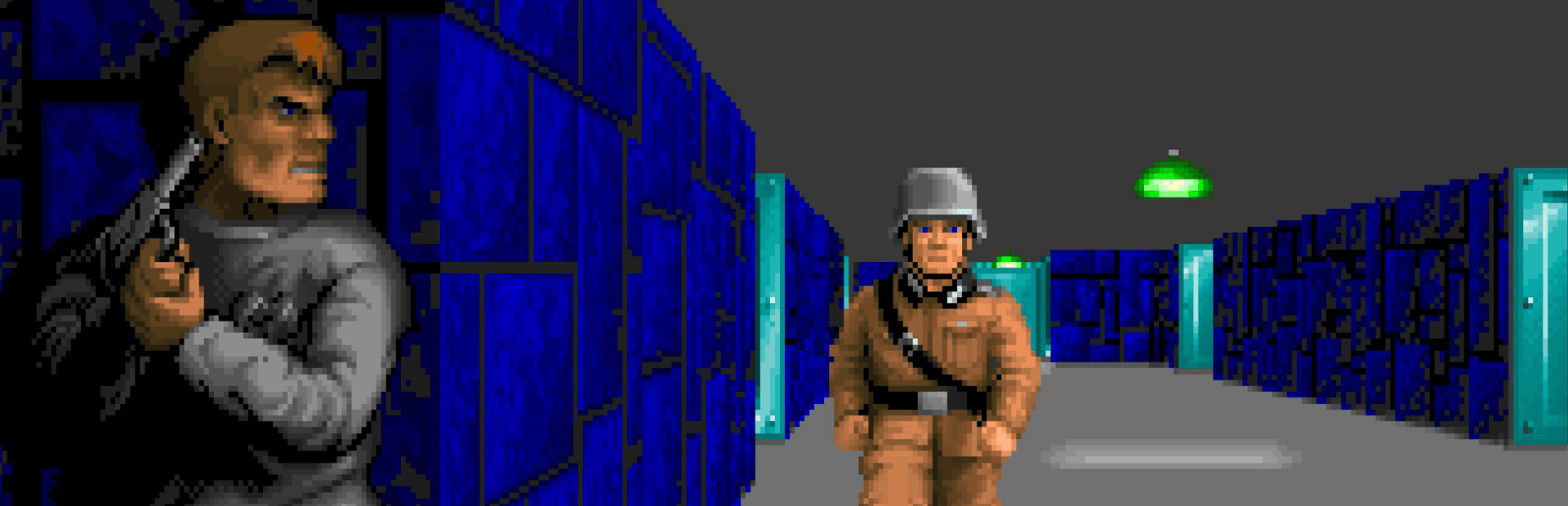

Running through the stone corridors of Wolfenstein 3D with a drawn pistol, you immediately feel how fast John Carmack's raycasting engine moves compared to the sluggish step-by-step dungeon crawlers that preceded it.
When id Software, Inc. built this action game, they prioritized pure velocity over geometrical complexity. By firing a single vertical ray per screen column on a two-dimensional grid, Carmack eliminated the need for full polygon transformations, allowing a 386 PC to render 256-color VGA scenes at smooth frame rates. The strict rule of this engine is that every wall stands at a exact ninety-degree angle, with uniform ceiling heights and zero room-over-room layouts.
That rigid math shapes how B.J. Blazkowicz moves through Castle Wolfenstein. You sprint at breakneck speeds down flat corridors, rounding right-angle corners and snapping your crosshair onto blue SS guards before they react. On an old Sound Blaster card, enemies yell digitized German commands like "Achtung!" or "Mein Leben!" across the room, giving audio cues that matter just as much as what you see on screen.
Compared to other releases from 1992, the weight of the guns relies heavily on rapid hitscan calculation rather than modeled projectiles. Your knife, pistol, machine gun, and chain gun all share a common ammunition supply, meaning spray-and-pray tactics with the chain gun can drain your stock in seconds during heavy firefights.
The trade-off for high speed is a distinct lack of spatial landmarks. Every floor in an episode uses repeating wall textures, and because there is no built-in automap or radar, you will inevitably spend minutes wandering through identical grey stone halls trying to remember which door leads back to the elevator.
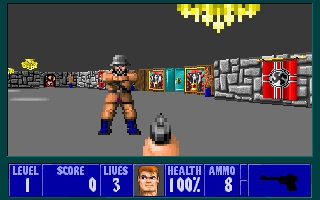
Navigation also means mashing the spacebar against every flat surface in sight. Players uncover secret rooms packed with gold chalices, extra ammo clips, and blood-replenishing dinners by pushing hidden wall panels, known as pushwalls, backward into adjacent grid spaces. If you got stuck on a brutal level layout back then, holding down L, I, and M at the same time granted full weapons and keys at the cost of zeroing your high score.
Control defaults present another hurdle for modern hands. Out of the box, movement rests on the keyboard arrow keys, requiring modified strafe keys rather than the familiar mouse-and-WASD setups we take for granted today. Enemy hitscan attacks trigger instantly the moment a guard clears a doorway, so peeking around corners with standard keyboard controls often results in sudden chunks of lost health.
Publisher Apogee Software, Ltd. released the game using Scott Miller's famous shareware strategy. Episode 1, Escape from Wolfenstein, was given away entirely free on bulletin boards and floppy disks, ending with a showdown against boss Hans Grosse. Players who wanted to continue B.J.'s story mail-ordered the remaining episodes, including Operation: Eisenfaust, Die, Führer, Die!, and the three prequel chapters titled The Nocturnal Missions.
The third episode delivers the most famous fight in the set, forcing you to infiltrate a underground bunker beneath the Reichstag to fight Adolf Hitler inside a four-barreled mechanical suit. Once you shoot away his armor, he breaks out on foot with pair of chain guns in hand, dropping health pools quickly if you stand still.
When Nintendo ported the game to the Super NES years later, corporate policy forced drastic content cuts. Swastikas were scrubbed, blood turned into sweat, Hitler lost his mustache and name, and enemy guard dogs were swapped for giant mutant rats. The raw PC original suffered no such edits, maintaining its harsh tone and explicit World War II backdrop across all fifty-four levels.
As a flat corridor shooter, combat remains fun because enemy sound signals keep you on edge. Dogs bark as they charge forward at high speed, standard soldiers shout upon sight, and SS officers shred your health pool with automatic fire if you hesitate in a open doorway. Taking down a hallway full of guard troopers with a full burst from the chain gun yields quick, direct feedback.
What plainly fails to hold up is the late-game maze design. Later levels in episodes four through six feature sprawling, multi-room mazes made of identical brick textures, turning progression into an exercise in hugging the right-hand wall. Without an in-game map, a single missed keycard forces you to retrace your steps through dozens of cleared, silent rooms.
If you want to spend an evening with a fast shooter, it still gives you tight controls and quick action, provided you can stomach flat mazes and awkward key bindings. It gives you early 90s PC gaming logic in its purest form, where raw engine speed beat out complex geometry every day of the week.
You can play Wolfenstein 3D online directly in your browser without downloading files or installing local software. This browser engine runs the full Wolfenstein 3D MS-DOS game code natively on modern hardware, accurately recreating the fast frame rates and classic digitised sound effects of the original PC release.
To start your run, step out of B.J.'s initial cell, grab the pistol off the fallen guard, and practice strafing through the opening hallway to check alcoves for hidden pushwalls. You can experience the first shareware mission or jump into later episodes right from the starting menu, making it easy to test your survival instincts against Hans Grosse or mech-Hitler within minutes.
Running through the stone corridors of Wolfenstein 3D with a drawn pistol, you immediately feel how fast John Carmack's raycasting engine moves compared to the sluggish step-by-step dungeon crawlers that preceded it.
When id Software, Inc. built this action game, they prioritized pure velocity over geometrical complexity. By firing a single vertical ray per screen column on a two-dimensional grid, Carmack eliminated the need for full polygon transformations, allowing a 386 PC to render 256-color VGA scenes at smooth frame rates. The strict rule of this engine is that every wall stands at a exact ninety-degree angle, with uniform ceiling heights and zero room-over-room layouts.
That rigid math shapes how B.J. Blazkowicz moves through Castle Wolfenstein. You sprint at breakneck speeds down flat corridors, rounding right-angle corners and snapping your crosshair onto blue SS guards before they react. On an old Sound Blaster card, enemies yell digitized German commands like "Achtung!" or "Mein Leben!" across the room, giving audio cues that matter just as much as what you see on screen.
Compared to other releases from 1992, the weight of the guns relies heavily on rapid hitscan calculation rather than modeled projectiles. Your knife, pistol, machine gun, and chain gun all share a common ammunition supply, meaning spray-and-pray tactics with the chain gun can drain your stock in seconds during heavy firefights.
The trade-off for high speed is a distinct lack of spatial landmarks. Every floor in an episode uses repeating wall textures, and because there is no built-in automap or radar, you will inevitably spend minutes wandering through identical grey stone halls trying to remember which door leads back to the elevator.
Navigation also means mashing the spacebar against every flat surface in sight. Players uncover secret rooms packed with gold chalices, extra ammo clips, and blood-replenishing dinners by pushing hidden wall panels, known as pushwalls, backward into adjacent grid spaces. If you got stuck on a brutal level layout back then, holding down L, I, and M at the same time granted full weapons and keys at the cost of zeroing your high score.
Control defaults present another hurdle for modern hands. Out of the box, movement rests on the keyboard arrow keys, requiring modified strafe keys rather than the familiar mouse-and-WASD setups we take for granted today. Enemy hitscan attacks trigger instantly the moment a guard clears a doorway, so peeking around corners with standard keyboard controls often results in sudden chunks of lost health.
Publisher Apogee Software, Ltd. released the game using Scott Miller's famous shareware strategy. Episode 1, Escape from Wolfenstein, was given away entirely free on bulletin boards and floppy disks, ending with a showdown against boss Hans Grosse. Players who wanted to continue B.J.'s story mail-ordered the remaining episodes, including Operation: Eisenfaust, Die, Führer, Die!, and the three prequel chapters titled The Nocturnal Missions.
The third episode delivers the most famous fight in the set, forcing you to infiltrate a underground bunker beneath the Reichstag to fight Adolf Hitler inside a four-barreled mechanical suit. Once you shoot away his armor, he breaks out on foot with pair of chain guns in hand, dropping health pools quickly if you stand still.
When Nintendo ported the game to the Super NES years later, corporate policy forced drastic content cuts. Swastikas were scrubbed, blood turned into sweat, Hitler lost his mustache and name, and enemy guard dogs were swapped for giant mutant rats. The raw PC original suffered no such edits, maintaining its harsh tone and explicit World War II backdrop across all fifty-four levels.
As a flat corridor shooter, combat remains fun because enemy sound signals keep you on edge. Dogs bark as they charge forward at high speed, standard soldiers shout upon sight, and SS officers shred your health pool with automatic fire if you hesitate in a open doorway. Taking down a hallway full of guard troopers with a full burst from the chain gun yields quick, direct feedback.
What plainly fails to hold up is the late-game maze design. Later levels in episodes four through six feature sprawling, multi-room mazes made of identical brick textures, turning progression into an exercise in hugging the right-hand wall. Without an in-game map, a single missed keycard forces you to retrace your steps through dozens of cleared, silent rooms.
If you want to spend an evening with a fast shooter, it still gives you tight controls and quick action, provided you can stomach flat mazes and awkward key bindings. It gives you early 90s PC gaming logic in its purest form, where raw engine speed beat out complex geometry every day of the week.
You can play Wolfenstein 3D online directly in your browser without downloading files or installing local software. This browser engine runs the full Wolfenstein 3D MS-DOS game code natively on modern hardware, accurately recreating the fast frame rates and classic digitised sound effects of the original PC release.
To start your run, step out of B.J.'s initial cell, grab the pistol off the fallen guard, and practice strafing through the opening hallway to check alcoves for hidden pushwalls. You can experience the first shareware mission or jump into later episodes right from the starting menu, making it easy to test your survival instincts against Hans Grosse or mech-Hitler within minutes.
How Wolfenstein 3D is played — the keys the game listens to, grouped by what they do.
Highlighted keys are mapped — hover or tap one to see what it does.
Controls can be remapped through the game setup menu. Joystick usage requires calibration in settings and takes additional processor power.
The on-screen keyboard and gamepad mapping the browser player uses on a phone, a tablet or a controller, as opposed to the real keys above. $PRO members make their own in the player and share them here; anyone can pick one to play with.
Cheat codes, console commands and memory pokes for Wolfenstein 3D — each one verified and attributed.
Sign in to submitHow Wolfenstein 3D is played — the keys the game listens to, grouped by what they do.
Highlighted keys are mapped — hover or tap one to see what it does.
Controls can be remapped through the game setup menu. Joystick usage requires calibration in settings and takes additional processor power.
The on-screen keyboard and gamepad mapping the browser player uses on a phone, a tablet or a controller, as opposed to the real keys above. $PRO members make their own in the player and share them here; anyone can pick one to play with.
Cheat codes, console commands and memory pokes for Wolfenstein 3D — each one verified and attributed.
Sign in to submit