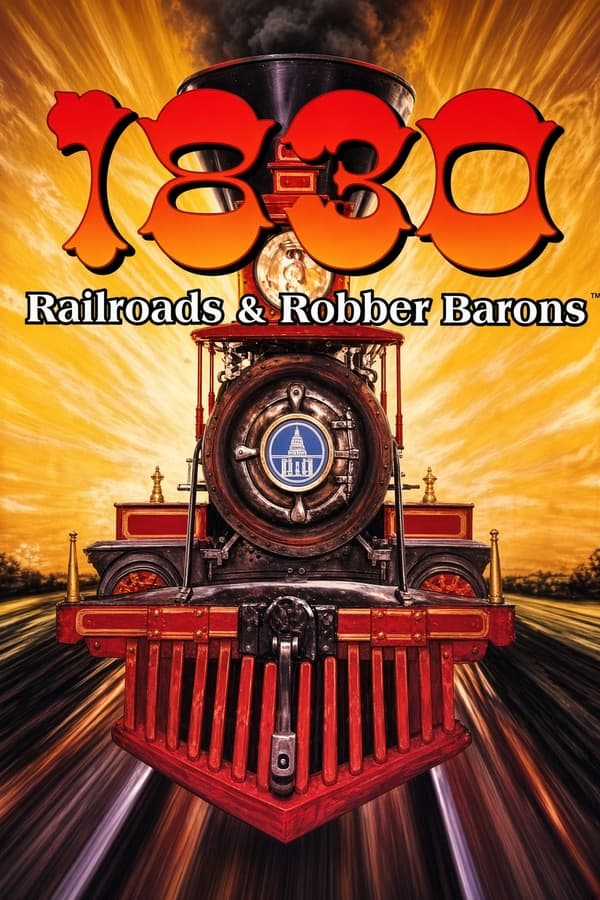
Playing 1830: Railroads and Robber Barons means learning that a rail company is just a tool to strip clean before dumping the stock on someone else.
Stock manipulation matters far more than laying track
Most train games ask you to connect cities and admire your sprawling network. Designer Stephen Barcia took Francis Tresham's classic board game and built something far colder. You play a 19th-century tycoon whose personal bank account is the only score that matters.
You can act as president of up to nine corporate entities on a hexagonal map of North America. Your company buys locomotives, lays track tiles, and places station tokens. Yet the company cash and your personal cash remain completely separate. A railroad can go bankrupt while you walk away rich on unpaid dividends.
This separation creates a brutal economic puzzle. Players sit around the table bidding on private freight lines, floating public stock, and dumping shares to crash market prices. If you start a run expecting a cozy simulator, you will be bankrupt within three stock rounds.
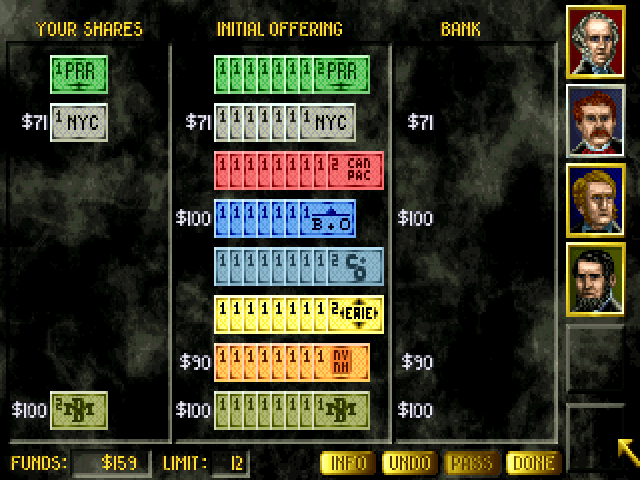
The mechanics of corporate plunder in 1830: Railroads and Robber Barons
Game turns alternate strictly between stock rounds and operating rounds. During stock rounds, players buy and sell equity in major railroads like the Pennsylvania or the Baltimore & Ohio. Whichever player holds the largest share percentage becomes president and controls the corporate wallet.
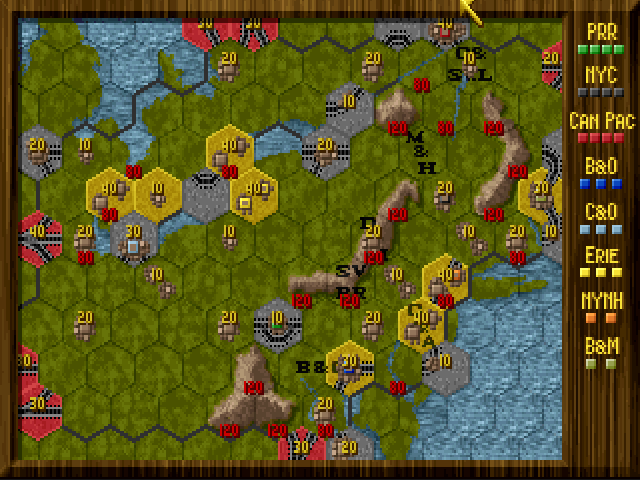
Operating rounds take you to the top-down map. The president lays track tiles across the map to link industrial hubs, routes trains across valid connections, and collects revenue. You then make a choice that defines the entire game loop. You can pay out revenues as dividends to inflate stock value, or withhold the cash inside the treasury to buy faster trains.
The strategic knife edge comes from rust schedules. When the board introduces new train models, older models instantly rust and vanish from service. If a company owns no valid trains, the president must buy one immediately, even if they have to pay out of their personal bank account.
- Bid on private companies during the initial auction to secure starting cash and unique map perks.
- Buy a majority share in a public railroad to claim its presidential director certificate.
- Lay yellow track tiles and place station tokens on the hexagonal map during operating rounds.
- Run routes and decide whether to distribute dividends to shareholders or hold cash in the company vault.
- Buy upgraded trains before older models rust, or dump majority stock to force a rival into corporate debt.
When the computer opponents decide to gang up on you
If you play against human opponents, the negotiation dynamics from the tabletop original shine. The DOS version lets you set up matches against human rivals or up to four computer industrialists. Developer SimTex, Inc. gave the computer players distinct personalities, but their behavior at high difficulty settings exposes a major flaw.
At high skill settings, computer players actively collude to defeat the human player. They will refuse to trade, buy up useless stock to ruin your holdings, and dump train burdens into your lap. Instead of evaluating their own financial growth, the software shifts toward wiping you out. This artificial teaming destroys the open economic backstabbing that makes tabletop matches work.
When the system works fairly, IGN praised how the title lays its mechanics bare without hidden variables or random dice rolls. Every stock price shift and route calculation stays completely transparent to the player. Victory depends entirely on outsmarting your rivals through pure mathematical planning.
Where this MS-DOS digital port hits friction
Publisher The Avalon Hill Game Company shipped this 1995 release with sharp SVGA graphics and standard Sound Blaster support. Classical MIDI music tracks play softly in the background while you study spreadsheet menus and track layouts. Programmer Russ Williams recreated the exact board game rulebook inside the engine.
However, translating a tabletop game to a PC screen removes the physical social interaction that softens long play sessions. Abandonware France pointed out that the digital transition leaves the experience feeling dry and repetitive. Looking at quiet menus for three hours lacks the lively table drama of a physical board game night.
The copy protection adds another layer of annoyance. After completing the initial private company auction, the game pauses to demand a manual word lookup before loading the hex map. If you do not have the physical booklet handy, your match ends before laying a single piece of track.
The engine offers a useful seed feature for custom setups. You can type the command COPY LASTSEED READSEED in DOS to reload generated maps and attempt the same map layout again. When a match finishes, your final score is recorded in a hall of fame using a logarithmic formula that factors your total net worth against total rounds played.
How to play 1830: Railroads and Robber Barons in your browser right now
If you want strict financial strategy, this adaptation puts corporate greed front and center. It discards terrain micro-management to focus entirely on stock manipulation and hostile takeovers. With deep turn-based balance and zero random luck, it is well worth an evening of swallowing up rival lines.
You can play 1830: Railroads and Robber Barons online free in your browser with nothing to install. Float your first railroad, purchase two shares to take the president seat, and start running routes right away. Just make sure to save your personal funds before your current company goes belly up.