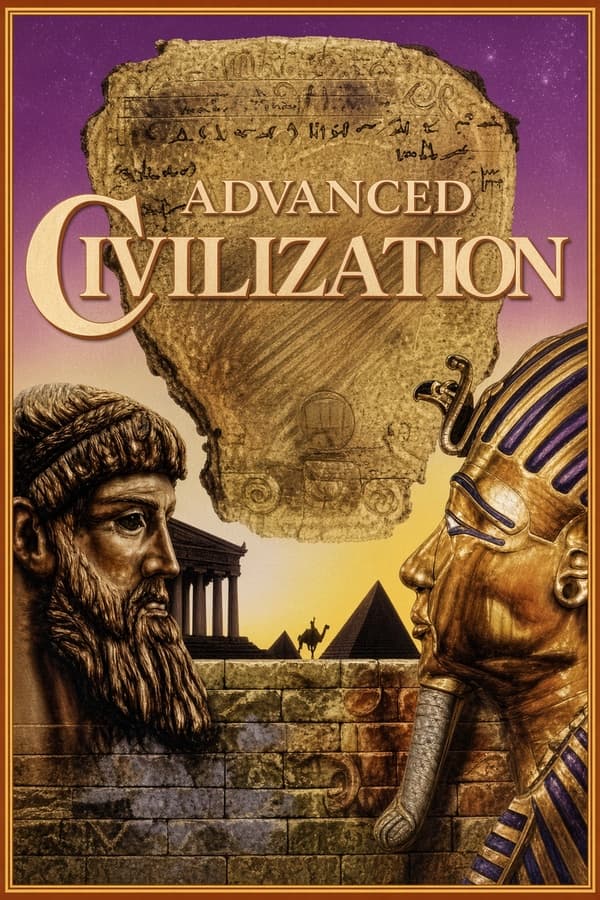
Advanced Civilization
aka Avalon Hill's Advanced Civilization
Rate this game
- Played
- A lot
Advanced Civilization asks you to guide an ancient Mediterranean nation through 8,000 years of history without rolling a single die. Victory relies on shrewd economic trading, strict population control, and pushing your marker up the Archaeological Succession Table.
Advanced Civilization turns ancient conquest into a ruthless stock market
Most strategy games of the nineties rewarded aggressive map painting, but this digital adaptation of Francis Tresham's classic board game plays out very differently. You pick one of nine ancient Mediterranean nations, including Egypt, Babylon, Crete, and Thrace. Your primary focus is not wiping your neighbors off the map. You win by expanding your culture and advancing through economic, political, and religious milestones.
Every turn begins with population expansion across top-down map regions. Placing six tokens in a black square space lets you construct a city. Blank terrain spaces demand twelve population units to build the same stronghold. Cities are the engine of your economy. They generate numbered commodity cards ranging from basic hides and salt to valuable spices and bronze.
The core tension hits during the trade phase. Players swap stacks of commodity cards facedown to accumulate sets. Matching multiple cards of the same tier multiplies their purchase power exponentially. That wealth buys civilization advancements like Mysticism, Astronomy, Literacy, and Democracy, which fuel your progress along the victory timeline.
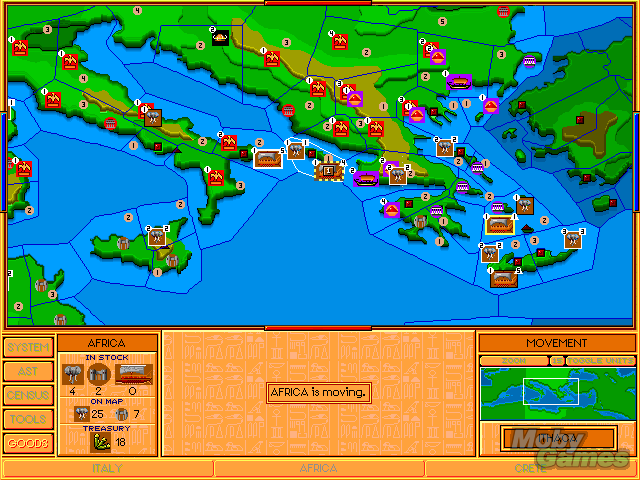
Zero dice rolls mean every lost city is entirely your own fault
Military conflict in Advanced Civilization contains no luck whatsoever. When two factions crowd into the same region beyond its support limit, units die off in a strict one-for-one ratio. Victory goes to the player who brought more bodies to the border. This complete lack of combat randomness turns every border dispute into a deliberate math problem.
The real damage to your empire comes from the trade deck instead of enemy armies. Calamity cards sit hidden among the resource cards, waiting to explode during trading sessions. Some misfortunes strike only the player holding them, while non-tradeable disasters spread outward to hit unsuspecting neighbors.
- Non-tradeable Calamities: Volcanic eruptions, famines, and civil wars detonate immediately when drawn.
- Tradeable Calamities: Plagues, revolts, and earthquakes can be slipped secretly into trade packages to ruin rival empires.
- Advancement Defenses: Technologies like Engineering or Philosophy mitigate specific disaster losses.
A single bad trading turn can drop a plague on your core provinces and cause your city count to collapse instantly. Because city loss reduces your card draws on subsequent turns, recovering from a bad outbreak requires intense long-term management.
How the static DOS presentation lost the war to MicroProse
Developer and publisher Avalon Hill released this digital conversion to defend their trademark rights to the Civilization name. A licensing dispute with MicroProse pushed the project forward, putting the game on store shelves alongside heavy competition. Producer Donald Greenwood and programmer Jim Synoski created a faithful recreation of the board game rules, but the visual execution struggled to captivate mainstream PC gamers.
By 1995, computer strategy fans were expecting animated battles and detailed isometric terrain. Advanced Civilization offered a flat, top-down map that looked like a digital cardboard board. The interface relied heavily on static menus and text boxes. While Eric Heberling provided fit-for-purpose audio score work, the overall presentation felt dated next to rival release Sid Meier's Civilization II.
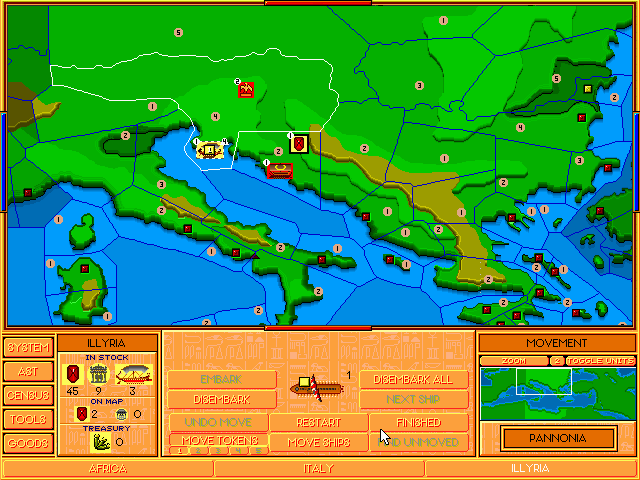
Period reviews reflected this sharp divide in design priorities. Bob Proctor gave it a 3/5 score in Computer Gaming World, noting it was a solid single-player translation for patient fans of long board games, though he disliked the limited multiplayer options. European outlets were far harsher. French magazine Gen4 handed out a brutal 1/6 rating, while PC Games reviewer Barry Brenesal awarded it a D grade. The title ultimately flopped at retail, selling under 20,000 copies in three years.
The computer opponent makes up for missing tabletop friends
While playing the physical board game requires seven or eight human players sitting around a table for ten hours, the MS-DOS strategy game automates all calculations instantly. The artificial intelligence programmed into the computer factions acts aggressively during trade phases. AI opponents aggressively unload calamities onto player hands while hoarding valuable resource pairs.
This boosted computer AI keeps single-player campaigns tight and competitive. You cannot easily cheat the system during trade swaps because the AI calculates set values with high precision. Managing five computer rivals while keeping your population fed and your city support limits balanced creates a constant mental workout.
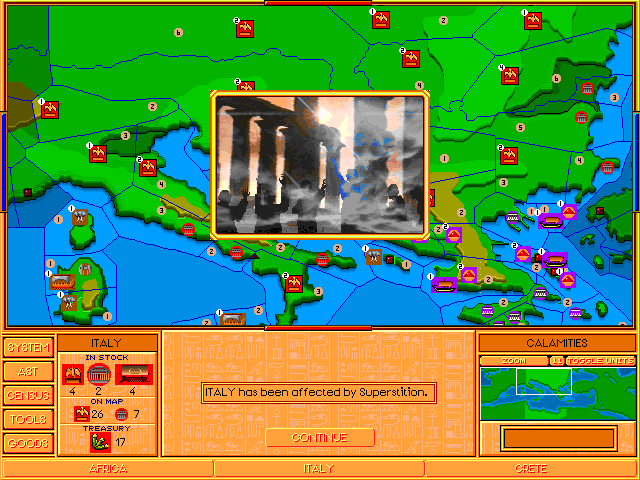
The interface takes some patience to master. Navigating sub-menus to audit your trade deck or verify opponent technology purchases requires deliberate clicking. Yet for players who appreciate pure mechanical depth over flashy graphical flair, the underlying framework remains exceptionally solid.
Play Advanced Civilization free in your browser right now
This digital adaptation remains the purest way to experience Francis Tresham's classic ruleset without clearing a dining table for an entire weekend. If you want to sample a turn-based board game where strategy and negotiation completely overwrite luck, this release is well worth an evening of your time.
Newcomers often make the mistake of over-expanding their armies early. Focus instead on maintaining high city counts to maximize your trade card draws every round. You can play Advanced Civilization online right here in your browser with zero installation needed. Click above, pick your nation, and watch your trade offers carefully before accepting your first deal.
How Advanced Civilization is played — the keys the game listens to, grouped by what they do.
- Action
- Interface
- Left click — Select and interact
Highlighted keys are mapped — hover or tap one to see what it does.
Advanced Civilization is primarily controlled using the mouse interface. Keyboard hotkeys are not detailed in the official game notes.
Players' controls
Touch and gamepad controls
The on-screen keyboard and gamepad mapping the browser player uses on a phone, a tablet or a controller, as opposed to the real keys above. $PRO members make their own in the player and share them here; anyone can pick one to play with.
Make your own touch controlsPRO
- 1Open the editorSign in below, then pick what to make. The game starts with the editor open over it.
- 2Place your keysAdd keys and drag them where your thumbs rest, or map a controller's buttons. Test plays the game with them; Save keeps them, and you play with them from then on.
- 3Share themShare them right after saving in the game, or name and share them here. Players vote, and the best become this game's controls for everyone.
Go PROSee how it worksSign in+20 XP for sharing · +50 XP if yours become the game's own
- The game's own controlsKeyboardGamepadWhat every player starts with.In use
5 screenshots
From the archive
No gameplay video yet
No gameplay video for Advanced Civilization yet. Sign in to add one.
No reviews yet
Tell the community what you think of Advanced Civilization. Reviews are public and tied to your username.
No archived manuals for Advanced Civilization yet
No manuals archived for this title yet. Sign in to upload the first scan.
Cheat codes, console commands and memory pokes for Advanced Civilization — each one verified and attributed.
Sign in to submitNo cheats yet for this title
Know a working cheat, poke or trainer? Add it with the button above. Moderators check every entry before it goes live.
No archived soundtrack for Advanced Civilization yet
No soundtrack archived for this title yet. Sign in to upload the first rip.
No save states for Advanced Civilization yet
No save states for this title yet. Sign in to share one.
Discussions
Sign in to post- Threads0
- Total posts0
- Online now6
Community · Advanced Civilization
Who's contributing, and what's new
- Reviews0
- Threads0
- Uploadsapproved0
- Contributors0
Recent activity