
Controlling a bright yellow smiley face across grid-based rooms, Arcy 2 demands careful spatial planning and pixel-perfect timing before you ever reach an exit door.
Stepping into the single-screen puzzles of Arcy 2
You drop into a room built from solid walls, keyholes, and narrow pathways with zero hand-holding. Your character is a minimalist yellow face, and the immediate goal across every level seems straightforward: clear the stage of keys, open the locked exit, and step through without touching anything hostile. Within thirty seconds, the game disabuses you of any notion that this is a simple arcade stroll.
Every level fits entirely onto a single 320x200 VGA screen without scrolling. That top-down viewport gives you full sight of every hazard from the second you spawn, which makes every mistake entirely your own fault. If you drop a stone in the wrong gap or step into a line of sight three moves too early, you trap yourself with no way out except a quick death.
Published in 1994 by MVP Software and developed by German studio CAPS Softwaredesign ULM, this shareware release built its challenge on spatial logic rather than fast trigger fingers. Pressing F1 at any moment opens an in-game legend detailing map symbols, which is mandatory reading if you want to understand how different tile types interact.
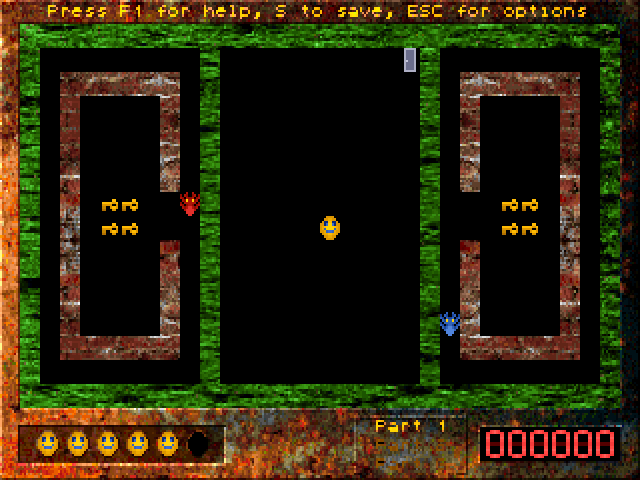
Rocks, water gaps, and line-of-sight monsters
Mechanically, the game functions like a cross between Soko-Ban sliding logic and action-puzzle grid dodging. You navigate obstacles using a specific set of tools and rules:
- Movable boulders can be pushed to clear passages, destroy select barriers, or block enemy movement routes.
- Water tiles instantly swallow your character, but pushing a rock into open water fills the tile to create a safe stepping stone.
- One-way directional arrows force tight pathing choices that restrict where you can backtrack.
- Bonus balls scattered across the grid provide high-score points for thorough clear runs.
The enemies follow strict, deterministic patterns that make every level a solvable machine. Spiders walk forward in straight lines until hitting an obstacle, at which point they execute a precise left or right turn. Gogglers and snakes behave differently: they stare fixedly down an alley, charging forward to instantly kill you the second you cross into their direct line of sight.
Because enemy movement is entirely predictable, success comes down to plotting three steps ahead. You might use a boulder to permanently seal off a spider spawning alley, or strategically drop a rock into a snake's field of view to break its line of sight. Touching any hazard means instant demise, so brushing against a wandering spider resets your entire progress on that screen.
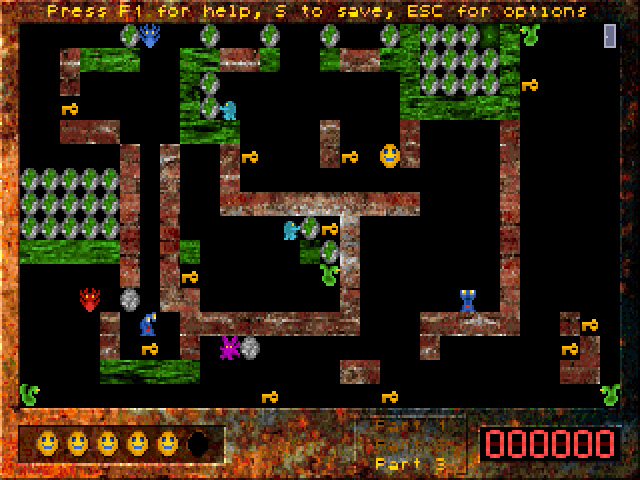
The Scott Joplin loop and 256-color shareware presentation
Visually, the title uses standard 256-color VGA Mode 13h to render crisp, colorful tile sets that make essential elements immediately recognizable. The trade-off for high readability is a total lack of decorative flare. Walls are plain geometric patterns, sprites feature minimal frame animation, and background scenery is entirely nonexistent.
The audio presentation is where most players form a love-it-or-hate-it relationship with the game. Throughout every level, the sound engine plays a single short stanza of Scott Joplin's ragtime standard "The Entertainer" on a endless loop. On an old Sound Blaster card or standard PC speaker setup, that looping melody becomes an inescapable background pulse that drives you forward or drives you crazy depending on your patience.
CAPS Softwaredesign ULM originally released the game under the classic shareware business model, distributing Episode 1 freely while locking Episodes 2 and 3 behind mail-order registration. The developer later went on to create the puzzle platformer Jack Flash in 1995, but this 1994 offering focuses entirely on tight, deliberate room design.
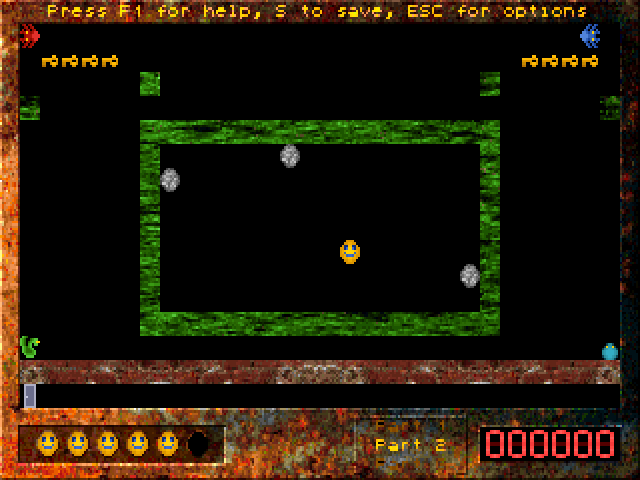
Why the save system in Arcy 2 fails you mid-stage
While the actual puzzle design received high praise from review outlets like DOSGames.com for placing deliberate thinking ahead of reflexes, the difficulty curve ramps up brutally in the later stages of each episode. Early levels give you plenty of open floor space to recover from a bad push, but advanced maps weave tight corridors with multiple overlapping sightlines.
The game's single biggest design flaw is its misleading save feature. You can open the save menu at any point mid-game, which leads you to believe you can create a safety checkpoint before trying a dangerous manoeuvre. However, loading that saved game forces the active level to restart from the beginning, completely wiping whatever intermediate progress you made in that room.
This quirk turns late-game sessions into exercises in endurance. When a single stage requires twenty precise boulder pushes and exact timing to bypass three snakes, having your save load drag you back to square one feels unnecessarily punishing. You cannot brute-force solutions or experiment safely without taking the hit of a full room reset.
Play Arcy 2 online now in your browser
Even with its repetitive sound loop and harsh save mechanics, this Arcy 2 MS-DOS game offers a sharp mental challenge for puzzle fans. The fixed single-screen layout keeps every variable visible, making every cleared board feel like a genuine victory of planning over chaotic chance.
You can play Arcy 2 free in your browser right here, running full speed with complete keyboard controls and no extra setup required. The subtle grid alignment when sliding past line-of-sight enemies is something static screenshots never capture, so jump in and see if you can outsmart those spiders on the first attempt.