Arka
aka Arkanoid (Eclipse Goodies)
Hacker Croll took the first three layouts of Arkanoid, stripped out every single power-up and enemy, and pushed the speed until Arka became a test of pure twitch reflexes.
Arka drops the arcade gimmicks for raw speed
When you start playing Arka, you expect the standard comfort safety nets of the breakout genre. You look for laser attachments to shoot down stubborn tiles, extra lives floating down from destroyed bricks, or sticky paddles that let you catch your breath and aim. None of that exists here. Marc Radermacher, coding under the handle Hacker Croll for the French demogroup Eclipse, built this freeware game as a lean C programming exercise, cutting away everything except a paddle, a bouncing pixel, and a wall of bricks.
That reduction leaves you with an unforgiving paddle-versus-wall game. You start with three spare balls, and losing one happens fast because the ball velocity is tuned absurdly high from the very first bounce. It runs native to MS-DOS, requiring a 386 processor just to keep up with its frame updates, but the lack of audio makes the experience strangely eerie. Without a Sound Blaster card or even a PC speaker beep to telegraph your hits, you have to rely entirely on visual cues to track the bounces.
How the minimalist physics shape every match
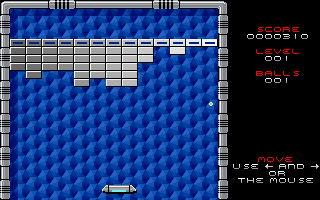
The mechanics strictly mirror traditional action titles in the action games section, but with zero margin for error. Most bricks shatter on a single hit, though marked blocks demand two solid strikes to clear. Because the angles are sharp and the deflection speed never lets up, clearing the bottom layers becomes a desperate struggle to keep the ball from slipping past your perimeter.
Without falling bonuses to reward you, your strategy focuses purely on creating a wedge through the wall. If you manage to bank the ball into the open space above the brick structure, it bounces frantically between the top edge and the bricks, clearing half the screen for you. The moment it drops back down, however, the sheer speed catches you off guard, usually ending a good run instantly.
- Stripped-down gameplay using the classic Arkanoid level layouts
- Single-hit standard bricks alongside reinforced two-hit blocks
- Fast ball mechanics with no item drops or enemy interventions
- Minimalist presentation with total silence on MS-DOS hardware
The strange afterlife of Eclipse and the goodies pack
Released on October 18, 1993 by Eclipse, this release often circulated on shareware disks wrapped inside a broader demo scene "goodies pack". Interestingly, the package included a separate music video demo by the author that struggled to run correctly on standard configurations. The main executable itself remained remarkably stable, operating as a quiet, isolated reflex test for anyone looking to push their response times.
It is a curious thing because of what it intentionally left out. Where commercial hits relied on flash visuals and complex power-up systems, this attempt focused entirely on execution. It grates on modern players who expect dynamic audio or scaling difficulty curves, but as a quick arcade challenge, its brutal momentum forces total concentration while you try to reach the final level layout.
Play Arka free in your browser right now
If you want to try this retro MS-DOS game yourself, you can play Arka online right here without setting up an emulator. The game loads directly into your browser window, letting you dive straight into its silent, high-velocity action. When you start your first round, keep your paddle moving toward the center immediately; the initial bounce happens much faster than you expect, and mastering that quick first deflect is the only way to keep your three lives intact.