


Blake Stone: Planet Strike was doomed from the start by shipping at the end of 1994 into the towering shadow of Doom II, yet it offers a clear look at how far the Wolfenstein 3D engine could be pushed.
You play as British Intelligence agent Blake Stone, sent to the planet Selon to hunt down the runaway mad scientist Dr. Pyrus Goldfire before he sweeps the galaxy with an army of biological horror. Instead of the multi-episode structure from Aliens of Gold, this sequel throws you into a single 20-level campaign with 4 secret levels tucked away behind pushable hidden walls. The flow of each stage is completely different from its predecessor: the elevators are gone, replaced by a strict demolition task.
To exit any map, you have to find a fission detonator, haul it across the sector to a Security Cube, arm it, and get clear before the charge blows. Only when that cube vanishes into scrap will the sector's main teleporter power up and let you escape. It is a neat idea that turns every stage into a tense extraction run, though searching for that single missing explosive in later levels can slow the pace down to a crawl.
Developers JAM Productions built this game using the modified Wolfenstein 3D engine via the classic Tile Editor tool, adding directional lighting and variable light intensity to darken hallway corners. However, memory limitations on standard PC setups were a constant fight during development. To save precious kilobytes when adding audio, the sound team pitched down and reversed existing digitized voice lines from Aliens of Gold to create alien speech rather than recording brand-new audio tracks.
That frugal design extends directly into the enemy roster you fight through the game's hallways. Aside from a handful of genuinely new targets like ceiling-mounted automatic turrets, roving proximity landmines, and semi-invisible cloaked aliens, most of the enemy workforce consists of reskinned guards or old boss sprites demoted to standard enemies. You still get classic music tracks and crisp sound effects composed by Bobby Prince on Sound Blaster cards, giving the heavy gunplay a satisfying punch despite the visual repetition.
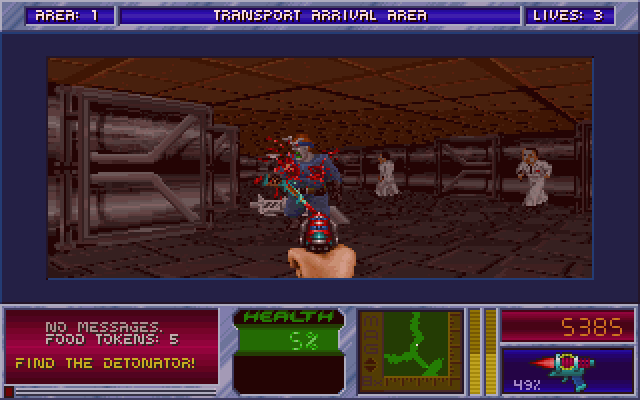
Combat remains rapid and brutal, giving you six weapons to clear out sector corridors. The star addition to your arsenal is the Plasma Discharger, an ultimate weapon that consumes heavy energy charges to clear out rooms of high-tier bio-techs and genetic mutants. To manage the chaos, you rely heavily on the top-corner automap, powered by collectible magnification units:
The catch is that the minimap forced a rotating orientation rather than a fixed overhead view. In narrow, uniform corridors, this spinning radar frequently leaves you disoriented, turning what should be a handy navigation tool into a dizzying distraction mid-firefight.
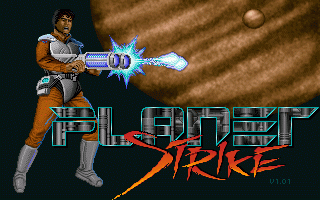
When you play this action game today, the age of the underlying tech shows instantly. While 1994 brought full three-dimensional movement, floor textures, and height variation to first-person shooters, JAM Productions was still bound to flat floors and right-angle walls. By the time you reach the second half of the campaign, levels start feeling like tiny padding stages wrapped in identical grey and green textures. Even the retail packaging pulled a fast one: Apogee placed a prominent female agent on the box art purely to catch eyes on store shelves, even though no such character appears anywhere in the game.
Yet, if you look past the outdated engine, the fast gunplay still works well. Apogee eventually released the source code under the GNU GPL-2.0 license in 2013, giving fans a chance to see how cleverly the team squeezed performance out of early PC hardware. It sits alongside other prominent 1994 releases as a direct look at 2D engine design.
While commercial success proved elusive at launch, this Apogee Software release is still a blast for anyone who loves fast corridor shooters with heavy weapons and hidden walls. Trying to hunt down Dr. Goldfire while managing your minimap charges gives you a real rush from pre-3D level design.
You can JAM Productions' classic Blake Stone: Planet Strike MS-DOS game straight from your browser page right now. You can play Blake Stone: Planet Strike online free in your browser with nothing to install, making it instantly easy to blow up your very first Security Cube within seconds.
Blake Stone: Planet Strike was doomed from the start by shipping at the end of 1994 into the towering shadow of Doom II, yet it offers a clear look at how far the Wolfenstein 3D engine could be pushed.
You play as British Intelligence agent Blake Stone, sent to the planet Selon to hunt down the runaway mad scientist Dr. Pyrus Goldfire before he sweeps the galaxy with an army of biological horror. Instead of the multi-episode structure from Aliens of Gold, this sequel throws you into a single 20-level campaign with 4 secret levels tucked away behind pushable hidden walls. The flow of each stage is completely different from its predecessor: the elevators are gone, replaced by a strict demolition task.
To exit any map, you have to find a fission detonator, haul it across the sector to a Security Cube, arm it, and get clear before the charge blows. Only when that cube vanishes into scrap will the sector's main teleporter power up and let you escape. It is a neat idea that turns every stage into a tense extraction run, though searching for that single missing explosive in later levels can slow the pace down to a crawl.
Developers JAM Productions built this game using the modified Wolfenstein 3D engine via the classic Tile Editor tool, adding directional lighting and variable light intensity to darken hallway corners. However, memory limitations on standard PC setups were a constant fight during development. To save precious kilobytes when adding audio, the sound team pitched down and reversed existing digitized voice lines from Aliens of Gold to create alien speech rather than recording brand-new audio tracks.
That frugal design extends directly into the enemy roster you fight through the game's hallways. Aside from a handful of genuinely new targets like ceiling-mounted automatic turrets, roving proximity landmines, and semi-invisible cloaked aliens, most of the enemy workforce consists of reskinned guards or old boss sprites demoted to standard enemies. You still get classic music tracks and crisp sound effects composed by Bobby Prince on Sound Blaster cards, giving the heavy gunplay a satisfying punch despite the visual repetition.

Combat remains rapid and brutal, giving you six weapons to clear out sector corridors. The star addition to your arsenal is the Plasma Discharger, an ultimate weapon that consumes heavy energy charges to clear out rooms of high-tier bio-techs and genetic mutants. To manage the chaos, you rely heavily on the top-corner automap, powered by collectible magnification units:
The catch is that the minimap forced a rotating orientation rather than a fixed overhead view. In narrow, uniform corridors, this spinning radar frequently leaves you disoriented, turning what should be a handy navigation tool into a dizzying distraction mid-firefight.

When you play this action game today, the age of the underlying tech shows instantly. While 1994 brought full three-dimensional movement, floor textures, and height variation to first-person shooters, JAM Productions was still bound to flat floors and right-angle walls. By the time you reach the second half of the campaign, levels start feeling like tiny padding stages wrapped in identical grey and green textures. Even the retail packaging pulled a fast one: Apogee placed a prominent female agent on the box art purely to catch eyes on store shelves, even though no such character appears anywhere in the game.
Yet, if you look past the outdated engine, the fast gunplay still works well. Apogee eventually released the source code under the GNU GPL-2.0 license in 2013, giving fans a chance to see how cleverly the team squeezed performance out of early PC hardware. It sits alongside other prominent 1994 releases as a direct look at 2D engine design.
While commercial success proved elusive at launch, this Apogee Software release is still a blast for anyone who loves fast corridor shooters with heavy weapons and hidden walls. Trying to hunt down Dr. Goldfire while managing your minimap charges gives you a real rush from pre-3D level design.
You can JAM Productions' classic Blake Stone: Planet Strike MS-DOS game straight from your browser page right now. You can play Blake Stone: Planet Strike online free in your browser with nothing to install, making it instantly easy to blow up your very first Security Cube within seconds.
How Blake Stone: Planet Strike is played — the keys the game listens to, grouped by what they do.
Highlighted keys are mapped — hover or tap one to see what it does.
Controls can be remapped in-game via F6 or through SETUP.EXE. Mouse input is optional for movement and menus.
The on-screen keyboard and gamepad mapping the browser player uses on a phone, a tablet or a controller, as opposed to the real keys above. $PRO members make their own in the player and share them here; anyone can pick one to play with.
Cheat codes, console commands and memory pokes for Blake Stone: Planet Strike — each one verified and attributed.
Sign in to submitaka Blake Stone: Firestorm
How Blake Stone: Planet Strike is played — the keys the game listens to, grouped by what they do.
Highlighted keys are mapped — hover or tap one to see what it does.
Controls can be remapped in-game via F6 or through SETUP.EXE. Mouse input is optional for movement and menus.
The on-screen keyboard and gamepad mapping the browser player uses on a phone, a tablet or a controller, as opposed to the real keys above. $PRO members make their own in the player and share them here; anyone can pick one to play with.
Cheat codes, console commands and memory pokes for Blake Stone: Planet Strike — each one verified and attributed.
Sign in to submit