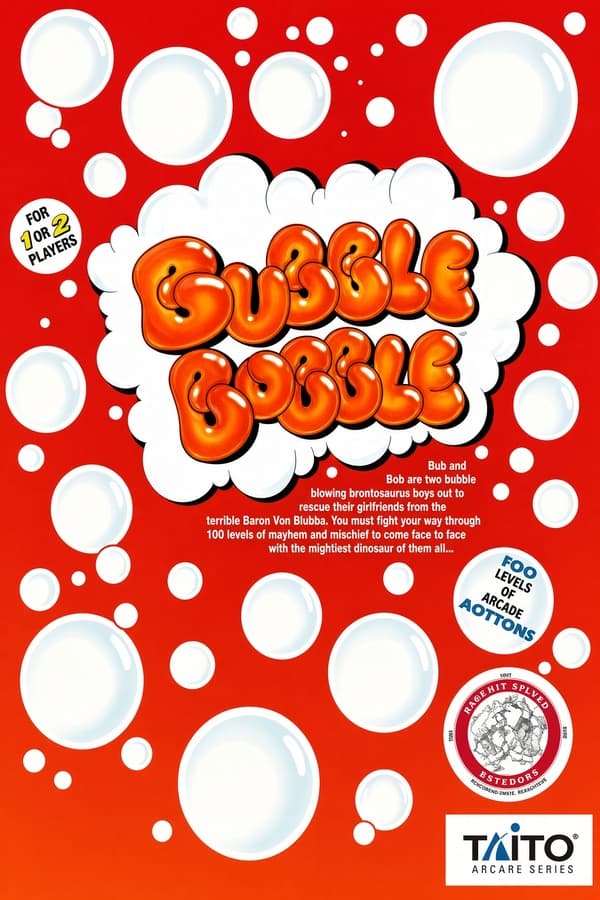
Bubble Bobble
aka Arcade Archives: Bubble Bobble · Bubble Bobble Classic
Rate this game
Trapping a monster in a soapy sphere and kicking it into a wall sounds simple, but Bubble Bobble turns a single screen of platforming into a frantic chase against the clock.
Blowing bubbles and dodging ghosts in early levels
You start as a small green dragon named Bub on the bottom ledge of a single static screen. Enemies wander across platforms above, and your main attack is blowing short-range bubbles that float slowly upward. Encasing an enemy converts them into a helpless sphere, which you must pop by jumping into it or slamming it with your tail before the creature breaks free.
The mechanics encourage momentum rather than caution. Popping an enemy hurls them into a wall, dropping fruit or sweets that boost your high score. You can also bounce on top of your own unpopped bubbles by holding the jump key, allowing you to scale gaps without touching a ladder or solid platform.
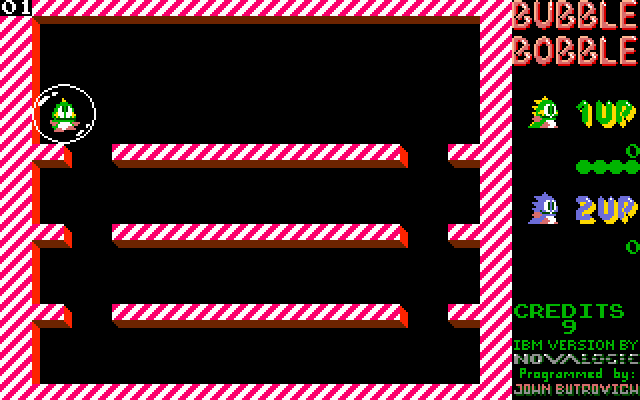
Special power-up bubbles occasionally drift into view from off-screen currents. Striking a water bubble triggers a small torrent that sweeps down platforms, dragging enemies with it. Lightning bubbles fire horizontal bolts that cut through foes across the whole room, giving you a quick way out when cornered.
Delaying for too long brings a severe penalty. When the timer expires, a menacing ghost named Baron Von Blubba appears to hunt you down down regardless of solid walls. This forced speed keeps matches brief and intense across all 100 rooms of the cavern.
The Bubble Bobble MS-DOS game brings co-op home
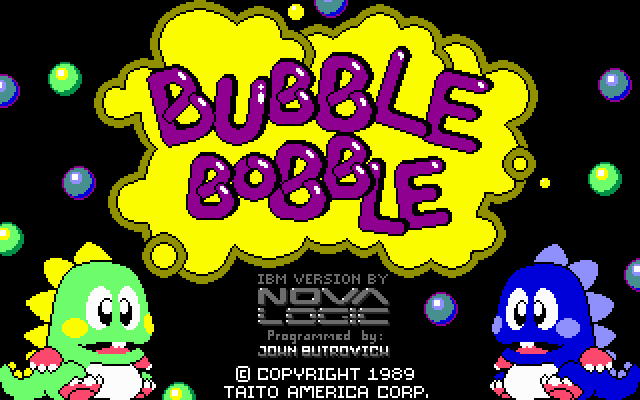
Designed by Fukio Mitsuji for arcade hardware, this home conversion was developed by NovaLogic and brought to PC hardware by Taito Software Inc. in 1988. While the arcade original stood out for bright hardware sprites, this DOS conversion compresses the palette into standard EGA graphics, making the cavern backgrounds feel darker and slightly flatter.
Despite the graphical downgrade, the two-player simultaneous option remains intact. Sitting two players at one keyboard to control Bub and Bob side by side creates chaotic cooperation, where one player sets up traps while the other pops them. To play Bubble Bobble with a friend on a single system required minimal setup, even on modest hardware of the late eighties.
The PC version supports a variety of video standards and audio configurations. Players in 1988 could run the code on CGA, EGA, or PCjr monitors. Sound support ranges from simple PC Speaker beeps to AdLib FM synthesis and Tandy audio chips, though hearing the main theme loop over a bleeping speaker can get grating after twenty levels.
A strange requirement of the original MS-DOS floppy release is disk write permission. Unlike most PC software that reads data passively from a floppy drive, this game modifies files on the original diskette while you play, requiring users to keep the write-protect tab open.
Why late-stage stages in Bubble Bobble test your patience
While early stages feel accessible, the difficulty escalates sharply past the half-way mark. On higher floors, enemies escape from bubbles in a fraction of a second, leaving very little margin for error. If you miss a jump, you will likely lose a life instantly as the angry red monster bursts free.
The jump controls introduce their own friction. While ground movement feels responsive, midair adjustments can feel heavy and sluggish, making precise landing on tiny floating bubbles a struggle. This floaty jump arc creates frustration when trying to dodge fast-moving enemies trapped in tight quarters.
Certain level layouts present severe bottlenecks that stop a good run cold. These hurdles stem from a few specific mechanical issues:
- Debatable hitboxes that trigger hits when a dragon barely touches an enemy edge.
- Awkward wrap-around screen edges that drop you directly into monster spawn points.
- Enemies hovering in narrow corridors where your bubbles cannot travel fast enough to trap them.
When you get stuck on a screen with bad platform placement, the game forces you into risky jumps that drain your remaining lives quickly. Getting a game over drops you right back, unless you have mastered the trajectory of your bubble bounces.
Where to play Bubble Bobble online today
As an early entry in the single-screen action genre, the game holds up primarily because its central mechanic remains satisfying. Trapping multiple enemies and chaining their pops into a screen-clearing waterfall of bananas and candy feels great, provided you are playing with an AdLib sound setup rather than the harsh PC Speaker sound.
While the midair movement can feel stiff compared to later platformers, the fast pace and spatial puzzle solving keep the early levels entertaining. If you enjoy arcade challenges built around score chasing and light puzzle platforming, Taito Corporation delivered a design that rewards practice and quick reflexes.
You can play Bubble Bobble free in your browser right now with no setup needed. Launch the game directly on this page to blow bubbles, dodge Baron Von Blubba, and experience this 1988 arcade translation in your web browser.
How Bubble Bobble is played — the keys the game listens to, grouped by what they do.
- Interface
Highlighted keys are mapped — hover or tap one to see what it does.
Movement and fire keys are user-defined during setup/in-game menu. A joystick can also be calibrated and used.
Players' controls
Touch and gamepad controls
The on-screen keyboard and gamepad mapping the browser player uses on a phone, a tablet or a controller, as opposed to the real keys above. $PRO members make their own in the player and share them here; anyone can pick one to play with.
Make your own touch controlsPRO
- 1Open the editorSign in below, then pick what to make. The game starts with the editor open over it.
- 2Place your keysAdd keys and drag them where your thumbs rest, or map a controller's buttons. Test plays the game with them; Save keeps them, and you play with them from then on.
- 3Share themShare them right after saving in the game, or name and share them here. Players vote, and the best become this game's controls for everyone.
Go PROSee how it worksSign in+20 XP for sharing · +50 XP if yours become the game's own
- The game's own controlsNone yet: played with a real keyboard only.In use
2 screenshots
From the archive
No gameplay video yet
No gameplay video for Bubble Bobble yet. Sign in to add one.
No reviews yet
Tell the community what you think of Bubble Bobble. Reviews are public and tied to your username.
No archived manuals for Bubble Bobble yet
No manuals archived for this title yet. Sign in to upload the first scan.
Cheat codes, console commands and memory pokes for Bubble Bobble — each one verified and attributed.
Sign in to submitNo cheats yet for this title
Know a working cheat, poke or trainer? Add it with the button above. Moderators check every entry before it goes live.
No archived soundtrack for Bubble Bobble yet
No soundtrack archived for this title yet. Sign in to upload the first rip.
No save states for Bubble Bobble yet
No save states for this title yet. Sign in to share one.
Discussions
Sign in to post- Threads0
- Total posts0
- Online now6
Community · Bubble Bobble
Who's contributing, and what's new
- Reviews0
- Threads0
- Uploadsapproved0
- Contributors0
Recent activity
Nothing here yet
Reviews, discussion threads and approved uploads appear here as members add them.