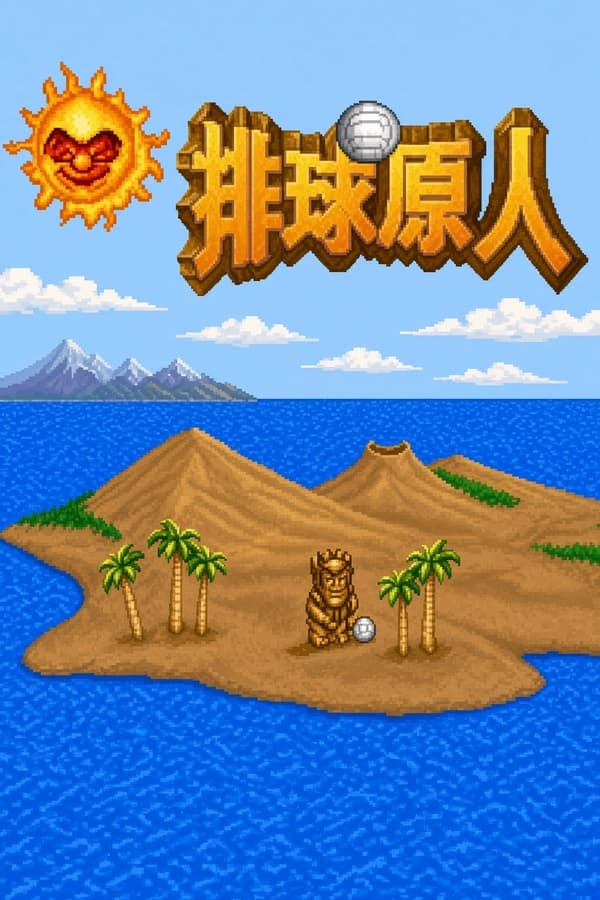
Caveman Volleyball
aka Paiqiu Yuanren · 排球原人
Rate this game
- Played
- Rarely
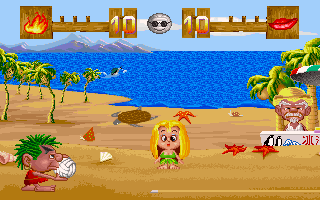
Playing Caveman Volleyball means taking control of side-view prehistoric hominids on a secluded island shore, volleying a ball back and forth with nothing more than raw timing and sharp positioning.
A two-dimensional court where timing beats tactic in Caveman Volleyball
You launch into the action from a flat side view, taking control of a primitive islander standing on a stretch of sand separated by a central net. The default single-player control layout hooks your movements to the WASD keys while assigning your primary action to Tab, forcing a slightly awkward hand position right off the bat. Your entire goal consists of reading the ball arc across the screen, sprinting underneath its shadow, and launching your character into the air to knock it over before it hits your ground.
The ball physics move with a stiff, high-gravity bounce that leaves zero room for lazy positioning. If your character misses the hit frame by a fraction of a second, the ball drops straight to the sand and hands a point to your opponent. Because there are no elaborate special moves or complex meters to manage, the match turns purely into a contest of reading trajectories and hitting your jump button at the precise apex of your leap.
That absolute simplicity makes the flow of a rally fast and surprisingly punitive. Hit the ball too early in your jump and you send a flat, weak shot straight into the net; time it right at the crest of your rise and you drive a sharp spike down into the enemy side of the court. The basic rhythm feels familiar to anyone who spent time with early two-player shareware sports titles, though the strict collision boxes mean you will miss plenty of easy returns while getting used to how close your character model needs to be to the ball.
Panda Entertainment takes a strange trip to the stone age
During the mid-1990s, Taiwanese publisher Panda Entertainment Technology carved out a clear identity by crafting bright, lightweight arcade titles geared toward quick sessions and simple fun. Developer Jack Home applied that exact design philosophy to this release, stripping away any real-world tournament rules or complex sports management to focus entirely on head-to-head arcade action. The result sits squarely among the wave of lightweight PC releases that filled shareware discs and budget catalogs throughout 1996.
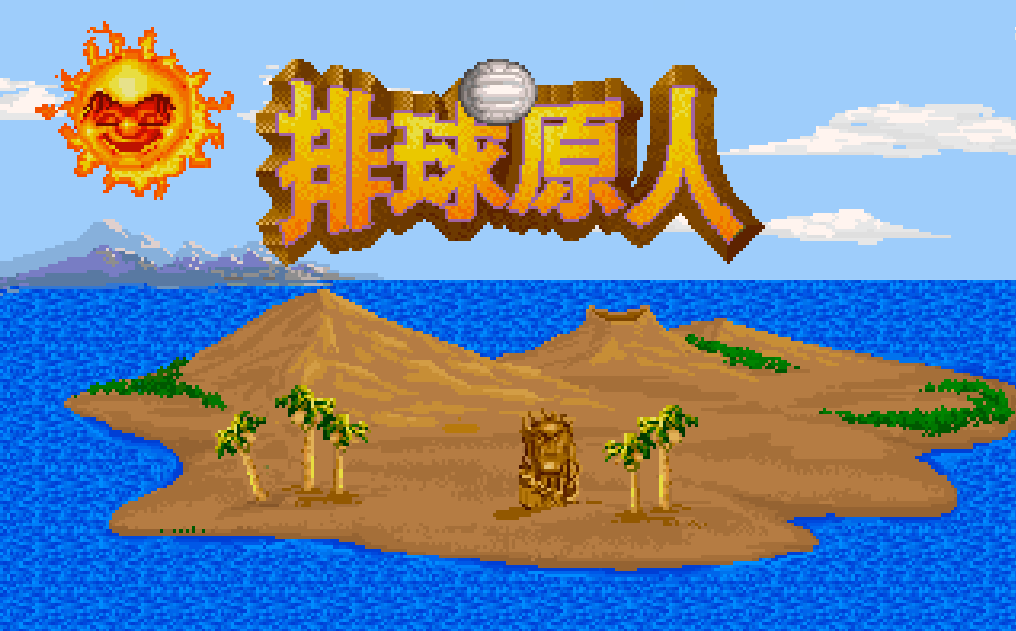
The game strips away standard volleyball team rosters in favor of a focused head-to-head showdown between wild hominid characters living on an island tucked away in the Pacific. According to the original setup, daily hunting and this wild variation of court play represent the only real recreation these islanders have. That cartoon premise drives the entire visual direction, replacing clean indoor sports arenas with wooden posts, basic palm trees, and primitive sprites that react with comical shock whenever a point gets scored against them.
Sound design follows that exact same straightforward budget approach. Run through a standard Sound Blaster card, the audio relies on sharp FM synth blips for ball bounces, punctuated by simple chiptune tracks that loop endlessly during play. It lacks the rich sound effects of bigger studio releases from the period, but the audio feedback gives you just enough cues to track when a hit lands clean or when the ball clatters into the net.
How the two-player match turns into a frantic struggle
While playing solo against the computer opponent offers a decent warm-up, the game leans heavily into its local multiplayer design. Sitting two people at the same keyboard creates an immediate pressure cooker where both players scramble for position on a single screen. Because screen real estate stays locked to a static side view, both sides can easily track the ball flight, making long rallies a matter of who blinks first under pressure.
The single-keyboard setup naturally leads to accidental key jamming and frantic elbows as both players attempt to jump for a contested volley near the net. Without complex strategy elements, victory comes down to reading your friend's movement patterns, baiting them into moving deep to their baseline, and dropping a short hit right over the central post. When you play this sports game with someone sitting next to you, the sheer speed of each point turns basic errors into instant crowd noise.
Single-player mode, by contrast, relies on a basic computer intelligence that rarely makes structural mistakes. The AI tracks the ball path instantly, forcing you to play aggressively and aim for extreme corners of the court if you want to pull ahead on points. That strict AI efficiency can make solo sessions feel repetitive, as the computer opponent tends to execute identical return paths every time you lob the ball high into the air.
Why reviewers hated it while retro players still laugh at Caveman Volleyball
When gaming outlets evaluated the title, opinion split heavily depending on what people expected from a budget PC release. A contemporary score from Old-Games.RU slapped the title with a harsh 4 out of 10, pointing directly to its bare-bones features, shallow depth, and absolute lack of game modes. Measured strictly against deep simulation games of the era, its single court design and limited move set offer very little for a player looking for a long single-player campaign.
Yet user ratings on retro repositories tell a somewhat different story, settling around a comfortable 7.00 out of 10. Fans of odd PC history often highlight the title under its alternative name, Volleyball Hominid, pointing to it as one of the more bizarre small-scale releases to emerge from the Taiwanese PC scene. People who return to it today rarely come looking for deep sports tactics; they come for a fast, silly ten-minute distraction that loads instantly and demands zero setup time.
The flaw that limits the experience is its sheer lack of content variety. You get one core loop, a fixed perspective, and a static background without tournament brackets, character selection stats, or variable court surfaces to alter ball bounce physics. What you see in your very first match is precisely everything the title has to offer, meaning your interest will live or die based on how much you enjoy its baseline arcade mechanic.
Play Caveman Volleyball online directly in your browser
If you want to try this piece of 1996 budget software history, you can play Caveman Volleyball free in your browser right now with zero installation steps required. There is no need to hunt down original floppy discs or wrestle with old system configurations. Launching the game loads the full, unedited MS-DOS release right in your active window, letting you drop into a match within seconds.
New players usually expect modern platformer physics and end up jumping far too late, sending the ball past their sprite for an easy enemy point. The trick to keeping a rally alive is to position your hominid early under the shadow on the sand, hitting your jump key before the ball reaches eye level so your spike hits at maximum height. Fire up the classic Caveman Volleyball MS-DOS game on this page, grab a friend to share the keyboard, and see how long you can keep the island rally going.
Players' controls
Touch and gamepad controls
The on-screen keyboard and gamepad mapping the browser player uses on a phone, a tablet or a controller, as opposed to the real keys above. $PRO members make their own in the player and share them here; anyone can pick one to play with.
Make your own touch controlsPRO
- 1Open the editorSign in below, then pick what to make. The game starts with the editor open over it.
- 2Place your keysAdd keys and drag them where your thumbs rest, or map a controller's buttons. Test plays the game with them; Save keeps them, and you play with them from then on.
- 3Share themShare them right after saving in the game, or name and share them here. Players vote, and the best become this game's controls for everyone.
Go PROSee how it worksSign in+20 XP for sharing · +50 XP if yours become the game's own
- The game's own controlsNone yet: played with a real keyboard only.In use
2 screenshots
From the archive
No gameplay video yet
No gameplay video for Caveman Volleyball yet. Sign in to add one.
No reviews yet
Tell the community what you think of Caveman Volleyball. Reviews are public and tied to your username.
No archived manuals for Caveman Volleyball yet
No manuals archived for this title yet. Sign in to upload the first scan.
Cheat codes, console commands and memory pokes for Caveman Volleyball — each one verified and attributed.
Sign in to submitNo cheats yet for this title
Know a working cheat, poke or trainer? Add it with the button above. Moderators check every entry before it goes live.
No archived soundtrack for Caveman Volleyball yet
No soundtrack archived for this title yet. Sign in to upload the first rip.
No save states for Caveman Volleyball yet
No save states for this title yet. Sign in to share one.
Discussions
Sign in to post- Threads0
- Total posts0
- Online now6
Community · Caveman Volleyball
Who's contributing, and what's new
- Reviews0
- Threads0
- Uploadsapproved0
- Contributors0
Recent activity