
Command & Conquer
Streaming build
Checking storage…
Preload in background
Setting up your first Tiberium refinery in Command & Conquer feels like taking the reins of a modern war room, until a single harvester wanders blindly into a swarm of Nod stealth tanks.
Westwood abandoned the sand of Dune to build a modern battlefield
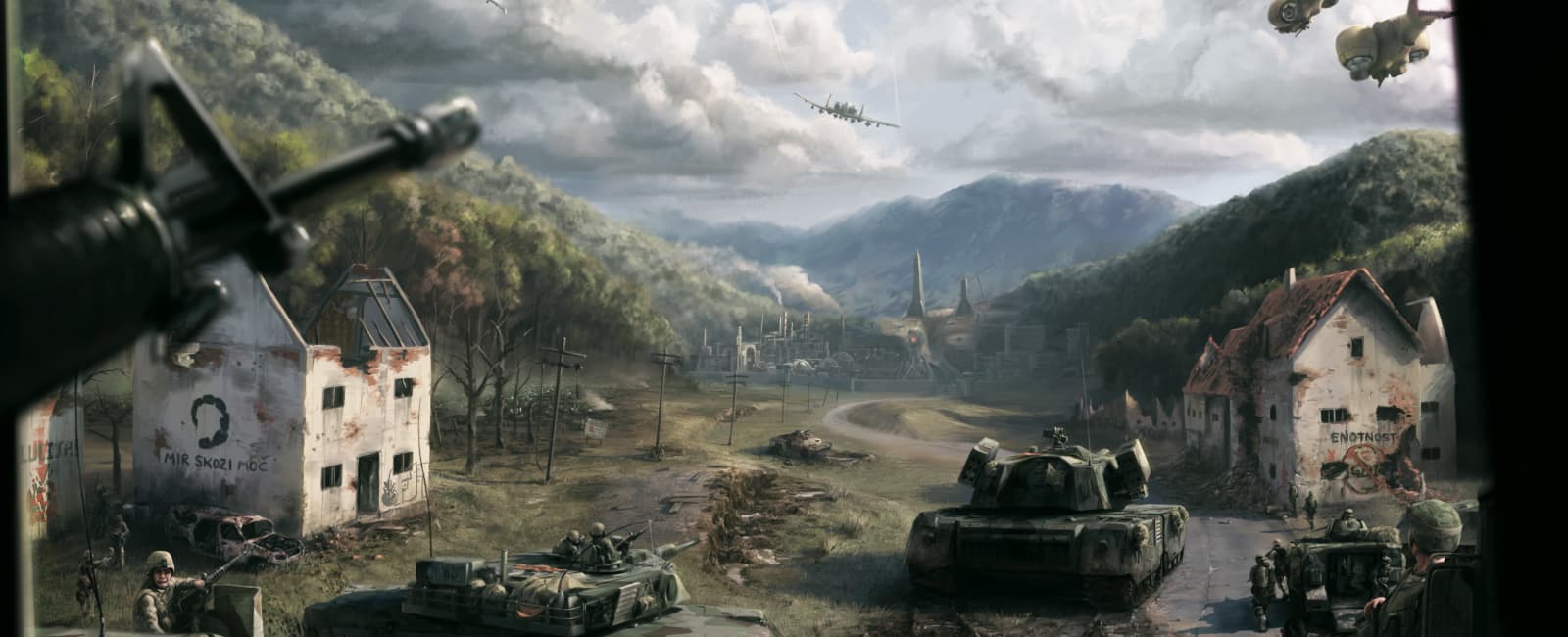
After working on science-fiction desert settings, the team at Westwood Studios, Inc. wanted something closer to contemporary headlines, famously claiming their programmers were simply tired of sand. Inspired by television coverage of modern conflicts like the Gulf War, they shifted from spice fields to a fictional global struggle over a glowing alien resource known as Tiberium. When the game launched in 1995, it replaced slow turn-based plotting with immediate, high-stakes base management.
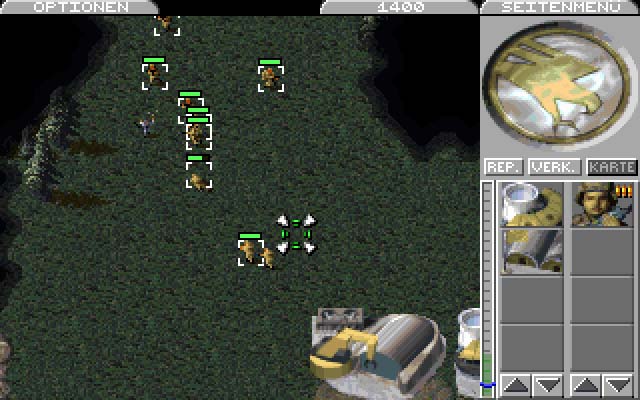
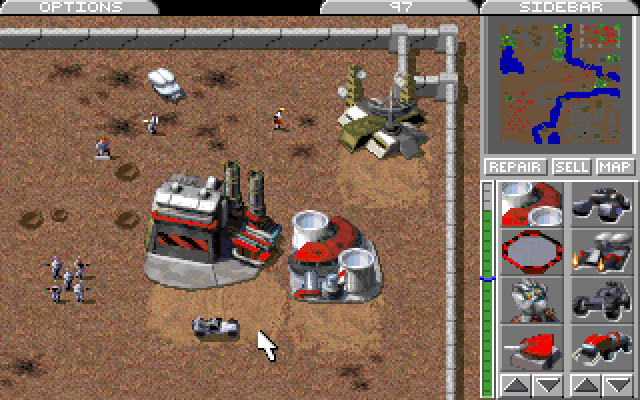
The core loop takes only minutes to master. You deploy a Construction Yard, drop down a power plant, build a refinery, and immediately watch a heavy harvester trundle out toward the nearest Tiberium patch. Watching that green crystal turn into hard credits on your sidebar ticker gives a steady rush of momentum, provided your harvester actually makes it back to base unharmed.
Sound design pulled massive weight in pulling you onto the field. Frank Klepacki composed an aggressive industrial soundtrack that pounded out through Sound Blaster 16 and Gravis UltraSound cards, giving every tank shell and infantry death-cry a sharp, crisp edge. Hearing a full synth bass line punch through while your base alarms go off created a level of tension few strategy games of the era could match.
The Command & Conquer campaigns pitch heavy armor against dirty tricks
The conflict splits into two full campaigns between the United Nations backed Global Defense Initiative and the mysterious cult-like Brotherhood of Nod. Both factions share basic structure, but their actual forces ask for completely different tactical mindsets on the map. Choosing between GDI order and Nod subversion shapes every decision you make in the field.
- Global Defense Initiative: Relies on conventional military muscle, deploying thick Medium Tanks, humvees, Orca gunships, and the orbital Ion Cannon superweapon.
- Brotherhood of Nod: Favors speed and deception, fielding fast reconnaissance buggies, flamethrowers, invisible Stealth Tanks, deadly long-range artillery, and a tactical Nuclear Strike.
- Resource Logistics: Both sides depend entirely on fragile Harvesters collecting Tiberium, making economic harassment the fastest way to cripple an opponent.
Between missions, narrative briefings play out through live-action video sequences recorded on green screens at Westwood offices. Westwood employee Joseph D. Kucan delivered a career-defining performance as Kane, the charismatic leader of Nod. Seeing real actors give mission orders gave the strategy genre a cinematic polish that felt light years ahead of text pop-ups.
Pathfinding blunders and missing skirmish modes test your patience
For all its tactical energy, the original DOS release hits some sharp bumps the moment battles scale up. Unit pathfinding is notoriously erratic, especially when sending groups across narrow bridges or around dense tree lines. Left to their own devices, your expensive Medium Tanks will frequently line up in single file or take a wide detour straight through a heavily defended enemy base.
Harvesters are the worst offenders. A harvester will happily drive through a lethal field of Tiberium trees or cross the entire map into Nod turf just to harvest a slightly fuller patch of crystal. If you fail to micro-manage their route, you will spend half your budget replacing lost machinery.
Single-player replay value also suffers from a curious omission: the original release lacks a random map skirmish mode against AI opponents. Once you finish the campaign missions, your only offline option is replaying scripted scenarios. Westwood did leave one strange gem hidden in the code, though. Typing a specific command-line argument unlocks "Funpark," a secret four-mission campaign where you defend against waves of aggressive dinosaurs.
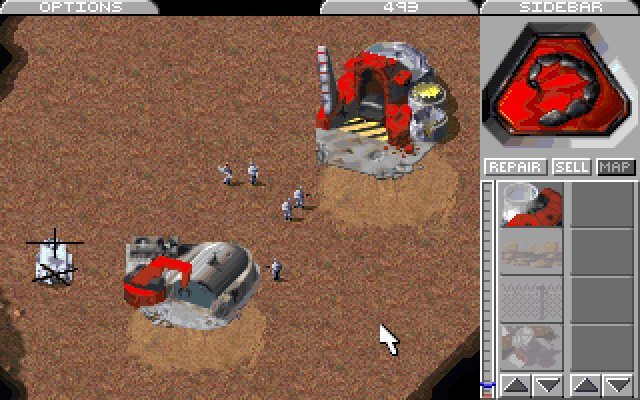
Save files save lives during sudden difficulty spikes
Published by Virgin Interactive Entertainment, Inc., the game balanced slick presentation against a brutal learning curve in its final third. Later missions abandon symmetrical base-building in favor of puzzle-like scenarios where you start with a tiny strike team and zero reinforcements. One wrong step near an unseen flame turret wipes out your command squad, forcing a total restart.
The save system offers no safety net if you forget to use it manually. If an unexpected Nod airstrike destroys your primary Construction Yard thirty minutes into a battle, you cannot rely on an auto-save to rescue the run. Getting into the habit of saving after every successful skirmish is the only way to protect your sanity.
Despite those harsh edges, the raw speed of combat and the immediate weight of mouse-driven unit selection hold up well. Selecting a dozen tanks with a quick box drag and ordering a simultaneous assault feels just as responsive today as it did decades ago.
Play Command & Conquer online straight from your browser
The DOS version of Command & Conquer set a high mark for real-time strategy design, balancing snappy combat against rich, industrial presentation. While tricky unit navigation and unforgiving late-game mission triggers can frustrate modern players, the core thrill of building an army and unleashing superweapons has lost none of its punch.
You can play Command & Conquer free in your browser right now with no setup required. The tactical click of selecting units, the hum of Tiberium refineries, and Frank Klepacki’s driving soundtrack are ready to launch instantly in your tab.
6 screenshots
From the archive
No gameplay video yet
No gameplay video for Command & Conquer yet. Sign in to add one.
No reviews yet
Tell the community what you think of Command & Conquer. Reviews are public and tied to your username.
No archived manuals for Command & Conquer yet
No manuals archived for this title yet. Sign in to upload the first scan.
Cheat codes, console commands and memory pokes for Command & Conquer — each one verified and attributed.
Sign in to submitNo cheats yet for this title
Know a working cheat, poke or trainer? Add it with the button above. Moderators check every entry before it goes live.
No archived soundtrack for Command & Conquer yet
No soundtrack archived for this title yet. Sign in to upload the first rip.
No save states for Command & Conquer yet
No save states for this title yet. Sign in to share one.
Discussions
Sign in to post- Threads0
- Total posts0
- Online now6
Community · Command & Conquer
Who's contributing, and what's new
- Reviews0
- Threads0
- Uploadsapproved0
- Contributors0
Recent activity
Nothing here yet
Reviews, discussion threads and approved uploads appear here as members add them.