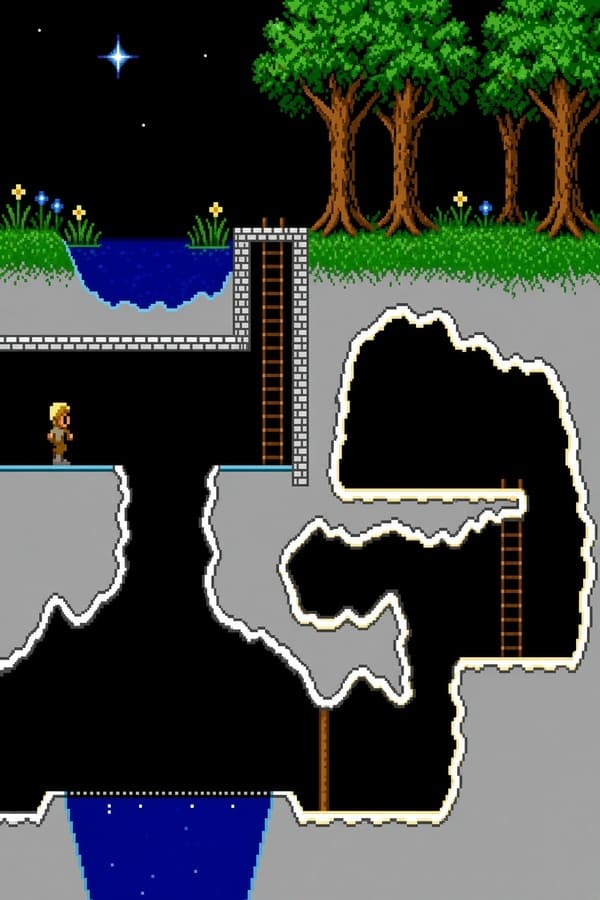
Long before independent developers had digital storefronts, high school coder Erik Isaksson built a side-scrolling tribute to an Apple II hero for Swedish school machines, eventually bringing Conan to MS-DOS as a raw, five-level action platformer.
A Swedish student converted an Apple II classic into a raw side-scrolling gauntlet
Back in 1990, eighteen-year-old developer Erik Isaksson, writing under the handle Exon, set out to recreate the feel of Conan: Hall of Volta on the Compis microcomputer used across Swedish high schools. The project started as a bedroom coding exercise, taking inspiration from the Apple II hit and translating its screen-by-screen survival into custom code. Four years later, Isaksson ported his creation over to MS-DOS, distributing the game for free without a commercial publisher backing the project.
That homebrew origin explains a lot about how the game feels from the moment you hit the keyboard. There are no splashy cinematic introductions or lengthy text scrolls explaining why you are swinging a sword. Instead, the game drops you directly into a side-view screen, hands you control of a muscle-bound hero, and expects you to start running, jumping, and striking down anything that gets in your path. It belongs to a straightforward era of action games from 1994, where clear mechanics mattered much more than elaborate narrative setups.
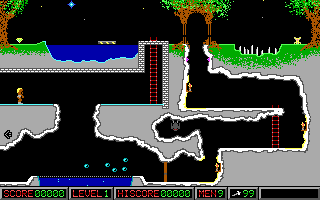
Isaksson would go on to be active in the Swedish retro computing scene, later writing an ABC80 microcomputer emulator under his Lysator university address. But this early effort is a clear snapshot of early 1990s hobbyist programming. By converting his school project into an executable file for standard PC hardware, he gave DOS players a tight, self-contained adventure that took no budget to produce but offered plenty of grit.
Navigating five levels of precise platforming and monster fights in Conan
The entire game spans five distinct levels, each built around a mix of platform jumping, creature combat, and basic navigation puzzles. Your objective across the entire campaign remains uncompromisingly simple: fight your way through every obstacle on screen until you reach the final level and kill the villain waiting at the end. Because the perspective stays strictly in a side view, success comes down to reading spatial distances accurately and mastering the timing of your attacks.
Movement requires patience. Enemies do not simply stand by while you execute flashy combos; they advance along ledges and press into your space, forcing you to calculate sword swings before hazards pin you against a wall. The level layouts incorporate puzzle elements that require you to find safe paths across pits, trigger the right sequence of moves, and avoid drop-offs that send you back to the start. The jump physics demand precision, meaning a rushed leap almost guaranteed a lost life on the microcomputers of the era just as it does on modern displays.
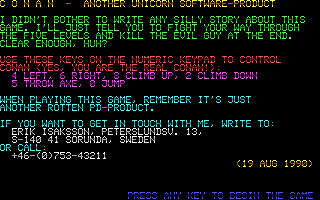
What gives the experience its bite is how unforgiving early platform design could be when built by a single author. Enemy placements often leave little room for error, and missing a ledge target means taking instant damage or falling into a trap. Reviewers on retro archives like Old-Games.RU awarded the title an 8 out of 10 score, appreciating the sheer focus of its design even if the graphic presentation remained simple compared to big-budget retail titles of the same year.
Single-handed code brings bare-bones DOS action to life
Building a fully playable platforming title completely alone was no minor task in the early nineties. Working under his handle Exon, programmer Erik Isaksson handled every line of logic himself, translating early Compis routines into assembly and C code capable of running smoothly on modern IBM-compatible PCs. Because the title hit bulletin board systems as freeware, it spread purely by word of mouth among gamers hunting for free software downloads.
The sound design reflects that garage-built reality. Sound cards on 1994 PCs were often hit or miss depending on whether a small developer could write drivers for them, but this title kept system requirements low so almost any desktop could handle the action without stutters. The graphics rely on crisp, high-contrast sprites that make character positions obvious against the dark cavern and castle backgrounds, ensuring you always know where your feet are landing.
- Five full levels of side-scrolling platform challenges leading to a final boss fight.
- Simple side-view controls that prioritize positioning, weapon reach, and jump timing.
- Puzzle elements mixed into level traversal, requiring careful route planning.
- Freeware release history rooted in the Swedish student microcomputing community.
Comparing this software to commercial releases of the mid-nineties shows a clear stylistic contrast. Where retail studios pushed heavy cinematic cutscenes and bloated installation sizes, this independent release kept the file size minimal and focused strictly on screen-by-screen execution. That lean structure means you spend all your time actually playing rather than watching loading screens or reading instruction manuals.
Conan holds up if you want straightforward 1990s platforming
Looking back at the game today, its main strength remains its lack of pretense. The controls respond quickly, the hitboxes are honest, and the goal remains obvious from the moment you hit the first platform. The main flaw lies in its raw difficulty curve; because there are no casual safety nets or frequent mid-level checkpoints, a bad jump on level four can ruin a solid twenty-minute run, forcing you to learn level layouts by repetition.
If you enjoy classic PC platformers that test your reaction time without burying you in complex inventory menus, this title is worth your time for a retro evening. It is a genuine piece of Nordic hobbyist history, showing how much entertainment a dedicated eighteen-year-old student could squeeze out of limited microcomputer hardware.
You can play Conan free in your browser right here on this page, with no downloads or extra setup required. When you launch the DOS session, pay close attention to your character's jump arc on the very first platform: mastering that horizontal distance early will keep you alive when the level hazards start crowding your screen in the later stages.