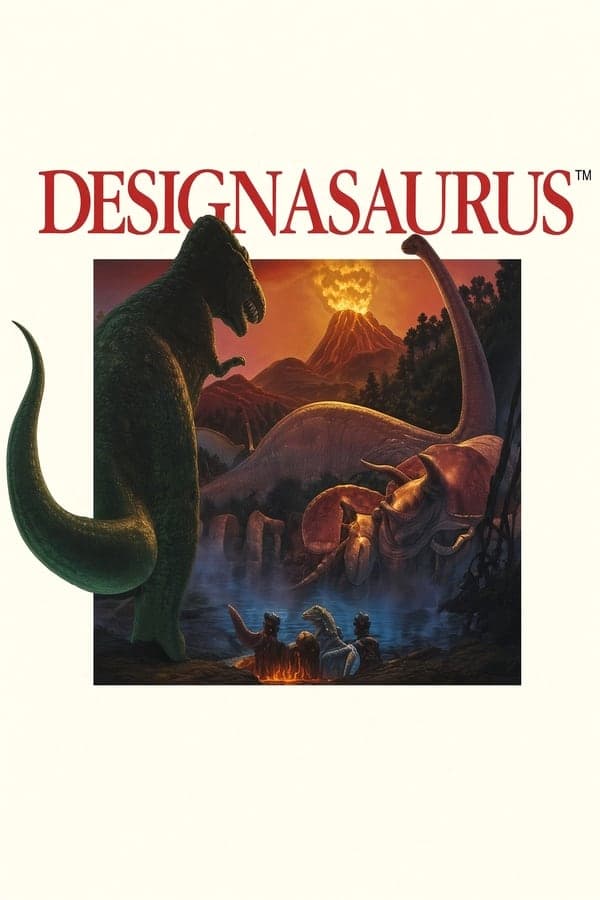
Long before modern simulations took over PC screens, Designasaurus invited players to assemble custom prehistoric beasts from mismatched fossil parts and march them straight into a side-scrolling fight for calories.
Most educational games of the late 1980s asked children to solve math problems or spell words to move a avatar across the screen, but designer Ezra Sidran and programmer Edward Isenberg tried something far more ambitious. Developed by DesignWare, Inc. and published by Britannica Software, this 1988 release required you to manage actual biological trade-offs before setting foot in the wilderness. The cost of that flexibility was immediate: build an absurd creature with mismatched parts, and the game explicitly warned you that your chances of living past the first screen were virtually zero.
The main menu breaks the experience into three straightforward modes: Build-a-Dinosaur, Walk-a-Dinosaur, and Print-a-Dinosaur. In the creation lab, you mix and match fossilized heads, necks, bodies, and tails from species like Tyrannosaurus, Brontosaurus, and Stegosaurus. Sidran, then a recent computer animation graduate from Marycrest College, brought in his classmates to draw the 2D artwork while insisting on scientific accuracy. The software calculates a survival rating for your creation based on its anatomical balance, forcing you to think about how a heavy head or a stubby tail affects a creature's physical limits.
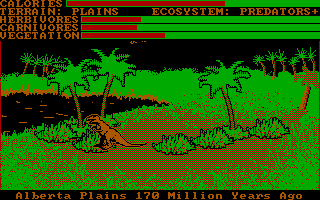
Once you take your beast out into the field, the game transitions to a 2D side-view landscape spanning five distinct ecosystems across three geological eras. Your primary objective is basic biological survival, which means watching your calorie and energy meters constantly. If you choose an herbivore like the Brontosaurus, you spent your time reaching for tall foliage or cropping short shrubs while constantly keeping an eye out for predators. Playing as a carnivore flips the routine, forcing you to stalk and take down other dinosaurs to keep your energy bar filled.
Walking to the far right edge of the screen advances your dinosaur into the next ecosystem, eventually earning you a spot in the Dinosaur Hall of Fame if you stay alive. Early screens feel manageable, but the action becomes chaotic as you push deeper into historical ages. Hostile creatures begin spawning in dense clusters, turning the terrain into a messy obstacle course where navigating hazards requires constant micro-adjustments. It lacks complex control mechanics, but surviving those crowded later screens requires precise movement decisions.
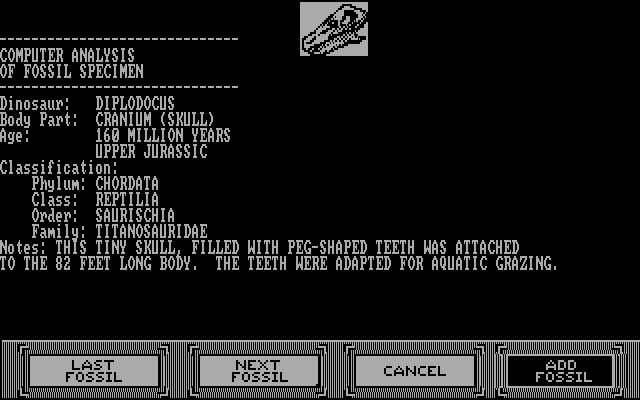
Beyond the survival gameplay, the physical package offered something unusual for home computer owners in 1988. The Print-a-Dinosaur utility allowed kids to generate line art and coloring pages for twelve different dinosaurs. Britannica even bundled heat-transfer paper in the retail box, letting families run the designs through their dot-matrix printers and iron custom graphics directly onto cotton T-shirts. That real-world hook helped fuel massive retail traction, earning over five million dollars for Intergalactic Development alongside Universal Military Simulator over an eighteen-month stretch.
Industry critics quickly took notice of the combination. The program picked up two Software Publishers Association CODiE awards in 1988, taking top honors for educational and primary school software. Period computer magazines praised how subtly it taught animal behavior without feeling like a classroom lecture, though some newspaper reviewers felt the limited arcade mechanics fell short of expectations. Players who remember the game today often mix up this original side-scroller with its 1990 top-down sequel, Designasaurus II, which overhauled the entire perspective.
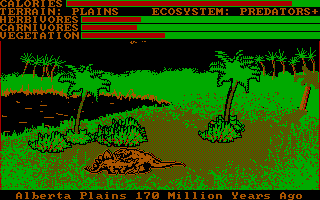
As a pure action title, the limits of this MS-DOS game show up quickly. The side-scrolling movement is basic, collision detection can feel unforgiving, and the lack of deeper combat controls means long sessions feel repetitive once you master the basic grazing and hunting patterns. Yet the underlying loop of assembling a weird hybrid dinosaur and testing its survival odds against prehistoric ecosystems remains genuine fun for anyone curious about late-eighties edutainment design.
You can play Designasaurus online right here in your browser, with nothing to install and no configuration screens to fight through. If you want to see how early PC games balanced actual science with arcade survival, load up the lab mode, assemble your first customized herbivore, and see how many ecosystems you can cross before the local carnivores catch up with you.
Long before modern simulations took over PC screens, Designasaurus invited players to assemble custom prehistoric beasts from mismatched fossil parts and march them straight into a side-scrolling fight for calories.
Most educational games of the late 1980s asked children to solve math problems or spell words to move a avatar across the screen, but designer Ezra Sidran and programmer Edward Isenberg tried something far more ambitious. Developed by DesignWare, Inc. and published by Britannica Software, this 1988 release required you to manage actual biological trade-offs before setting foot in the wilderness. The cost of that flexibility was immediate: build an absurd creature with mismatched parts, and the game explicitly warned you that your chances of living past the first screen were virtually zero.
The main menu breaks the experience into three straightforward modes: Build-a-Dinosaur, Walk-a-Dinosaur, and Print-a-Dinosaur. In the creation lab, you mix and match fossilized heads, necks, bodies, and tails from species like Tyrannosaurus, Brontosaurus, and Stegosaurus. Sidran, then a recent computer animation graduate from Marycrest College, brought in his classmates to draw the 2D artwork while insisting on scientific accuracy. The software calculates a survival rating for your creation based on its anatomical balance, forcing you to think about how a heavy head or a stubby tail affects a creature's physical limits.
Once you take your beast out into the field, the game transitions to a 2D side-view landscape spanning five distinct ecosystems across three geological eras. Your primary objective is basic biological survival, which means watching your calorie and energy meters constantly. If you choose an herbivore like the Brontosaurus, you spent your time reaching for tall foliage or cropping short shrubs while constantly keeping an eye out for predators. Playing as a carnivore flips the routine, forcing you to stalk and take down other dinosaurs to keep your energy bar filled.
Walking to the far right edge of the screen advances your dinosaur into the next ecosystem, eventually earning you a spot in the Dinosaur Hall of Fame if you stay alive. Early screens feel manageable, but the action becomes chaotic as you push deeper into historical ages. Hostile creatures begin spawning in dense clusters, turning the terrain into a messy obstacle course where navigating hazards requires constant micro-adjustments. It lacks complex control mechanics, but surviving those crowded later screens requires precise movement decisions.
Beyond the survival gameplay, the physical package offered something unusual for home computer owners in 1988. The Print-a-Dinosaur utility allowed kids to generate line art and coloring pages for twelve different dinosaurs. Britannica even bundled heat-transfer paper in the retail box, letting families run the designs through their dot-matrix printers and iron custom graphics directly onto cotton T-shirts. That real-world hook helped fuel massive retail traction, earning over five million dollars for Intergalactic Development alongside Universal Military Simulator over an eighteen-month stretch.
Industry critics quickly took notice of the combination. The program picked up two Software Publishers Association CODiE awards in 1988, taking top honors for educational and primary school software. Period computer magazines praised how subtly it taught animal behavior without feeling like a classroom lecture, though some newspaper reviewers felt the limited arcade mechanics fell short of expectations. Players who remember the game today often mix up this original side-scroller with its 1990 top-down sequel, Designasaurus II, which overhauled the entire perspective.
As a pure action title, the limits of this MS-DOS game show up quickly. The side-scrolling movement is basic, collision detection can feel unforgiving, and the lack of deeper combat controls means long sessions feel repetitive once you master the basic grazing and hunting patterns. Yet the underlying loop of assembling a weird hybrid dinosaur and testing its survival odds against prehistoric ecosystems remains genuine fun for anyone curious about late-eighties edutainment design.
You can play Designasaurus online right here in your browser, with nothing to install and no configuration screens to fight through. If you want to see how early PC games balanced actual science with arcade survival, load up the lab mode, assemble your first customized herbivore, and see how many ecosystems you can cross before the local carnivores catch up with you.
How Designasaurus is played — the keys the game listens to, grouped by what they do.
Highlighted keys are mapped — hover or tap one to see what it does.
The on-screen keyboard and gamepad mapping the browser player uses on a phone, a tablet or a controller, as opposed to the real keys above. $PRO members make their own in the player and share them here; anyone can pick one to play with.
Cheat codes, console commands and memory pokes for Designasaurus — each one verified and attributed.
Sign in to submitHow Designasaurus is played — the keys the game listens to, grouped by what they do.
Highlighted keys are mapped — hover or tap one to see what it does.
The on-screen keyboard and gamepad mapping the browser player uses on a phone, a tablet or a controller, as opposed to the real keys above. $PRO members make their own in the player and share them here; anyone can pick one to play with.
Cheat codes, console commands and memory pokes for Designasaurus — each one verified and attributed.
Sign in to submit