
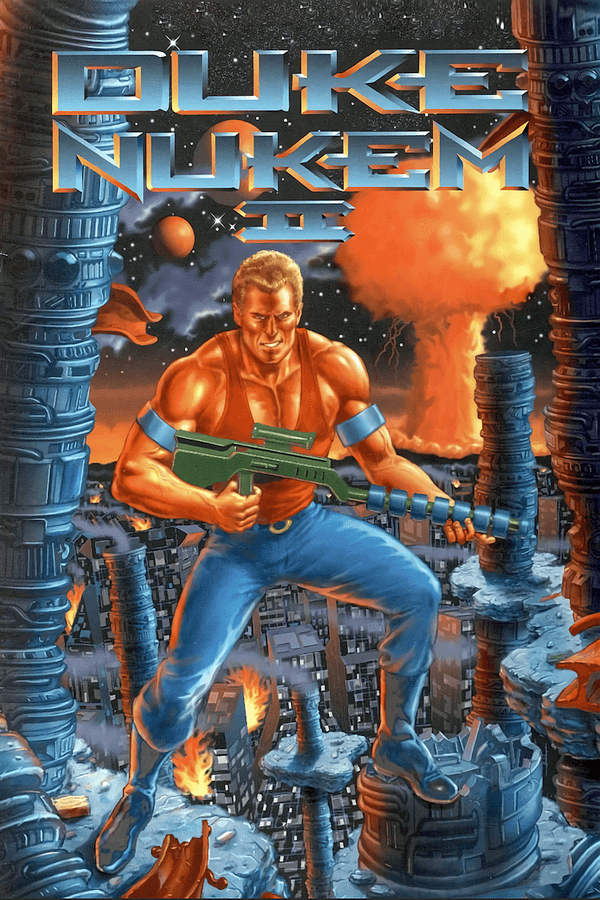

Duke Nukem II built on its 1991 predecessor by introducing multi-directional VGA scrolling, Sound Blaster audio, and heavy firepower. You break out of an alien prison cell with an explosive tooth implant and blast through four episodes of arcade shooting.
By late 1993, PC gamers wanted high-color graphics and fast side-scrolling. Lead designer Todd Replogle worked alongside Allen H. Blum III, Scott Miller, and George Broussard to build a custom VGA 2D engine. Artists Stephen A. Hornback and Randy Abraham drew detailed digitized sprites that stood apart from the blocky look of early shareware titles.
The engine used a clever trick with three distinct 16-color palettes to squeeze extra visual depth out of standard VGA hardware. Running the game on older EGA setups resulted in incorrect colors, making VGA displays essential. Sound designer Bobby Prince supplied a driving musical score alongside digitized sound effects tailored for Sound Blaster cards.
Apogee Software published this action game during a major hardware transition in 1993. While id Software was about to shift the PC market toward full 3D spaces, this 2D engine pushed action platforming on MS-DOS about as far as it could go.
The campaign spans four distinct episodes with eight levels each, offering 32 stages of platforming. Duke starts with a standard laser rifle, but the level design quickly forces you to hunt for heavier weapons. Limited ammunition keeps you searching stages for blue laser cannons, rocket launchers, and the signature flamethrower.
The flamethrower does more than burn through enemy forces and punch straight through thin walls. Aiming it downward while airborne creates a thrust of recoil that launches Duke higher into the air. That vertical boost lets you reach high ledges, secret power-ups, and alternative routes across a level.
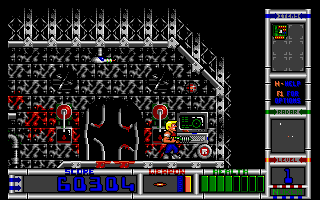
Level progression requires tracking down color-coded keycards and keys to bypass electrical force fields and locked security doors. In each episode, one specific stage tasks you with hunting down and destroying alien radar dishes before you can exit. You also spend plenty of time shooting supply boxes. Some yield health items like soda cans or atom power-ups, while others conceal active bombs that detonate in your face.
Navigating stages means using overhead pipes, vertical ladders, teleporters, and upward air currents. Certain levels let you hijack a small attack shuttle armed with high-powered cannons. The shuttle lets you tear through swarms of alien forces, though you must eventually disembark when narrow corridors block your vehicle.
Former id Software designer Tom Hall wrote the narrative and text for the project. The setup finds Duke abducted by the Rigelatin alien race during a TV interview for his autobiography, Why I'm So Great. The aliens plan to siphon his brain power to construct a conqueror computer, prompting his immediate prison escape.
Duke's dialogue here carries a sharp sarcastic tone that differs from his later macho catchphrase era. Standing next to environmental hazards prompts lines about leaning against oozing bulbous walls to wait for death. It gives the hero a slightly cynical edge that fits the frantic pace of the levels.
The development files hide a few quirks of their own. Deep inside the game data sits an unused graphics file named END4-2.MNI, an extra frame for the final Episode 4 ending cinematic that was skipped in the release build. For players struggling with the difficulty, typing E-A-T restores health while wiping your score to zero, while N-U-K grants a random heavy weapon and every key card required for the active stage.
Despite strong reviews at launch, the title lost some spotlight when Doom arrived in December 1993. Players migrating toward true 3D shooters overlooked how solid this classic 2D shooter actually was.
The levels stay direct and compact, weapon recoil kicks back hard, and Bobby Prince's soundtrack drives the action without stopping. Later stages get tough on precise jumps, but the fast running speed and secret rooms keep every map moving.
You can play Duke Nukem II online free in your browser right now with no setup required. Load into Episode 1, grab a flamethrower, and use the downward thrust recoil to uncover secret rooms on your very first run.
Duke Nukem II built on its 1991 predecessor by introducing multi-directional VGA scrolling, Sound Blaster audio, and heavy firepower. You break out of an alien prison cell with an explosive tooth implant and blast through four episodes of arcade shooting.
By late 1993, PC gamers wanted high-color graphics and fast side-scrolling. Lead designer Todd Replogle worked alongside Allen H. Blum III, Scott Miller, and George Broussard to build a custom VGA 2D engine. Artists Stephen A. Hornback and Randy Abraham drew detailed digitized sprites that stood apart from the blocky look of early shareware titles.
The engine used a clever trick with three distinct 16-color palettes to squeeze extra visual depth out of standard VGA hardware. Running the game on older EGA setups resulted in incorrect colors, making VGA displays essential. Sound designer Bobby Prince supplied a driving musical score alongside digitized sound effects tailored for Sound Blaster cards.
Apogee Software published this action game during a major hardware transition in 1993. While id Software was about to shift the PC market toward full 3D spaces, this 2D engine pushed action platforming on MS-DOS about as far as it could go.
The campaign spans four distinct episodes with eight levels each, offering 32 stages of platforming. Duke starts with a standard laser rifle, but the level design quickly forces you to hunt for heavier weapons. Limited ammunition keeps you searching stages for blue laser cannons, rocket launchers, and the signature flamethrower.
The flamethrower does more than burn through enemy forces and punch straight through thin walls. Aiming it downward while airborne creates a thrust of recoil that launches Duke higher into the air. That vertical boost lets you reach high ledges, secret power-ups, and alternative routes across a level.
Level progression requires tracking down color-coded keycards and keys to bypass electrical force fields and locked security doors. In each episode, one specific stage tasks you with hunting down and destroying alien radar dishes before you can exit. You also spend plenty of time shooting supply boxes. Some yield health items like soda cans or atom power-ups, while others conceal active bombs that detonate in your face.
Navigating stages means using overhead pipes, vertical ladders, teleporters, and upward air currents. Certain levels let you hijack a small attack shuttle armed with high-powered cannons. The shuttle lets you tear through swarms of alien forces, though you must eventually disembark when narrow corridors block your vehicle.
Former id Software designer Tom Hall wrote the narrative and text for the project. The setup finds Duke abducted by the Rigelatin alien race during a TV interview for his autobiography, Why I'm So Great. The aliens plan to siphon his brain power to construct a conqueror computer, prompting his immediate prison escape.
Duke's dialogue here carries a sharp sarcastic tone that differs from his later macho catchphrase era. Standing next to environmental hazards prompts lines about leaning against oozing bulbous walls to wait for death. It gives the hero a slightly cynical edge that fits the frantic pace of the levels.
The development files hide a few quirks of their own. Deep inside the game data sits an unused graphics file named END4-2.MNI, an extra frame for the final Episode 4 ending cinematic that was skipped in the release build. For players struggling with the difficulty, typing E-A-T restores health while wiping your score to zero, while N-U-K grants a random heavy weapon and every key card required for the active stage.
Despite strong reviews at launch, the title lost some spotlight when Doom arrived in December 1993. Players migrating toward true 3D shooters overlooked how solid this classic 2D shooter actually was.
The levels stay direct and compact, weapon recoil kicks back hard, and Bobby Prince's soundtrack drives the action without stopping. Later stages get tough on precise jumps, but the fast running speed and secret rooms keep every map moving.
You can play Duke Nukem II online free in your browser right now with no setup required. Load into Episode 1, grab a flamethrower, and use the downward thrust recoil to uncover secret rooms on your very first run.
How Duke Nukem II is played — the keys the game listens to, grouped by what they do.
Highlighted keys are mapped — hover or tap one to see what it does.
Key map is incomplete as movement, jumping, and firing controls were not provided in the research notes.
Cheat codes, console commands and memory pokes for Duke Nukem II — each one verified and attributed.
Sign in to submitHow Duke Nukem II is played — the keys the game listens to, grouped by what they do.
Highlighted keys are mapped — hover or tap one to see what it does.
Key map is incomplete as movement, jumping, and firing controls were not provided in the research notes.
Cheat codes, console commands and memory pokes for Duke Nukem II — each one verified and attributed.
Sign in to submit